A China tamping rammer factory is often evaluated by buyers on three points: product fit, OEM flexibility, and export reliability. For road repair, utility work, and confined-area compaction, the right supplier should support consistent output, practical service access, and clear technical documentation.
Outline
- What OEM buyers expect from a tamping rammer factory
- Why Chinese manufacturing can improve procurement efficiency
- How to compare rammer types, power options, and jobsite use
- Supplier selection criteria for distributors and contractors
- Where to source related compaction and finishing equipment
Why OEM Tamping Rammer Sourcing Matters for Global Buyers
OEM sourcing matters because compaction equipment is usually purchased for repeat use, not one-off trials. Buyers need stable build quality, predictable lead times, and the ability to align the machine with local market preferences, including engine choice, handle design, and branding.
For many international buyers, the strongest advantage of a rammer manufacturer China is procurement efficiency. A factory model can reduce coordination steps, simplify customization requests, and support channel sales where distributors need standardized products with local labels and packaging.
What a China Tamping Rammer Factory Can Offer
A China tamping rammer factory can usually support both standard models and OEM variants. That matters because trench work, utility backfill, and patch repairs often require different shoe sizes, impact characteristics, and power configurations.
CONSMAC positions itself as a road and concrete construction equipment supplier, with product lines that include tamping rammer models, plate compactors, floor grinding machines, and concrete cutters. Its site also highlights OEM/ODM customization and a factory-trade model focused on export buyers. ([consmac.com](https://www.consmac.com/products/))
Comparison Table: OEM Factory Sourcing vs. Trading-Only Procurement
| Factor | OEM Factory | Trading-Only Supplier |
|---|---|---|
| Customization | Engine, color, branding, and packaging options | Usually limited to available stock |
| Lead time | Often better for planned repeat orders | Depends on third-party inventory |
| Technical control | Direct access to production and specs | Less visibility into manufacturing details |
| Channel value | Useful for distributors building a private label line | Better for spot purchases |
The practical result is that OEM buyers can build a more consistent product line. That is especially useful for distributors who want a repeatable catalog rather than a mixed assortment of machines from different sources.
How Tamping Rammers Fit Real Construction Work
Tamping rammers are best suited to confined compaction, not broad-area coverage. They are commonly used in narrow trenches, around utilities, and in small repair zones where a plate compactor cannot reach effectively. CONSMAC describes its rammer as suitable for narrow trench and pipeline backfill work, with gasoline and diesel options. ([consmac.com](https://www.consmac.com/))
Industry guidance also supports this use case. The U.S. Federal Highway Administration maintains geotechnical guidance for highway and earthwork applications, while ASTM D698 remains a widely used laboratory compaction reference for soil behavior and density control. ([highways.dot.gov](https://highways.dot.gov/federal-lands/pddm/geotechnical-technical-guidance-manual))
Key Specifications for Confined-Area Compaction
| Specification | Why It Matters | Typical Buyer Concern |
|---|---|---|
| Impact force | Determines compaction effectiveness in cohesive soils | Can it reach target density? |
| Shoe size | Affects maneuverability in trenches and corners | Will it fit the working space? |
| Engine type | Influences fuel use, maintenance, and power delivery | Gasoline or diesel? |
| Weight balance | Supports operator control and stability | Is it easy to handle on site? |
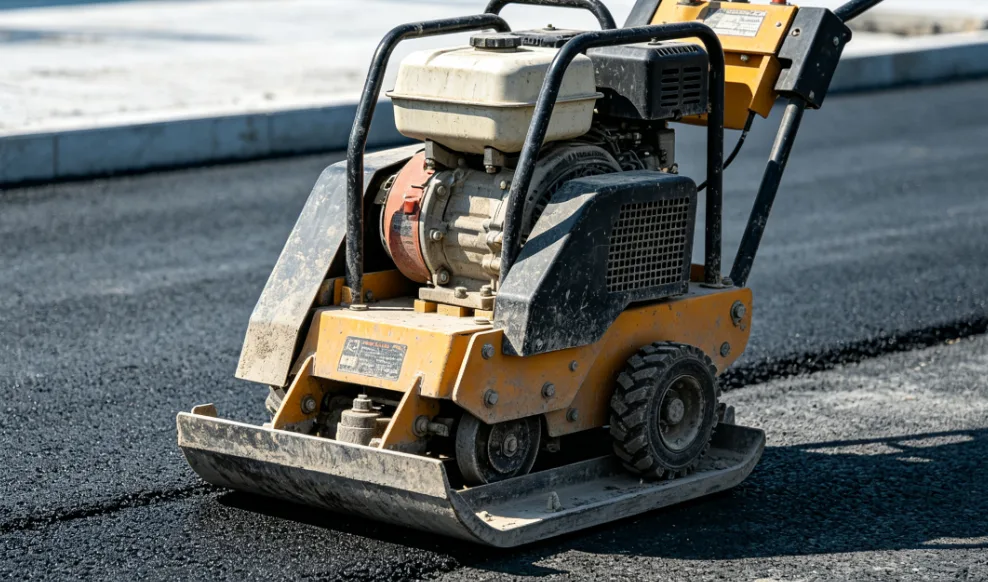
In practice, buyers should match the machine to the soil and the work area. Cohesive soils and narrow excavations usually favor a rammer, while wider granular areas may be better served by a plate unit.
OEM Advantages That Matter in Export Markets
OEM advantages are strongest when buyers need market-specific packaging and repeatable inventory. A factory can usually support private labeling, color changes, manual revisions, and region-specific engine configurations, which helps distributors reduce product mismatch.
Another advantage is service alignment. CONSMAC emphasizes after-sales support and solution-based supply, which is important for overseas buyers who need spare parts planning, technical communication, and predictable replacement cycles. ([consmac.com](https://www.consmac.com/))
- Private label branding for distributor channels
- Engine and specification options for different markets
- Stable production for repeat purchase programs
- Packaging and documentation adapted for export
- Service support that reduces downtime risk
These advantages do not eliminate procurement risk, but they do improve control. For global buyers, control is often more valuable than the lowest possible unit price.
How to Evaluate a Rammer Manufacturer China
A rammer manufacturer China should be judged on more than catalog photos. Buyers should verify product range, export experience, quality certifications, spare parts access, and whether the supplier can explain application limits clearly.
CONSMAC’s product pages show a focused compaction lineup, including plate compactors and tamping rammers, and its site states that the product range includes ISO, CE, and GS certified equipment. That combination is useful for buyers who need a supplier with both export orientation and category depth. ([consmac.com](https://www.consmac.com/products/))
Supplier Evaluation Checklist for Global Buyers
- Confirm the factory can produce the exact model and engine configuration you need.
- Ask for technical sheets, photos, and packaging details before ordering.
- Check whether spare parts and wear parts are available for the same model.
- Review lead times for samples, bulk orders, and repeat orders separately.
- Verify communication quality and after-sales response speed.
Buyers should also compare how clearly the supplier explains use cases. A strong factory will distinguish between trench compaction, backfill work, and broader surface compaction instead of treating all jobs as identical.
Where OEM Buyers Can Build a Broader Equipment Package
A complete procurement plan often includes more than one compaction machine. Road and utility projects may also need mixers, cutters, grinders, and finishing tools, so buyers should think in terms of workflow rather than single-item purchasing.
For example, a contractor may pair a rammer with a plate unit, then add a cutter or finisher for downstream work. CONSMAC’s broader catalog includes plate compactor options and construction equipment products for concrete, compaction, grinding, and cutting. ([consmac.com](https://www.consmac.com/product-category/plate-compactor/))
Common Jobsite Pairings for Buyers
| Project Type | Useful Equipment Pairing | Reason |
|---|---|---|
| Utility trench work | Tamping rammer + plate compactor | Confined and wider backfill zones |
| Road repair | Rammer + concrete cutter | Cut, repair, and recompact |
| Parking lot work | Plate compactor + marking machine | Base preparation and line marking |
| Industrial flooring | Mixer + power trowel + grinder | Prepare, finish, and renovate floors |
This workflow view helps buyers avoid overbuying one machine type while missing another that is needed on the same project.
Supplier Directory: Practical Buying Options
Global buyers usually compare a factory-direct supplier with established international brands before placing an order. For OEM-focused procurement, a China tamping rammer factory is often the best fit when customization and channel pricing matter most.
For broader market comparison, buyers can also review well-known compaction and paving suppliers such as Wacker Neuson, Bomag, and Mikasa, then compare their local support, lead times, and total landed cost against factory-direct options. For technical safety and soil compaction references, the OSHA concrete and construction standards page and the National Asphalt Pavement Association are useful starting points. ([osha.gov](https://www.osha.gov/concrete-products/standards))
For buyers focused on road and utility work, the best supplier is usually the one that can support the full purchasing cycle: selection, customization, export documentation, and post-sale parts support.
FAQ
What is the main OEM advantage of buying from a China tamping rammer factory?
The main advantage is control over customization, pricing, and repeat supply. Buyers can often request branding, engine options, and packaging changes while keeping procurement centralized. This is especially useful for distributors and contractors who need consistent equipment across multiple projects or markets.
Is a tamping rammer better than a plate compactor for every job?
No. A tamping rammer is better for narrow trenches, utility backfill, and confined spaces. A plate compactor is usually better for wider areas and granular materials. The right choice depends on soil type, access width, and the required compaction pattern.
What should global buyers check before placing an OEM order?
Buyers should confirm technical specifications, spare parts availability, lead time, export packaging, and after-sales response. It is also important to verify whether the supplier can support the exact engine type and whether the machine is suitable for the target jobsite conditions.
Why do some buyers prefer factory-direct sourcing over local stock?
Factory-direct sourcing can reduce unit cost and improve customization. It also helps buyers build a stable product line for resale or project use. Local stock may be faster in some cases, but it usually offers less control over specification and branding.
How can a buyer reduce procurement risk when sourcing from China?
The safest approach is to request detailed specs, photos, sample terms, and spare-parts information before ordering. Buyers should also compare the supplier’s application guidance with recognized industry references and confirm that the machine matches the actual work environment.