
- Tamping rammers are best for cohesive soils, trenches, and confined areas where maneuverability matters more than footprint.
- The best rammer for contractors balances compaction force, weight, shoe size, and ease of maintenance rather than chasing the highest engine rating.
- Jobsite efficiency improves when the rammer is matched to the lift thickness, material moisture, and trench geometry.
- Contractors should verify performance using measurable targets such as lift density, pass count, and operator uptime, not only brand reputation.
Tamping rammer selection has a direct impact on compaction quality, and that matters because soil behavior is measurable, repeatable, and governed by standards such as ISO 17892-12 for laboratory compaction testing and ASTM D1557 for maximum dry density determination. On a real jobsite, a trench backfill crew may need a compact, easy-to-lift rammer for confined work, while a paving contractor may prefer plate compactors for wider base layers, rammers for narrow utility trenches, and concrete cutting machines for repair and restoration work. The practical question is not which machine looks strongest, but which rammer can consistently meet density targets with fewer passes, less downtime, and lower operator fatigue.
What a tamping rammer does on a contractor jobsite
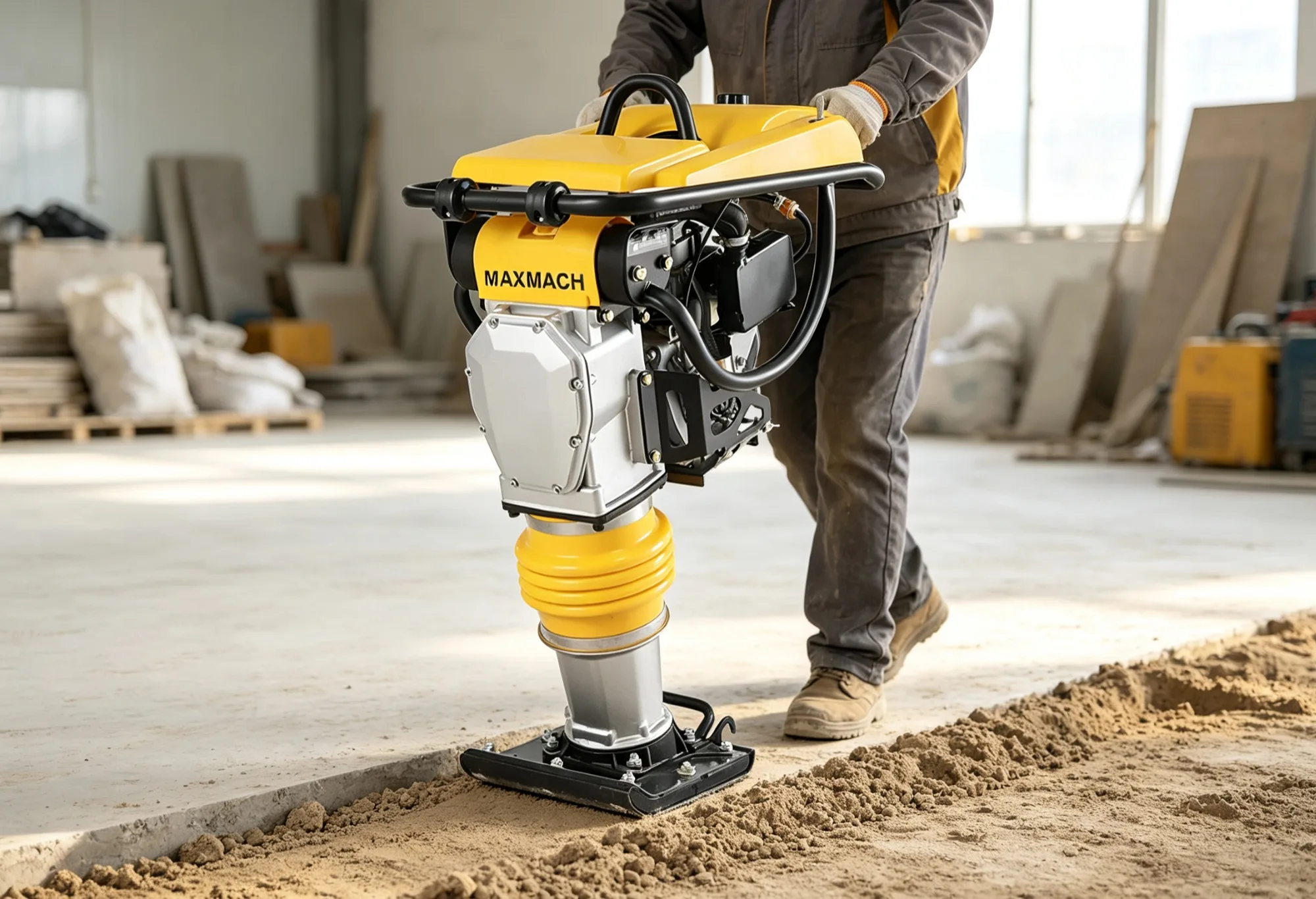
A tamping rammer delivers high-impact vertical force to compact soil in narrow or hard-to-reach areas.
This makes the rammer especially useful for utility trenches, foundation edges, backfill around pipes, and patch repair work where a plate compactor cannot work efficiently. Unlike a plate machine, which spreads force over a wider base, a rammer concentrates energy in a smaller shoe area. That concentrated force helps bind cohesive or mixed soils and reduces voids in confined lifts. For contractors, that means fewer soft spots, less settlement risk, and a cleaner handoff to paving, slab, or restoration crews. In a mixed equipment fleet, it is common to pair rammers with concrete mixers for site preparation, power trowels for slab finishing, and floor grinders for surface correction after the base is complete.
Compaction quality is not only about force; it is also about controlling lift thickness and moisture content.
Standard Proctor testing under ASTM D698 and Modified Proctor testing under ASTM D1557 provide density benchmarks that contractors can use to confirm whether the placed material is being compacted close to its target condition. In practice, crews usually compact in thinner lifts than the final fill thickness because a rammer works best when each layer can transmit impact energy through the soil column. If the lift is too thick or too dry, even a powerful rammer will produce poor density gain. That is why experienced contractors treat the rammer as part of a process, not a standalone machine.
How to compare rammer models for professional construction contractors
The best rammer for contractors is the one that matches the soil, access, and productivity target of the job.
When comparing rammer models, start with the work envelope. A narrow trench beside utilities needs a lightweight, highly maneuverable unit with a smaller shoe. A roadway shoulder repair may justify a heavier rammer if the crew can still move it safely. Then look at energy transmission: impact frequency, stroke design, and shoe geometry matter because they control how efficiently force enters the soil. Engine selection also matters, especially for fleets that operate in different fuel environments. CONSMAC highlights gasoline and diesel power options across its road and concrete equipment lineup, which is useful for contractors working in mixed site conditions where refueling logistics vary.
| Evaluation factor | Why it matters | Typical contractor priority |
|---|---|---|
| Operating weight | Influences portability and compaction energy | Higher for dense backfill, lower for utility trenches |
| Shoe size | Affects force concentration and maneuverability | Smaller for narrow trenches, larger for open edges |
| Engine type | Impacts fuel logistics and maintenance | Gasoline for general mobility, diesel for site logistics |
| Impact frequency | Controls compaction rhythm and pass efficiency | Match to soil response, not just maximum number |
| Service access | Reduces downtime during high-use seasons | Tool-free filters, easy inspection points |
Contractors should also check how the machine supports daily maintenance.
Dust, fuel quality, and long operating hours can expose weak design details quickly. Air filters, recoil systems, bellows, and baseplate wear surfaces are common service points. A model that is easy to inspect can outperform a technically stronger machine if it spends less time waiting on repairs. For multi-crew operations, this is often the difference between a rammer that stays in rotation and one that becomes a spare. The same logic applies across the broader fleet, which is why contractors often want one vendor that can also support asphalt saws, concrete finishers, and other road-work equipment from a single procurement channel.
Rammer models by job type: where each model fits best
Different rammer models solve different site constraints, so the wrong model usually fails because of access, not power.
For trench work, a compact rammer is the most logical choice because the operator needs to work close to walls, pipes, and shoring. For backfill around footings or retaining walls, a model with stable balance and predictable vertical travel helps reduce edge damage. For municipal repair crews, mobility may matter more than raw compaction strength because the machine must move from patch to patch quickly. A contractor who frequently alternates between trench work and slab prep should consider how the rammer fits into the broader equipment sequence, including road marking machines for final traffic marking and concrete cutters for repair cuts and joint opening.
| Job type | Best rammer profile | Why it fits | Typical risk if mismatched |
|---|---|---|---|
| Utility trench backfill | Compact, narrow shoe, easy handling | Works in confined spaces | Bridging, under-compaction |
| Foundation edge compaction | Balanced weight, stable vertical stroke | Reduces edge settlement | Cracking or uneven support |
| Patch repair and pothole support | Portable, fast start-up, low downtime | Improves crew movement | Lost time between locations |
| Residential backfill | Operator-friendly, low fatigue design | Fewer handling issues | Inconsistent density from fatigue |
Material type changes the answer as much as job type does.
Cohesive soils, silty mixes, and damp backfill usually respond well to rammer action because the impact helps close air voids and improve particle interlock. Granular base layers often compact better with plate equipment, especially over wider surfaces, because surface coverage is more efficient. That is why contractors rarely buy a rammer in isolation. A practical fleet often includes both rammers and plate compactors, letting the foreman assign the right tool to the right layer rather than forcing one machine to do everything.
Technical data contractors should verify before buying a tamping rammer
Contractors should verify measurable performance data before they purchase a rammer model.
Look for operating weight, shoe dimensions, impact rate, engine output, and service intervals in the product sheet. If the vendor does not publish these numbers clearly, procurement becomes a guessing game. For reference, soil compaction testing standards such as ASTM D698 and ASTM D1557 define reference methods for maximum dry density, while field acceptance usually depends on project specifications, lift control, and inspection. That means the machine does not need to “match” a standard number in isolation; it needs to help the crew consistently reach the project’s density requirement.
| Specification | Why contractors care | What to request from supplier |
|---|---|---|
| Operating weight | Impacts transport and force delivery | Exact dry and ready-to-run weight |
| Shoe size | Determines access and contact area | Width and length in millimeters |
| Impact frequency | Supports pass efficiency | Measured impacts per minute |
| Engine power | Affects start-up and site reliability | Rated power in kW or hp |
| Fuel system | Impacts logistics and runtime | Tank capacity and expected runtime |
Industry standards also help contractors frame inspection and acceptance discussions.
NIST SI Units guidance is useful when comparing imperial and metric specifications, especially for international purchasing teams, because one supplier may list dimensions in inches while the site engineer tracks millimeters. If a trench specification calls for compaction verification at a given density, the contractor should confirm the testing method, the gauge location, and the acceptance threshold before equipment is dispatched. This is where project coordination matters more than brand preference.
How to choose the best rammer for contractors on mixed-surface projects
The best rammer for contractors is the one that keeps the crew productive across the most common site conditions.
On mixed-surface jobs, a contractor may start with trench compaction, move to patch prep, and then hand off to a paving or finishing crew. In those conditions, one machine rarely solves every stage. A rammer should therefore be selected as part of a workflow. If the project includes concrete replacement, a contractor may also need concrete vibrators for consolidation, cutting equipment for removal, and a finisher for surface leveling. Fleet compatibility becomes a real advantage because it reduces training time and spare-parts variation.
- Identify the dominant soil type before selecting a rammer model.
- Measure trench width, edge clearance, and access constraints on site.
- Confirm the required density test method and acceptance criteria.
- Compare service access, fuel availability, and operator comfort.
- Choose the model that minimizes passes while maintaining safe handling.
Operator fatigue is often underestimated, but it changes compaction quality.
A machine that is technically capable but awkward to control can create inconsistent results at the end of a long shift. For that reason, lightweight handling, balanced recoil behavior, and predictable throttle response matter just as much as raw force. In contractor terms, the best rammer is the one that gets used correctly every time, not occasionally by the most experienced operator. That logic is especially important for subcontractors and rental fleets, where equipment turnover is high and training time is short.
Common mistakes when contractors buy a tamping rammer
Most rammer buying mistakes come from ignoring soil, access, and maintenance realities.
One frequent mistake is choosing a machine based only on engine size. A stronger engine does not automatically produce better compaction if the shoe geometry or stroke design is not matched to the material. Another mistake is buying too much machine for the trench. Excessive weight can make the rammer harder to control, especially near utilities or formed edges. A third mistake is failing to check routine maintenance access, which leads to unnecessary downtime during peak season. Contractors also underestimate the value of a complete road-and-floor equipment set, where floor grinders and power trowels support the downstream stages after base compaction is complete.
- Do not select by engine rating alone.
- Do not use a heavy rammer in very narrow trenches if control suffers.
- Do not ignore operator training and pass consistency.
- Do not skip maintenance access checks during procurement.
- Do not assume one model can handle every soil condition equally well.
Field evidence often shows that the most cost-effective purchase is not the lowest price.
A cheaper machine can become expensive if it causes rework, delays, or safety issues. In compaction work, a missed lift or uneven trench can trigger callbacks that are far more expensive than the machine’s purchase delta. That is why experienced buyers evaluate lifecycle cost: fuel, wear parts, labor, and uptime. When procurement teams think this way, the choice becomes clearer and more defensible.
Practical buying checklist for professional construction contractors
A contractor should treat rammer procurement as a performance decision, not a catalog decision.
Before buying, ask for the actual specs, the recommended soil types, the maintenance schedule, and the parts support plan. If possible, compare the candidate machine side by side with other site tools in the same supplier ecosystem. For example, a vendor that also supplies mortar mixers, shotcrete machines, and road repair equipment may be easier to standardize across a contractor’s fleet than a fragmented source network. Standardization can reduce procurement friction, but only if the machines themselves fit the work.
- Request full specification sheets with exact dimensions and operating weight.
- Ask for the recommended lift thickness and soil types.
- Confirm the service interval and wear-part availability.
- Verify transport method, storage footprint, and fueling requirements.
- Check whether the machine fits the crew’s training level and workload.
For contractors serving multiple project types, the best rammer model is usually the one that stays versatile without becoming cumbersome.
That may mean a mid-weight machine for mixed utility work, a lighter unit for repair crews, or a fleet pair that includes a compact rammer and a plate compactor. The goal is consistency: fewer failed lifts, fewer callbacks, and fewer delays when the schedule is tight. That is the practical standard contractors care about.
FAQ
What is the best tamping rammer for contractors?
The best tamping rammer for contractors is the model that matches trench width, soil type, and operator workflow, rather than the one with the highest advertised power.
When should a contractor use a tamping rammer instead of a plate compactor?
A contractor should use a tamping rammer for narrow trenches, edge compaction, and confined backfill, while a plate compactor is usually better for wider granular base areas.
What soil types work best with a rammer?
Rammers are generally more effective in cohesive or mixed soils and in confined lifts where vertical impact helps reduce voids and improve density.
Which standards are useful when evaluating compaction work?
Useful references include ASTM D698, ASTM D1557, and ISO 17892-12.
How do I know whether a rammer model is too heavy for my crew?
If the machine slows trench movement, increases fatigue, or makes edge control difficult, it is probably too heavy for the job profile.
What specification matters most when comparing rammer models?
For most contractors, the most important comparison points are operating weight, shoe size, impact frequency, and service access, because those variables directly affect productivity and uptime.
Can one rammer model handle all contractor jobs?
One model can cover many tasks, but no single rammer is ideal for every site condition, which is why many contractors pair a rammer with a plate compactor in the same fleet.