
- 2026 demand is strongest where access is tight: trenches, backfill zones, edge compaction, and repair work.
- Compaction performance should be judged by application fit, not engine size alone.
- Buyers increasingly value lightweight design, easier maintenance, and multi-fuel operating options.
- Regional distributors and contractors need products that balance transportability, durability, and service response.
The tamping rammer 2026 outlook is best understood through compaction physics, project workflows, and procurement pressure, not hype. For example, ASTM D1557, the Modified Proctor test, uses 56,000 ft-lbf/ft3 of compaction effort, which is a practical benchmark for comparing how seriously a jobsite controls density targets. In municipal repair and utility trench work, that kind of quality focus matters because poor backfill compaction leads to settlement, callbacks, and surface failure. For buyers evaluating market trends and rammer forecast 2026 plans, the real question is which machine can deliver dense, repeatable results in narrow spaces while keeping fuel use, maintenance time, and operator fatigue under control.
Tamping Rammer Market Trends and Tamping Rammer 2026 Demand Drivers
The tamping rammer market is being pulled forward by repair-heavy construction, not only by new infrastructure starts. Utility work, curbside maintenance, foundation backfill, and small road-repair jobs create a steady need for compact equipment that can work where rollers and plates cannot.
That demand pattern is especially visible in urban and suburban sites. Contractors often need to work in trenches, against walls, around pipe runs, or near manholes. A tamping rammer is designed for those tight geometries because its narrow shoe and vertical impact make it effective in cohesive or mixed soils where point compaction matters more than surface coverage.
One reason the 2026 market is favoring rammers is portability. Smaller crews want machines that can be loaded quickly, moved between jobs, and maintained without a large service bay. This is one reason lightweight construction, simple controls, and easy access to wear parts are now commercial advantages, not just engineering details.
Another driver is procurement realism. Many buyers now compare total lifecycle cost instead of only purchase price. That means looking at filter service intervals, throttle response, engine availability, and part replacement frequency. In practice, a lower-cost machine that loses work time in the trench can become more expensive than a slightly better-built model with faster turnaround support.
Rammer Forecast 2026: What Buyers Should Expect
The 2026 forecast points to more differentiated product demand, not one universal rammer standard. Buyers will increasingly segment by soil type, site size, and regional energy preference.
For example, projects with granular fill and broader working surfaces may still lean toward a plate compactor, while mixed backfill and cohesive soil in narrow cuts still favor a tamping rammer. That means distributors who can explain application boundaries clearly are likely to convert more inquiries than those who only list horsepower.
On the product side, 2026 is likely to reward machines that combine predictable jumping action with lower operator strain. Because repetitive trench compaction is physically demanding, buyers increasingly notice handle vibration, balance, recoil behavior, and throttle smoothness. These are not small details; they affect crew speed, fatigue, and safety compliance.
From a market planning perspective, the strongest opportunity is in replace-and-upgrade cycles. Contractors with older equipment often replace machines after failures accumulate, especially if downtime has already triggered client complaints. For importers and dealers, this creates a chance to position a rammer lineup as a reliability and service package rather than a commodity purchase.
| Market signal | 2026 implication | Buyer action |
|---|---|---|
| More trench and utility repair work | Higher need for narrow-area compaction | Prioritize rammers over broad-surface machines |
| Smaller crews and faster mobilization | Demand for lighter, easier-to-load equipment | Check weight, handle design, and transport footprint |
| Lifecycle cost focus | Maintenance and parts availability become decision factors | Ask for service intervals and wear-part access |
| Fuel flexibility | Different jobsite energy conditions across regions | Compare petrol and diesel options by market |
How a Tamping Rammer Works in Real Site Conditions
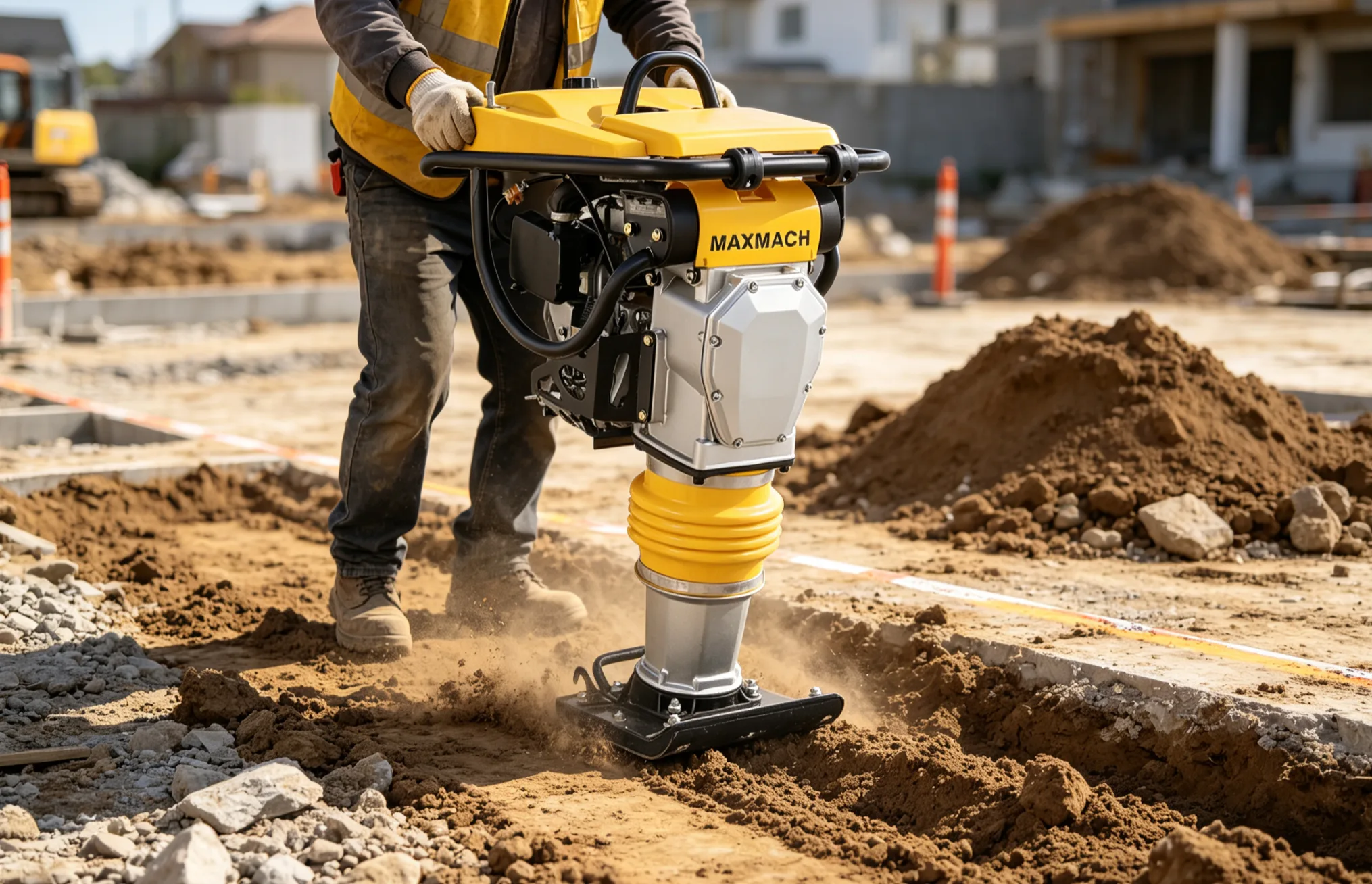
A tamping rammer works by converting engine power into repeated vertical impact that drives the shoe into the soil. That “jumping” motion is why it performs well in cohesive material and confined spaces where a vibrating plate can lose effectiveness.
The key practical variable is energy concentration. Instead of spreading force across a wide base, the rammer focuses impact on a smaller footprint, improving density in trenches, along foundations, and at pipe surrounds. In field terms, that means fewer weak zones near edges and fewer settlement issues after reinstatement.
Operators should also understand moisture sensitivity. Soil that is too dry may not densify efficiently, while overly wet material may pump or rebound. That is why compaction decisions should always be tied to the material condition, lift thickness, and required density target. Good equipment cannot compensate for poor compaction sequencing.
For buyers, the takeaway is simple: a tamping rammer is not a generic “small compactor.” It is a niche machine optimized for trench backfill, confined repairs, and edge work. If the site mainly needs base flattening on open ground, a plate may be the better purchase. If the work involves corners, utilities, and narrow reinstatement strips, the rammer earns its place quickly.
Technical Selection Guide for Tamping Rammer 2026 Buyers
The best tamping rammer is the one that matches the jobsite profile, not the one with the loudest spec sheet. Buyers should compare compaction force, shoe size, travel speed, engine option, fuel consumption, and service access together.
| Selection factor | What to check | Why it matters |
|---|---|---|
| Compaction application | Trench backfill, edges, pipe zones, foundations | Confirms the rammer is the right tool |
| Shoe geometry | Narrow shoe for confined access | Improves work near walls and trenches |
| Weight and balance | Transport and operator control | Affects loading, handling, and fatigue |
| Engine choice | Petrol or diesel based on market preference | Affects operating cost and service availability |
| Serviceability | Air filter access, throttle parts, wear shoes | Reduces downtime and maintenance cost |
In procurement conversations, it helps to ask one extra question: how often will the machine be used in confined, repetitive tasks versus occasional maintenance work? That distinction changes the acceptable durability threshold. High-duty trench crews need stronger parts support and simpler field repair. Occasional users may prioritize price and ease of operation.
It is also smart to compare the rammer with neighboring categories in the product line. For example, a plate compactor may outperform a rammer on large granular areas, while a concrete cutting machine can be part of the same maintenance workflow when the job includes opening and restoring pavement. That broader workflow view often produces better purchasing decisions than single-machine comparisons.
Standards, Testing, and the Numbers That Matter
Compaction quality is measurable, and the 2026 market increasingly rewards buyers who know the standards behind the job. ASTM D1557 specifies the Modified Proctor compaction test, which uses a higher compactive effort than standard Proctor testing and is widely used when projects require tighter density control.
ASTM D698, the Standard Proctor test, remains another important reference for soil compaction behavior. The practical value of knowing both methods is that they help contractors align equipment selection with the required density outcome and soil class. If a project specification calls for density verification, a rammer must be part of a controlled compaction sequence, not an afterthought.
For surface tolerance and equipment accuracy thinking, ISO 230-1:2022 is a useful example of how industrial buyers rely on standardized performance assessment. While it is not a rammer standard, it illustrates a broader procurement principle: serious buyers prefer measurable performance over marketing language. That mindset is spreading across compaction equipment purchasing too.
In equipment comparisons, the most useful numbers are not always the biggest ones. Buyers should ask for operating weight, impact rate, shoe dimensions, and fuel type, then connect those values to the actual work area. A machine that is easier to use and maintain can outperform a larger unit in real output if the job requires frequent repositioning or narrow trench work.
| Reference | Value | Why it matters |
|---|---|---|
| ASTM D1557 | 56,000 ft-lbf/ft3 compaction effort | Higher-density benchmark for modified compaction |
| ASTM D698 | Standard Proctor reference method | Baseline for soil compaction comparison |
| ISO 230-1:2022 | Machine tool positioning and test framework | Shows the value of standardized performance validation |
Operational Scenarios Where a Tamping Rammer Wins
A tamping rammer wins when access is tight and density matters. That is the core rule buyers should remember in 2026.
In trench backfill, the machine’s narrow footprint helps compact around pipes and utilities without overloading adjacent areas. In foundation work, it helps seal edges and corners where a plate may bridge. In pavement repair, it supports reinstatement where the repaired area is too small for broader compaction machinery.
Municipal crews also rely on rammers for sidewalks, curbside patches, and service cuts. These jobs are small individually but frequent in aggregate, which makes speed of setup and breakdown a major economic factor. A machine that starts reliably and moves easily between locations can save far more labor time than its sticker price suggests.
For dealers serving export markets, this scenario clarity is important. Buyers in one region may prefer petrol models because fuel and service are easier to source, while another market may prefer diesel for fleet standardization. That is why a flexible product lineup matters in 2026.
- Confirm the soil type and target density before selecting the machine.
- Check whether the site is open-surface or confined-access.
- Match engine type to local service and fuel availability.
- Evaluate transport weight and maintenance access.
- Ask for the exact application use case, not only the horsepower figure.
Comparison With Other Site Equipment
A tamping rammer should be compared against neighboring compaction and finishing tools, not just against other rammers. That broader comparison reduces buying errors.
| Tool | Best use case | Strength | Limitation |
|---|---|---|---|
| Tamping rammer | Trenches, backfill, edges | High point compaction in confined spaces | Less efficient on broad granular bases |
| Plate compactor | Road base, patios, parking areas | Fast coverage over larger surfaces | Weaker in narrow or cohesive areas |
| Concrete cutter | Pavement repair and reopening | Precision cutting and restoration workflow | Not a compaction tool |
| Power trowel | Surface finishing | Smooth concrete finishing | Not suitable for backfill density work |
This comparison matters because many buyers use compact construction equipment as a system. A project may begin with cutting, continue with backfill compaction, and end with finishing. In that workflow, a rammer is only one part of the solution, which is exactly why buyers increasingly look for suppliers with broader site-equipment coverage such as cutting machines, power trowels, and other road and concrete equipment.
Buying and Distribution Strategy for 2026
The smartest 2026 buying strategy is to purchase for use case, serviceability, and market fit. That is especially true for distributors and export-oriented buyers.
Distributors should build a compact line around common application clusters: trench compaction, patch repair, slab preparation, and road maintenance. Buyers in these segments expect practical documentation, spare parts support, and the ability to explain why a rammer is better than a plate in certain jobs. Technical education can be a sales advantage.
For contractors, a balanced approach is even better. One job may require a rammer for utility backfill, while the next requires a plate for broader sub-base preparation. Procurement teams that think in terms of job sequences reduce idle equipment and improve utilization rates.
In 2026, the most competitive offers will likely be the ones that combine clear application guidance, transparent specs, and dependable after-sales support. That is especially important for cross-border buyers who cannot afford long repair delays or ambiguous parts sourcing.
What This Means for the Rammer Forecast 2026
The rammer forecast 2026 is positive where repair work, trenching, and small-team productivity remain important. Demand is unlikely to be driven by flashy innovation alone. Instead, it will grow where contractors need reliable density results in narrow spaces and distributors can support the purchase after delivery.
That is why the most durable market message is not “buy more power.” It is “buy the right machine for the job.” A rammer with the correct balance of impact, transportability, and service support is more likely to stay in use, earn repeat orders, and reduce project risk.
For readers comparing options, a practical starting point is to review the full category of rammers, then see how they fit beside plate compactors, mortar mixers, and concrete cutting machines within the broader construction workflow.
That workflow-first mindset is what turns a purchase into a better operating result.
FAQ
What is the biggest trend in the tamping rammer market for 2026?
The biggest trend is demand growth from trench repair, utility work, and small-site maintenance, where compact machines are more practical than larger compaction equipment.
Is a tamping rammer better than a plate compactor?
A tamping rammer is better for narrow trenches, cohesive soil, and edge compaction, while a plate compactor is usually better for broader granular surfaces.
What should I compare before buying a rammer in 2026?
You should compare compaction application, weight, shoe size, engine type, service access, and the availability of spare parts and local support.
Why do standards matter in compaction equipment selection?
Standards such as ASTM D698 and ASTM D1557 give buyers a way to connect machine choice with verified density targets and testing methods.
Are lightweight rammers actually useful on site?
Yes. Lightweight design improves transport, loading, and maneuverability, especially for small crews and distributed maintenance jobs.
Should distributors focus on one fuel type or multiple options?
Multiple fuel options are often more practical because fuel availability, service habits, and buyer preferences vary by region.
How does a tamping rammer fit into a broader road and concrete workflow?
It typically supports the compaction stage in a sequence that may also include cutting, surface preparation, and finishing equipment.