
- Transport incidents are usually caused by tipping, poor tie-downs, or moving a hot, fueled machine.
- Weight distribution matters as much as restraint strength when you move a tamping rammer across uneven job-site terrain.
- Safe handling depends on shutdown, cooling, drainage, securement, and a clear loading path.
- Most transport damage can be prevented with a documented checklist and crew roles.
How to transport a tamping rammer machine safely on job sites is ultimately a question of control, not speed, because a compact rammer may look simple but still carries concentrated mass, vibration loads, and fuel risk. In lifting and transport planning, OSHA notes that rigging and material-handling failures remain a major source of struck-by and caught-in incidents, which is why equipment movement should be managed with the same discipline as operation. For compaction work, the safest approach is to pair a transport checklist with the machine manual and standard site practice, especially when the machine must be moved between trench sections, loading ramps, or service vehicles. If your crew also uses rammers, plate compactors, or cutting machines, a common transport routine can reduce mistakes across the whole job site.
Why tamping rammer transport safety matters on active job sites
Safe transport prevents injuries, equipment damage, and downtime at the same time.
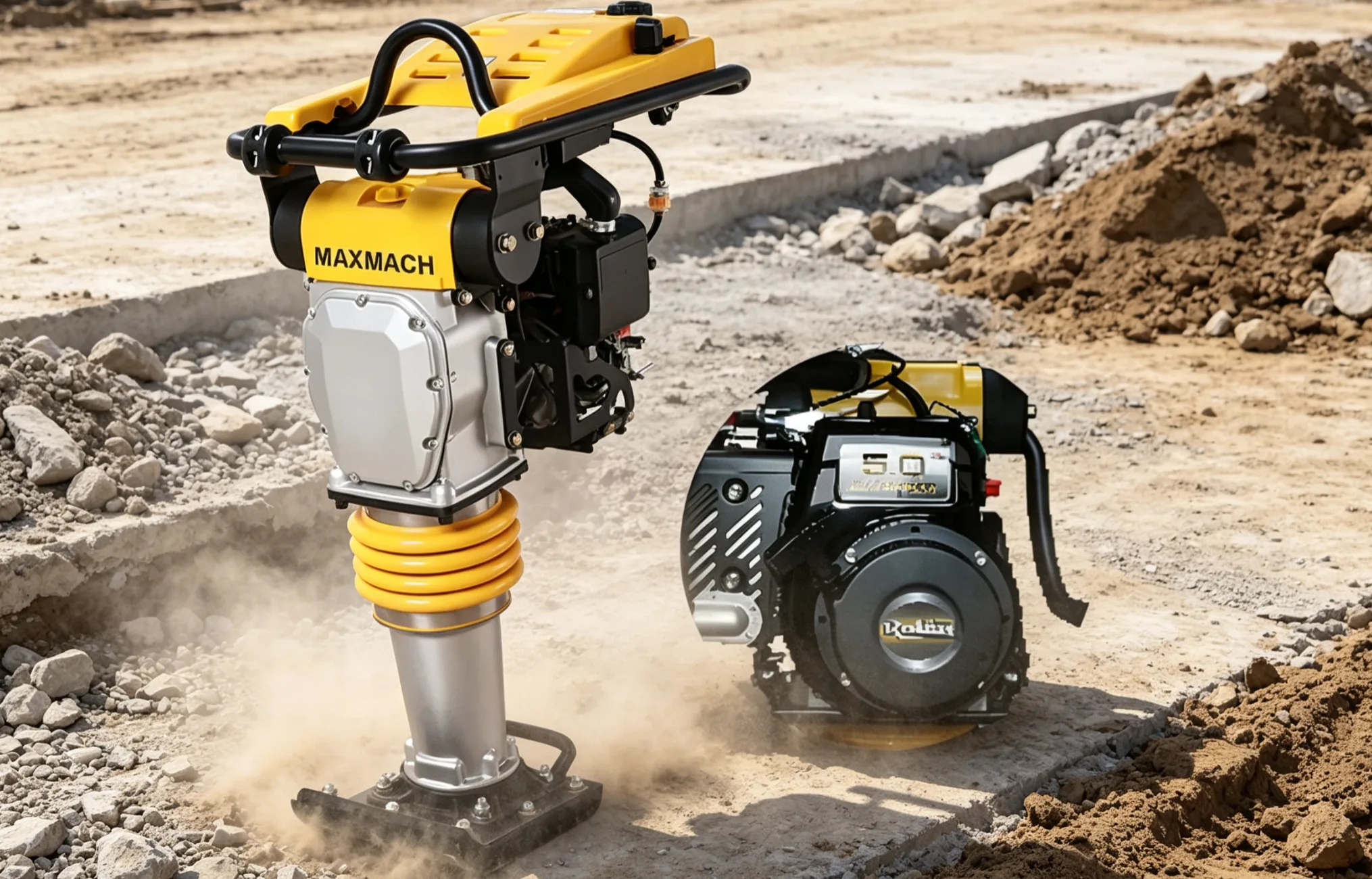
A tamping rammer is small enough to move by hand in many situations, but its vibration system, engine mass, and tall handle create a narrow stability window. That makes it easy to tip when crossing trench boards, trailer ramps, curbs, or uneven backfill. On active sites, transport risk rises because the machine often moves while workers, tools, and vehicles are sharing the same space.
OSHA data on occupational injuries shows why movement discipline matters: the Bureau of Labor Statistics reported 5,283 fatal work injuries in the United States in 2023, with transportation incidents accounting for 36.8% of all fatalities. While that statistic covers the whole economy, it is a strong reminder that moving equipment is never a trivial task. For compactors and similar site machines, the practical lesson is simple: the safest move is the one planned before the engine is shut off.
For compact construction equipment, transport safety also protects the machine itself. Repeated tipping can damage throttle linkages, fuel caps, air filters, and mounting brackets. Even a small leak or bent handle can turn into a service call that stops trench compaction or utility restoration.
Transport rammer checklist before loading or moving
A short checklist catches most preventable transport errors.
- Shut the engine down and let hot components cool.
- Close the fuel valve if the model has one.
- Check for fuel, oil, or loosened fasteners.
- Remove loose tools, accessories, and debris from the machine.
- Verify the handle lock, lifting point, and base plate condition.
- Choose a path with minimal slope, holes, and cross traffic.
- Confirm the load surface can support the machine and tie-down points.
The checklist should be completed before the machine is lifted, rolled, or loaded onto a truck. In practical field work, this is especially important when the machine is coming out of a trench, where mud and uneven ground can change grip and balance in seconds.
| Transport step | What to check | Why it matters | Typical failure risk |
|---|---|---|---|
| Shutdown | Engine off, key removed | Prevents accidental start | Unexpected vibration or movement |
| Cooling | Muffler and engine housing cool | Reduces burn and fire risk | Heat damage to straps or gloves |
| Fuel control | Cap sealed, valve closed | Limits leakage during tilt | Fuel spill and vapor hazard |
| Securement | Straps tight, machine upright | Prevents sliding and tipping | Damage on ramps or turns |
How to move a tamping rammer by hand without losing control
Manual movement is safest only when the path is short, level, and clear.
To move a tamping rammer by hand, one person should control the handle while another clears the route if the ground is uneven or crowded. The operator should keep the machine upright, move at walking speed, and avoid sudden turns that can shift the center of gravity. On compacted soil or concrete, small obstacles can act like a wedge and cause the frame to twist.
The lifting position matters. The rammer should be moved with the handle designed for control, not with improvised grabbing points such as the muffler, fuel tank, or guard. Those parts are not made for carrying loads and can deform or loosen under repeated use.
When the route includes a ramp, the machine should always be kept aligned with the slope, because diagonal movement increases rollover potential. If the surface is wet, loose, or covered with mud, manual transport should be replaced with a cart, loader, or vehicle securement method.
Loading a transport rammer onto a truck or trailer
Loading is the highest-risk transport stage because gravity, ramp angle, and restraint all interact.
The safest loading method is the one that minimizes lifting and eliminates side slip. For many job sites, that means using a ramp with adequate width and a non-slip surface, or a forklift/loader if the machine design and site procedure allow it. The ramp angle should be as low as possible, and the machine should be guided in a straight line rather than pushed from the side.
ANSI and OSHA lifting guidance consistently emphasize load stability, rated capacity, and clear communication during material handling. A compact rammer may be light compared with larger paving equipment, but it can still become unstable if it is carried one-handed or loaded onto a narrow ramp under poor footing conditions.
If a truck bed is used, place the machine so its weight is centered over the axle area of the transport vehicle whenever possible. This helps maintain balance during braking and cornering. Keep the handle folded or locked in its transport position if the design allows it, because a loose handle can act like a lever and shift the machine during movement.
| Loading method | Best use case | Strength | Limitation |
|---|---|---|---|
| Manual carry | Very short moves on level ground | No equipment needed | High fatigue and tip risk |
| Ramp loading | Truck or trailer loading | Flexible on site | Requires stable footing |
| Forklift or loader | Heavier units or rough ground | Better control | Needs trained operator |
| Vehicle securement | Any roadway transfer | Best for longer moves | Needs proper tie-down points |
How to secure a tamping rammer for road transfer
Proper tie-down is the difference between a safe delivery and a damaged machine.
The machine should be restrained at multiple points using straps or chains rated for the load, with anchor points that cannot slip off the frame. General cargo securement guidance from the U.S. Department of Transportation emphasizes that cargo must be immobilized to prevent shifting during transport, especially under braking, turning, and vibration. That principle applies directly to a tamping rammer on a flatbed, pickup bed, or enclosed trailer.
Use separate restraint lines where the frame geometry allows it, because a single strap rarely prevents forward, backward, and lateral movement all at once. The machine should remain upright unless the manufacturer specifies another transport orientation. If the unit must be tilted, ensure fuel leakage and oil migration have been addressed first.
Recheck strap tension after the vehicle has moved a short distance. New vibration often settles the load, and a strap that looked tight at the loading point may loosen slightly after rolling over the first bumps.
Transport rammer risks: the most common mistakes to avoid
Most transport damage comes from predictable, repeated errors.
- Moving the machine while it is still hot and fueled.
- Using worn straps, weak hooks, or damaged anchor points.
- Carrying the rammer by the engine cover or muffler area.
- Loading on a slope without a spotter.
- Failing to lock the handle or secure loose components.
- Crossing uneven ground at speed instead of walking pace.
These mistakes usually happen because crews treat a small machine like a light object rather than a powered tool. That mindset creates shortcuts, and shortcuts create rollover, spill, or strain injuries. A transport rammer should always be handled as equipment, not as hand luggage.
Another common problem is poor site coordination. If a crew is working around excavation edges, concrete forms, or fresh backfill, the route should be selected before the machine starts moving. Changing the route mid-move often leads to awkward lifting and rushed footwork.
Site conditions that change how you move a tamping rammer
Ground conditions should drive transport decisions more than habit does.
On dry, compacted pavement, a rammer can often be rolled or carried safely over short distances. On mud, gravel, or demolition debris, the same move becomes unstable because the operator cannot predict traction. That is why transport planning must consider the actual surface under the machine, not just the distance to the next work area.
Weather also matters. Rain, frost, and high heat all change grip and fatigue levels. Wet ramps and slick truck beds are especially hazardous because the machine may shift before the operator notices. In cold weather, gloves reduce dexterity, so strap adjustment and handle locking should be checked carefully.
For mixed fleets, it helps to standardize movement rules across compactors. For example, the same crew may use rammers for trench work, plate compactors for base layers, and concrete cutting machines for pavement opening. A shared transport routine reduces confusion when different tools are rotated through the same vehicle and loading path.
Material handling standards and practical safety benchmarks
Transport safety improves when crews work to recognized handling rules instead of informal habits.
OSHA’s general industry and construction rules require equipment to be maintained in safe condition, and cargo securement guidance from the U.S. DOT requires loads to be restrained against movement during normal transport forces. For operators who want a specific reference point, the OSHA walking-working-surfaces rule at 29 CFR 1910.22 is a useful reminder that clean, dry, and unobstructed surfaces reduce slip and trip hazards during loading and unloading. The standard’s basic principle is straightforward: a safe path is part of safe transport.
In equipment planning, the accepted engineering approach is to ask four questions: Can the machine be stopped safely? Can it be lifted without side load? Can it be tied down without slipping? Can it be unloaded on the far side without forcing a manual carry in a dangerous area?
If the answer to any of those is no, the transport plan should be changed before the move begins. This is one reason many contractors prefer compact, easy-to-operate equipment that fits their workflow without excessive repositioning. For site teams expanding their fleet, it is often helpful to review machine families such as concrete mixers and power trowels alongside rammer handling procedures, because transport planning is easier when every tool follows the same loading logic.
| Reference | What it says | Why it helps on site |
|---|---|---|
| OSHA 29 CFR 1910.22 | Walking-working surfaces must be kept clean and orderly | Reduces slips during loading and unloading |
| U.S. DOT cargo securement guidance | Cargo must be immobilized against movement | Supports proper tie-down practice |
| OSHA construction equipment rules | Equipment must be maintained in safe operating condition | Prevents transport with defects |
Job-site scenarios: how the transport process changes
The best transport method depends on the work scenario, not the machine alone.
In trench backfill, the safest move is usually a short controlled carry or a ramp-assisted transfer from one work zone to another. In parking lot repair, the machine is often loaded into a service vehicle because the work area may be spread across several patches. In utility maintenance, the crew may need to move the rammer through narrow corridors, which makes handle control and spotter communication more important than raw speed.
When the job site is large, the transport plan should be written into the daily toolbox talk. That reduces guesswork for new crew members and subcontractors who may not know the preferred route or loading point. If the machine is shared between crews, mark the transport position, restraint points, and fuel procedure on a laminated checklist stored with the equipment.
Contractors who build a repeatable process usually spend less time correcting minor damage. Over a season, that can save service labor, reduce accidental fuel spills, and improve the life of wear items such as handles, mounts, and throttle assemblies.
When to stop and choose a different transport method
Safety should override convenience whenever conditions exceed the crew’s control.
Stop manual transport and switch methods if the path is steep, wet, cluttered, or close to open edges. Stop if the machine is leaking fuel, vibrating abnormally, or has a damaged handle or base plate. Stop if the crew does not have a clear spotter or if the loading surface is too narrow for stable movement.
In those cases, the right answer is not to push harder. It is to use a loader, a better ramp, a different vehicle, or a delayed move after the area is made safe. This is especially important for companies that serve multiple markets, because a transport rule that works on one site may fail completely on another.
FAQ about tamping rammer transport safety
How should you move a tamping rammer on a job site?
Move it at walking speed, upright, and with the engine off, using a clear route and controlled hand position.
Can you transport a tamping rammer on its side?
Only if the manufacturer explicitly allows it; otherwise keep it upright to reduce fuel and oil leakage risk.
What is the safest way to load a tamping rammer into a truck?
Use a stable ramp, a trained spotter, and rated tie-down points, or use lifting equipment if the site procedure allows it.
Do you need to drain fuel before transporting a tamping rammer?
Not always, but fuel should be controlled, the cap should be secure, and leakage risk must be checked before tilting or loading.
How many tie-down points should be used?
Use enough restraints to prevent forward, backward, and side-to-side movement; the exact number depends on the machine and vehicle setup.
Why does a tamping rammer tip over so easily?
Its tall handle and concentrated engine mass create a higher center of gravity than its footprint suggests.
What should be checked after transport?
Inspect for loosened fasteners, fuel leaks, strap damage, and handle alignment before returning the machine to service.