
- Manual compaction is acceptable for tiny patches, but it is rarely the best option for controlled density.
- A tamping rammer is more effective in trenches, backfill zones, and edge compaction where plate access is limited.
- Compaction quality matters because inadequate density increases settlement risk, joint failure, and future repair cost.
- Selection should be based on soil type, lift thickness, access width, and the density target, not habit.
- For contractors, the main advantage is not just speed, but repeatability and lower rework.
Tamping rammer performance is best understood through compaction control, not just machine size, because soil density targets are commonly defined by standards such as ASTM D698 and ASTM D1557, which specify laboratory compaction methods used to benchmark field work. In practical field terms, a machine that can deliver consistent blows in tight areas usually beats manual compaction on both quality and labor efficiency. If you are comparing tamping rammer use with hand tamping, also see how it fits with plate compactors for broad areas and concrete cutters for related pavement repair workflows. The key question is not whether manual compaction is possible, but whether it can reliably reach the required density without excessive time, fatigue, and inconsistency.
Why a Tamping Rammer Beats Manual Compaction in Real Jobsite Conditions
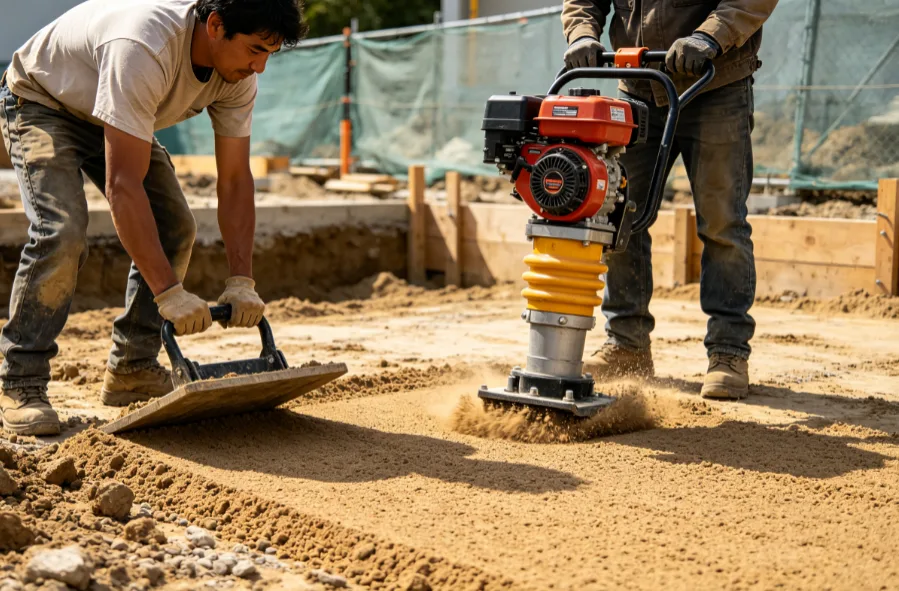
A tamping rammer wins because impact compaction is more controllable than hand force, especially when the work area is narrow or the fill must be built in thin lifts. Manual compaction depends heavily on operator strength, rhythm, and endurance, which makes results vary across workers and across the same job. A rammer standardizes the energy delivered to the soil, so the crew can focus on placement, moisture control, and lift thickness instead of trying to compensate for uneven hand tamping.
This advantage becomes more obvious in utility trenches, around curbs, and along foundations. The problem with manual compaction is not only lower force; it is also the inability to maintain that force over a full shift. Fatigue changes the result, and soft zones often appear where the operator could not reach or repeat enough blows. A tamping rammer, by contrast, is designed for repeated high-frequency impact, which makes it better suited to compacting cohesive and semi-cohesive soils in confined spaces.
| Compaction Method | Typical Best Use | Strength | Limitation | Practical Density Control |
|---|---|---|---|---|
| Manual compaction | Very small patches, light repairs | No equipment cost, simple setup | Low repeatability, high fatigue | Poor to moderate |
| Tamping rammer | Trenches, edges, backfill, confined areas | Higher impact energy, consistent action | Less efficient on wide granular areas | Good to very good |
| Plate compactor | Large flat surfaces, granular base | Fast coverage over wider areas | Less effective in narrow spaces | Good for uniform surfaces |
The table above reflects the basic rule contractors use on site: choose the tool that matches the geometry and soil condition. A tamping rammer is not a universal replacement for all compaction equipment, but it is much more reliable than manual methods once access narrows and quality requirements tighten. For broad pavement prep, many crews shift to a plate compactor, then use a rammer for trench edges and utility cut zones.
Tamping Rammer vs Manual Compaction: What the Numbers Mean
Compaction quality is measured by density, moisture condition, and consistency, and those outcomes are difficult to guarantee with hand tools alone. Standard Proctor testing under ASTM D698 and Modified Proctor testing under ASTM D1557 are still the common benchmarks for comparing field compaction performance. ASTM D698 is used for the standard effort method, while ASTM D1557 uses a higher compactive effort and is often referenced for heavier-duty applications. In the field, contractors generally aim for a percentage of the laboratory maximum dry density rather than relying on visual judgment.
That is the core weakness of manual compaction: the operator has no direct feedback loop. You may feel that the soil is firm, but without density verification, the result can still be below spec. In utility restoration, poor compaction often shows up later as settlement, cracking, or a depressed patch after rain and traffic loads. A tamping rammer reduces that risk by making the process more predictable from lift to lift.
| Metric | Manual Compaction | Tamping Rammer | Why It Matters |
|---|---|---|---|
| Repeatability | Operator dependent | Machine controlled | More consistent density |
| Coverage in tight space | Low | High | Better trench and edge access |
| Fatigue impact | High | Low to moderate | Less quality drift over time |
| Rework risk | Higher | Lower | Fewer settlement-related callbacks |
| Benchmarking method | Usually none | Can be matched to ASTM D698 or D1557 targets | Improves quality control |
According to the U.S. Federal Highway Administration, inadequate compaction is a common contributor to pavement and trench settlement problems, which is why field control matters as much as machine choice. You can review FHWA guidance on pavement and soil-related performance through FHWA geotechnical field practice materials. For contractors, the practical lesson is simple: a tamping rammer is valuable because it helps convert a subjective task into a repeatable process.
Where Manual Soil Compaction Still Makes Sense
Manual compaction still has a place when the repair area is tiny, access is awkward, or equipment use would be inefficient. For example, a small patch around a pipe riser, a very shallow top-off, or a final touch near a delicate edge may not justify bringing in powered equipment. In those cases, the goal is not maximum throughput but localized correction.
However, the threshold where manual compaction stops being practical arrives faster than many crews expect. Once the fill depth grows, the trench gets longer, or the project starts carrying traffic loads, hand tamping becomes a labor bottleneck. The risk is not only slow progress; it is also inconsistent density across the repair footprint. That is why many contractors reserve manual work for spot correction and use a tamping rammer for the actual compaction cycle.
- Use manual compaction only for very small, low-risk touch-ups.
- Switch to a tamping rammer when the area is narrow, deep, or load-bearing.
- Use a plate compactor on open granular surfaces where coverage is more important than impact.
- Verify density whenever the work affects future pavement, slabs, or utility access.
If your workflow also includes site cleanup and surface preparation, pairing compaction with mixers for material prep and floor grinders for finish correction can reduce idle time between stages. The point is to match equipment to the full job sequence, not only the compaction moment.
Soil Type, Lift Thickness, and Why Rammer Performance Changes
Soil behavior changes the answer more than many beginners realize. Cohesive soils such as silty clay or clayey fill respond better to impact compaction because the rammer’s repeated blows help rearrange particles and expel air. Granular soils with freer drainage often benefit more from vibration-based equipment, especially on wider open areas. That is why a tamping rammer can outperform manual compaction dramatically in trench backfill yet still be less efficient than a plate on a sand base.
Lift thickness matters for the same reason. If the layer is too thick, neither manual tamping nor a small machine can compact the full depth effectively. Good field practice is to place fill in manageable lifts and compact each lift before adding the next. This is where a tamper proves its value: it helps crews maintain the discipline of thin, controllable lifts instead of trying to force density into an oversized layer.
| Condition | Manual Compaction | Tamping Rammer | Recommended Action |
|---|---|---|---|
| Very narrow trench | Possible but slow | Preferred | Use rammer in thin lifts |
| Cohesive backfill | Low efficiency | Strong performance | Control moisture and lift thickness |
| Open granular base | Inefficient | Useful only at edges | Use plate compactor |
| Small patch repair | Acceptable | Optional | Choose based on target density and time |
Moisture content is another critical variable. ASTM D1557 and related field procedures remind contractors that density gains depend on the soil being near its optimum moisture condition. Too dry and the particles resist rearrangement; too wet and the soil becomes difficult to densify. A tamping rammer cannot fix bad moisture management, but it can make correct moisture control much more effective.
Jobsite Efficiency: Labor, Rework, and Safety
A tamping rammer usually reduces total job cost because it cuts labor hours and lowers the chance of callbacks. Manual compaction looks cheap at first because it uses hand labor, but the hidden cost appears in slower production, more fatigue, and inconsistent results that may need rework. In contractor economics, rework is often more expensive than the original task because it disrupts sequencing and delays the next trade.
Safety also matters. Hand tamping encourages awkward postures, repetitive motion, and overexertion, especially when workers are compacting for long periods in trenches or near edges. A powered rammer does not eliminate risk, but it shifts the work from pure manual force to controlled machine handling. That can reduce strain injuries and improve productivity if the crew is properly trained and the equipment is maintained.
For contractors handling road patching, utility restoration, and sidewalk work, the most common operational mistake is underestimating how quickly hand labor becomes inefficient. Once a crew has to compact multiple bays, hand methods stop being the “simple” option. A tamping rammer becomes the more practical tool because it compresses both labor time and quality variation into a manageable process.
How to Choose Between Rammer and Manual Compaction
The right choice depends on four variables: access width, soil type, lift depth, and quality target. If the area is wide and flat, a different machine may be better. If the area is narrow but deep, a tamping rammer is usually the best answer. If the area is tiny and the load requirement is low, manual compaction can still be acceptable. The mistake is choosing by habit instead of by site condition.
- Measure the work area width and access constraints.
- Identify the soil type and expected moisture range.
- Confirm the required density or compaction standard.
- Select the tool that can achieve repeatable results with the least rework.
- Test and verify before covering the lift.
For buyers comparing equipment across a roadwork or concrete finishing lineup, the compaction decision often fits into a broader workflow. A contractor may use a plate compactor for base areas, a tamping rammer for confined zones, and a concrete vibrator for fresh concrete consolidation. The point is to match the machine to the material and geometry, not to force one tool to do every job.
Maintenance and Operating Discipline Affect Real-World Results
Even the best tamper underperforms if maintenance is neglected. Air filters, fuel quality, shoe wear, and vibration components all influence output and reliability. Operators also need to watch for improper throttle use, uneven footing, and excessive layer thickness, because a machine cannot compensate for poor technique.
In practical terms, pre-start inspection is part of compaction quality. A machine with worn components or unstable idle may still run, but its field consistency can drop. That matters because compaction is cumulative: one weak pass may not look serious, yet it can create a low-density zone that causes later settlement. A disciplined crew treats the tamper as a quality tool, not just a powered hammer.
- Check fuel, air filter, and fasteners before every shift.
- Inspect the shoe and bellows for wear or damage.
- Compact in thin lifts rather than trying to “make up” depth in one pass.
- Keep moisture in the workable range before starting.
- Verify density where the work will carry load or support pavement.
Practical Conclusion: Rammer vs Manual Compaction
The clearest conclusion is that manual compaction is a fallback method, while a tamping rammer is the better production tool for most confined-area soil work. Manual tamping can still solve very small problems, but it is too dependent on operator strength and too inconsistent for serious backfill and repair work. A tamping rammer improves speed, repeatability, and quality control, which is why it is the preferred choice for trenching, edge zones, and utility restoration.
If your project includes repeated backfill, patch repair, or roadside maintenance, the equipment decision should be based on density target and access, not on whether the task looks small at first glance. Contractors who standardize the compaction step typically see fewer callbacks and cleaner handoff to the next trade. That is the real advantage of moving from manual compaction to a machine-based process.
For broader road and concrete workflows, the best results usually come from combining compaction equipment with the right supporting tools, such as plate compactors, floor grinders, and concrete cutters. When each step is matched to the task, field quality becomes easier to control and easier to repeat.
FAQ
Is a tamping rammer always better than manual compaction?
No. A tamping rammer is better for most confined-area and load-bearing work, but manual compaction can still be acceptable for tiny, low-risk touch-ups where equipment would be inefficient.
What soil types benefit most from a tamping rammer?
Cohesive and semi-cohesive soils, especially trench backfill and edge areas, usually benefit most because impact action helps improve density in confined spaces.
Why does manual compaction often lead to settlement later?
Because it is hard to keep force, coverage, and lift thickness consistent across the full repair area, which can leave soft spots that settle under traffic or moisture changes.
What standards are commonly used to judge compaction quality?
ASTM D698 and ASTM D1557 are widely used Proctor compaction standards for comparing field density to laboratory benchmarks.
When should I choose a plate compactor instead of a tamping rammer?
Choose a plate compactor for broader, flatter, granular surfaces where coverage is more important than high-impact action in a narrow space.
How do I know if the soil is ready for compaction?
The soil should be placed at the right moisture content and in thin enough lifts that the selected machine can compact the full layer effectively.
What is the biggest mistake crews make with compaction?
The most common mistake is choosing the wrong tool for the site geometry, then trying to compensate with extra passes instead of correcting the workflow.