
- Rammer safety starts with matching the tool to the soil, trench width, and access constraints.
- Pre-use checks, correct PPE, and stable operator footing prevent most avoidable incidents.
- Vibration exposure, fuel handling, and confined-space risks must be managed as part of daily workflow.
- Safety and compaction quality are linked: poor control can create loose lifts, edge failure, and costly rework.
Tamping rammer safety tips matter because compacting cohesive soils in trenches, around footings, and beside curbs creates a high-risk environment where vibration, recoil, and fuel-powered equipment all converge. In practical terms, a well-maintained rammer can deliver impact frequencies around 600 to 700 blows per minute, while a typical forward plate compactor operates at much lower frequencies and is better suited to broader surfaces; that difference changes both the safety profile and the job method. For operators building roads, utilities, parking lots, and small foundation pads, the safest workflow is to inspect, set up, compact, and shut down in a disciplined sequence. If you need to compare machine types for different sites, review the rammers, plate compactors, and power trowels used across related finishing and compaction tasks.
Tamping Rammer Safety Tips for Daily Jobsite Use
The safest rammer operators treat every start-up as a short risk assessment, not a routine button press. Before the engine starts, check the throttle, fuel lines, air filter, bellows or boot condition, fasteners, and the integrity of the shoe assembly. A loose bolt or damaged boot can change the machine’s balance and increase recoil, which is especially dangerous in narrow trenches or near formwork.
Use the machine only on ground conditions it was designed for. A tamping rammer is built for cohesive and mixed soils that need high-impact compaction in tight spaces, not for loose, deep granular fills that demand a different compaction method. On a narrow utility trench, the operator should keep a balanced stance, stand slightly offset from the machine’s travel line, and never force the shoe through an obstruction. If the machine begins to hop, twist, or stall, stop and diagnose the cause rather than pushing harder.
Noise and hand-arm vibration are part of the operating environment, so PPE is not optional. Safety glasses, hearing protection, sturdy boots with slip-resistant soles, and close-fitting gloves are standard. For prolonged use, operators should also manage fatigue by rotating tasks, because poor posture and tired hands reduce control. OSHA’s construction noise limit is 90 dBA over 8 hours, and the action level is 85 dBA, so hearing protection should be selected with the full site noise profile in mind, not only the rammer itself. For additional context on occupational hearing conservation.
Rammer Safety and Soil Compaction: Why the Wrong Tool Creates Risk
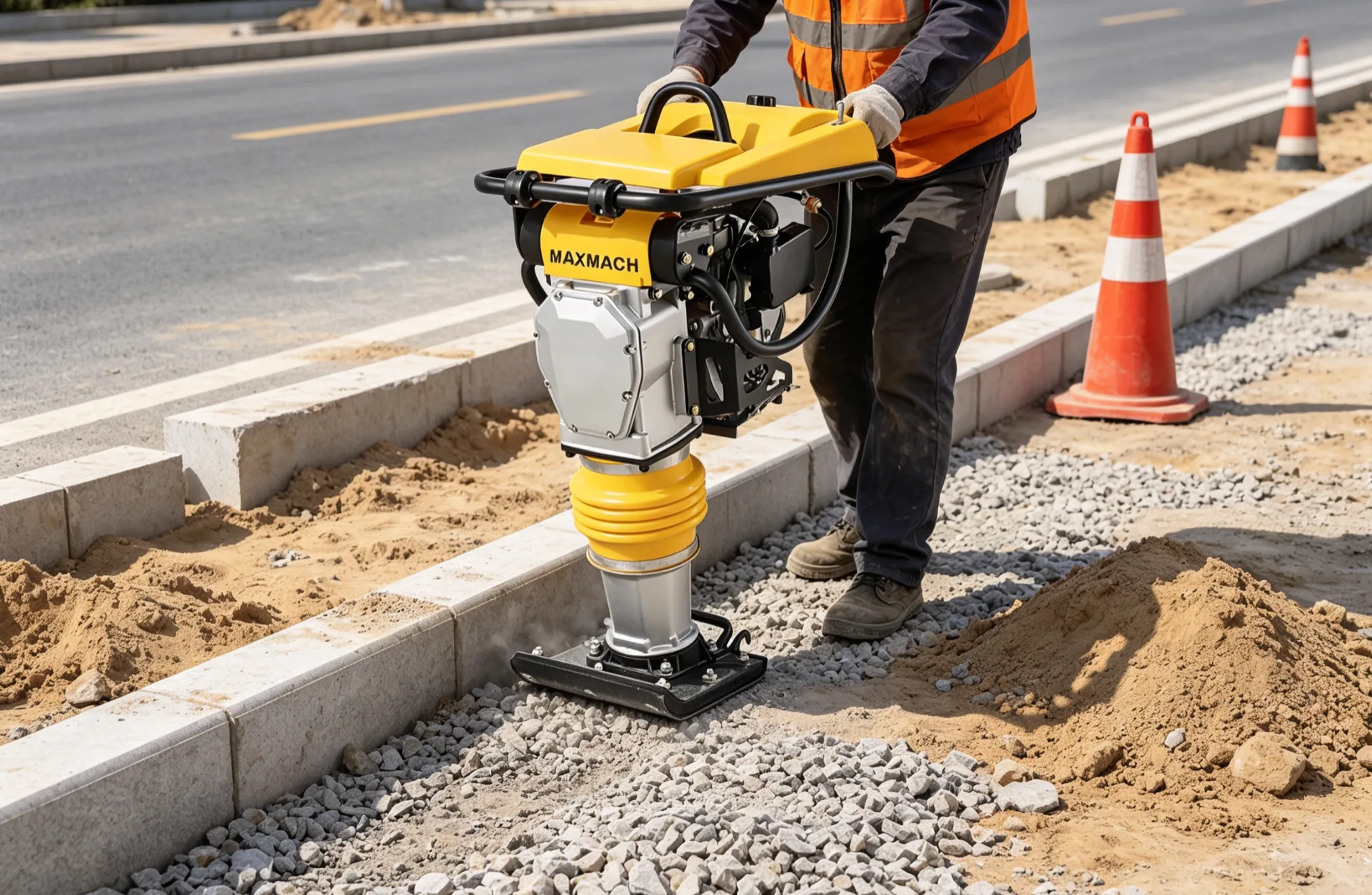
The correct compaction tool reduces both injury risk and structural defects. A tamping rammer delivers concentrated impact force for trench backfill, utility work, and edge zones, while a plate compactor spreads force over a wider footprint for larger areas. This matters because a mismatched machine can bounce, slip, or leave weak zones that later settle and create trip hazards or pavement failure.
Compaction quality is easier to defend when it is tied to measurable field targets. ASTM D1557, the Modified Proctor test, is commonly used to establish maximum dry density and optimum moisture content for controlled fill design, while field acceptance often relies on nuclear gauge or sand cone testing against that baseline. In many civil projects, a relative compaction target of 95 percent of the modified maximum dry density is a common specification, though the project documents always control. If the soil is too dry, the rammer may bridge and bounce; if too wet, it can pump and lose bearing strength. A safety-minded operator watches for both machine behavior and soil response.
| Compaction task | Best-fit machine | Typical working zone | Main safety concern |
|---|---|---|---|
| Utility trench backfill | Tamping rammer | Narrow, deep, confined | Recoil and footing instability |
| Parking lot base layers | Plate compactor | Broad open surface | Hand-arm vibration and edge control |
| Edge compaction beside curbs | Tamping rammer | Limited access edges | Loss of balance near drop-offs |
| Granular subbase | Plate compactor | Large uniform area | Overcompaction at thin lifts |
For crews that need a broader project view, the road construction machinery category helps connect trench work, surface prep, and finishing into one job sequence. That matters because safety problems often come from workflow gaps, not one machine alone.
Rammer Safety Tips for PPE, Vibration, and Operator Fatigue
Exposure control is as important as machine control on a rammer crew. Long periods of high-vibration work can affect grip strength, attention, and judgment, which increases the chance of small mistakes becoming incidents. The operator should follow task rotation, break scheduling, and tool maintenance as part of the safety plan rather than treating them as admin details.
Vibration exposure should be managed with the same seriousness as fuel and cutting hazards. According to the European Union’s vibration directive 2002/44/EC, the daily exposure action value for hand-arm vibration is 2.5 m/s² A(8), and the exposure limit value is 5 m/s² A(8). While regulations differ by country, these reference points show why a rammer crew must track exposure time, machine condition, and operator rotation. A worn handle or damaged isolator can increase transmission and make the tool harder to control.
Safe PPE also depends on job context. In trench work, visibility is critical, especially if multiple trades are moving around the same area. In road repair or parking lot maintenance, traffic exposure may require reflective garments and a spotter. If the machine is used near cut concrete or demolition residue, eye protection should resist flying chips and dust. For compaction crews working near saw-cutting operations, the broader equipment set may also include concrete cutting machines, where emergency-stop readiness and dust control become part of the same site safety plan.
| Hazard | Practical control | Reference point | Why it matters |
|---|---|---|---|
| Hand-arm vibration | Task rotation and maintenance | 2.5 m/s² A(8) action value | Reduces cumulative exposure |
| Noise | Hearing protection and exposure planning | 85 dBA action level | Protects long-term hearing |
| Fatigue | Short cycles and crew rotation | Site-specific | Preserves footing and reaction time |
| Dust and debris | Eye and respiratory protection | Task-specific | Prevents injury during trench cleanup |
How to Operate a Tamping Rammer Safely on Trenches and Edges
Controlled movement is the core skill that separates a safe operator from a merely experienced one. A rammer should be started on firm, level ground whenever possible, then eased into the work area so the shoe lands cleanly and vertically. Sudden thrusting into the soil can cause the machine to twist, especially at the trench wall or at the base of a footing.
On a trench wall, keep the shoe moving in overlapping passes instead of holding one point too long. Overworking one spot can create a hard crust over a weak base or destabilize the sidewall if the excavation is not properly shored. The operator should also check lift thickness. Thin lifts compact more uniformly and reduce the need to overdrive the machine, which lowers fatigue and improves surface consistency.
Engine data matters because machine power affects control. Many professional tamping rammers use small gasoline engines in the 4 hp to 5 hp class, with single-cylinder designs chosen for portability and site flexibility. That makes them easy to move, but it also means they depend on stable fueling, clean air filtration, and proper idle control. If the engine surges or stalls, the operator should stop and correct the cause rather than restarting repeatedly in a confined area.
For larger site planning, the rammer is only one part of the compaction chain. If the fill area expands beyond a trench or access channel, a machine such as the plate compactors category may be more efficient and safer because it reduces operator time spent in unstable foot positions. If the project also includes surface finishing, a trowel machine becomes relevant once the slab is placed and the compaction stage is complete.
- Inspect the rammer before fuel-up and before start-up.
- Confirm trench stability, clearance, and access route.
- Start on firm ground and guide the shoe vertically.
- Compact in controlled passes with stable footing.
- Shut down before cleaning, refueling, or moving the machine.
Maintenance and Inspection Practices That Prevent Rammer Accidents
Preventive maintenance is one of the cheapest safety controls on a compaction crew. A machine with loose hardware, worn bellows, contaminated fuel, or a damaged recoil system is harder to control and more likely to fail during use. The daily inspection should include the shoe, engine mounts, throttle linkage, air filter, spark plug condition, fuel cap seal, and any visible cracks in the frame or handle.
Maintenance intervals should be tied to operating hours, not only calendar time. On compact site equipment, hours can accumulate quickly during road patching or utility backfill. If the rammer starts losing impact consistency, jumps at idle, or produces unusual noise, those are early warnings, not minor annoyances. Abnormal vibration often signals a loosened component or wear inside the drive system.
Recordkeeping also improves safety. A simple log that tracks hours, service dates, parts replacement, and operator notes helps identify repeated problems before they create incidents. In a small contractor fleet, that record can also support resale value and reduce downtime. For companies managing mixed equipment, a broader service program across company support and product-specific maintenance pages helps crews standardize inspection habits.
| Inspection item | What to look for | Risk if ignored | Suggested frequency |
|---|---|---|---|
| Fuel system | Leaks, cap seal, line cracks | Fire and engine stall | Every use |
| Fasteners | Loose bolts, handle play | Loss of control | Every use |
| Drive system | Noise, abnormal vibration | Mechanical failure | Daily |
| Shoe and boot | Wear, cracks, deformation | Poor compaction and bounce | Daily |
Tamping Rammer Safety Tips for Refueling, Transport, and Storage
Fuel handling is a high-consequence task that should always happen with the machine shut down and cooled. Refueling a hot engine or smoking near a fuel source creates preventable fire risk, especially on sites with multiple generators, cutters, and compactors operating at once. A safe procedure also keeps fuel containers closed, stored away from ignition sources, and labeled properly.
Transport matters because many incidents happen between jobs rather than during the compaction pass itself. Before lifting or loading the machine, verify the transport handles, tie-down points, and machine weight. A compact rammer may be light enough for two-person handling, but awkward posture can still cause strain injuries. When moving on ramps or truck beds, keep the path clear and avoid sudden changes in direction. A rammer should never be left unsecured in a vehicle where it can tip, leak fuel, or damage other equipment.
Storage should protect both the equipment and the operator. Dry storage reduces corrosion, fuel degradation, and starting issues on the next job. If the machine is used in coastal or wet environments, a short post-job cleaning routine helps remove abrasive grit from the shoe and frame. Good storage discipline also aligns with broader site safety culture, which is why contractors that carry finishing and cutting equipment often standardize their fleet with related tools such as concrete mixers and support equipment.
When a Tamping Rammer Is the Right Choice and When It Is Not
The right compaction tool depends on access, soil type, and project tolerance. A tamping rammer is the right choice when the work area is narrow, the material is cohesive or mixed, and the crew needs concentrated force near obstacles. It is usually not the best choice for wide open granular subbase, where a plate compactor can cover more area with less operator strain.
Project requirements also matter. If the job requires a uniform finished surface before concrete placement, the compaction method should be selected to preserve grade and avoid disturbing the base. In municipal repair, road patching, and utility reinstatement, the safest plan is usually the one that minimizes operator time in the trench while still achieving density targets. That is why planning the equipment sequence before the crew arrives saves both time and risk.
For buyers and contractors comparing equipment, the key question is not which machine is strongest, but which machine is safest for the actual task. In many cases, the answer combines a rammer for edges and confined areas, a plate compactor for open zones, and finishing equipment for the next phase. A coordinated fleet helps crews move from compaction to surfacing without improvising. If you are building that workflow, the products page is a practical starting point for mapping each stage to the right machine family.
FAQ on Tamping Rammer Safety Tips
What is the most important tamping rammer safety tip?
The most important tip is to inspect the machine and the work area before starting. A safe operator confirms that the fuel system, fasteners, shoe, and handle are intact, and that the trench or work zone is stable enough for controlled movement.
How close can a tamping rammer work to trench edges?
It should only work as close as the excavation support, soil condition, and site plan allow. In unsupported or unstable trenches, the risk is not the rammer alone but the potential for sidewall collapse and loss of footing. The trench protection plan must control that hazard.
Do operators need hearing protection for a tamping rammer?
Yes, hearing protection is strongly recommended because compact construction equipment often contributes to noise levels that can exceed action thresholds over a shift. The operator should use the site’s overall noise assessment, not just the machine’s engine sound, to choose PPE.
How often should a tamping rammer be inspected?
It should be checked before every use and again whenever abnormal vibration, noise, or loss of impact is noticed. Daily inspection is the minimum safe practice for a machine that moves through dusty, high-impact conditions.
Can a tamping rammer be used on all soil types?
No. It is best suited to cohesive and mixed soils in confined areas. Loose granular base often responds better to a plate compactor, while saturated or unstable soil may require dewatering or a revised compaction method before work continues.
What causes a tamping rammer to bounce or hop?
Bouncing usually points to soil conditions, lift thickness, machine wear, or operator technique. The machine may be overworking a thin layer, striking a hard obstruction, or running with a worn shoe or drive component that changes its balance.
Why does maintenance affect rammer safety?
Maintenance affects safety because worn or loose parts change how the machine transfers force to the ground. A poor-quality impact cycle increases recoil, reduces control, and can force the operator to compensate in ways that raise the chance of injury.