- The best concrete mixer machine is the one that matches your batch volume, crew size, and site access.
- Mix consistency is more important than raw capacity when you need repeatable strength and finish quality.
- Power source, mobility, and discharge height can affect real productivity as much as drum volume.
- For procurement, compare capacity, mixing time, engine type, and maintenance access before price.
- Road work and floor work often need different mixer setups even when the material is similar.
Choosing a concrete mixer machine is a production decision, not just a purchase decision, because concrete quality depends on controlled mixing, predictable discharge, and site efficiency. The ASTM C192/C192M laboratory standard uses a mixing period of 3 minutes for the initial mix after all materials are added, showing how sensitive consistency is to process control. For project teams working on sidewalks, slabs, parking lots, or patch repair, the right concrete mixer machine can reduce rework, keep crews moving, and improve the finish of downstream operations such as screeding and troweling.
How to choose a concrete mixer machine for project size and output
The correct mixer capacity should be based on daily output, not on the largest possible drum size.
A 120 L to 200 L portable mixer is usually suitable for small repair jobs, residential work, and intermittent batch production, while larger site crews often need mixers in the 350 L to 500 L class for steadier supply. In concrete planning, what matters is usable batch volume, because the drum is not filled to 100 percent in normal operation. As a practical rule, many contractors estimate working load at roughly 60 to 80 percent of nominal capacity to preserve mixing movement and avoid spillover.
For a small crew, a mixer that produces one useful batch every few minutes can be more productive than a larger unit that is hard to move or slow to clean. If your work includes mobile maintenance, look at the plate compactor and rammer alongside the mixer, because material handling and compaction are usually part of the same workflow.
| Project type | Typical useful batch size | Best mixer style | Main selection reason |
|---|---|---|---|
| Small repair and patching | 120-200 L | Portable drum mixer | Easy transport and quick setup |
| Residential slabs | 200-350 L | Towable drum mixer | Balanced output and mobility |
| Parking lots and sidewalks | 350-500 L | Site-duty mixer | Higher repeat output |
| Maintenance crew work | Variable | Lightweight portable mixer | Fast redeployment between jobs |
When the project has narrow access or frequent relocation, a smaller machine can outperform a larger one in real use. That is especially true for municipal maintenance, basement work, and patch crews that must unload equipment from a truck multiple times per day.
Concrete mixer machine types and where each one fits best
Different mixer types solve different site problems, and the wrong type usually creates handling waste rather than savings.
Drum mixers are the most common choice for general-purpose concrete mixing because they are simple, familiar, and suitable for many contractors. Pan mixers are often used when higher uniformity is needed, especially for stiffer mixes or precast-style consistency. Continuous mixers make sense when material flow is steady and the job requires uninterrupted output rather than discrete batches. For many road and floor contractors, the right answer is still a drum-based cement mixer guide option, because it is easier to deploy at changing work zones.
| Mixer type | Typical strength | Typical limitation | Best use case |
|---|---|---|---|
| Drum mixer | Simple operation, broad compatibility | Batch consistency depends on operator | General construction |
| Pan mixer | Better uniformity for stiff mixes | Higher cleaning effort | Precision and finishing work |
| Continuous mixer | Stable high throughput | Less flexible for small jobs | Long, steady production runs |
| Portable mixer | High mobility | Lower batch volume | Repair and maintenance crews |
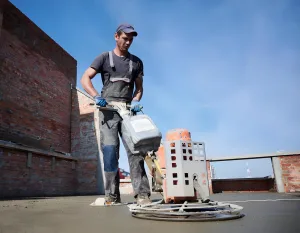
For contractors who also handle surface prep, the mixer is only one part of the kit. A project that ends with slab finishing may also need a power trowel for final surface density and a concrete cutter for joints or repair cuts. Thinking in workflow terms helps avoid buying a mixer that is faster than the rest of the crew can use.
Power source, mobility, and site conditions for a cement mixer guide
Power availability often decides the best mixer before capacity does.
Gasoline and diesel engines are useful where grid power is not reliable, while electric models fit enclosed sites, urban repairs, and work areas with stable supply. If the crew works in parking structures, inside warehouses, or in city maintenance zones, electric operation can simplify logistics and reduce local exhaust issues. If the machine will be moved repeatedly from truck to curbside to slab edge, wheel design, handle geometry, and overall weight matter as much as the motor.
Mobility also affects fatigue and safety. A lighter machine is easier to position, but excessively low mass may reduce stability during charging and discharge. In real jobsite use, a concrete mixer machine should be easy to move, easy to clean, and stable when loaded. That balance is often more valuable than one extra size class of drum capacity.
- Choose gasoline when the crew needs independence from site power.
- Choose diesel when durability and fuel economy matter on larger outdoor jobs.
- Choose electric when indoor use, ventilation, or low-noise operation is a priority.
- Check whether the mixer can be loaded, cleaned, and stored by one or two workers safely.
For road and patch contractors, mobility matters because the same crew may also use asphalt cutter equipment and compaction tools in the same shift. A mixer that is easy to transport can reduce downtime between operations.
How to compare concrete mixer machine specifications before buying
Specification sheets should be compared as a system, not one line at a time.
The most important fields are nominal capacity, usable batch volume, drum speed, power type, loading height, and maintenance access. Mixing performance is influenced by drum geometry and rotation speed, but more speed is not automatically better because overmixing can increase heat and wear. In concrete testing and production control, time, sequence, and uniformity matter. That is why the ASTM method ASTM C172/C172M emphasizes representative sampling of fresh concrete from the middle portion of the batch rather than the first or last discharge.
| Specification | Why it matters | What to check |
|---|---|---|
| Nominal capacity | Shows drum size | Compare with usable working load |
| Drum speed | Affects mixing action | Match to material consistency |
| Power type | Controls deployment flexibility | Gas, diesel, or electric |
| Discharge height | Influences labor effort | Match wheelbarrows or forms |
| Maintenance access | Reduces downtime | Cleaning, belts, bearings, controls |
Procurement teams should also verify serviceability. Bearings, belts, drum liners, and switches are common wear points. A mixer with easy access for routine maintenance usually costs less over time than a cheaper machine with difficult cleanup or parts replacement.
Concrete quality, mixing time, and project performance
Concrete mixer machine selection affects concrete quality because fresh concrete is a process-sensitive material.
Mixing should be long enough to achieve uniform distribution of cement, aggregate, water, and admixtures, but not so long that segregation or unnecessary wear becomes a problem. The ASTM laboratory practice in ASTM C192/C192M uses a defined mixing sequence and 3-minute initial mixing time to help standardize test batches. Field crews do not always follow the same procedure, but the principle is the same: predictable sequence produces predictable results.

Quality control also depends on sampling and testing. Slump testing is commonly used to assess workability, and fresh concrete sampling is covered by ASTM C172/C172M. These standards matter because a mixer that produces uneven discharge can lead to variable workability, which in turn affects placing speed, finish quality, and strength consistency.
In practical terms, better mixing control can reduce rework on finishing crews. A slab that is easier to place and consolidate usually costs less to finish than one that arrives inconsistent or partially set.
- Keep water addition controlled and documented.
- Load aggregates and cement in a repeatable sequence.
- Inspect discharge uniformity before placing the first batch.
- Clean the drum promptly to avoid build-up that changes future mixing behavior.
Buying checklist for contractors, dealers, and maintenance teams
A good buying checklist reduces the risk of undercapacity, overcapacity, and hidden operating cost.
Contractors should test the machine against actual job conditions, not just brochure claims. Dealers should confirm whether the product is suitable for frequent relocation, and maintenance teams should ask how quickly standard wear parts can be serviced. For many buyers, the real question is not “What is the biggest mixer?” but “What mixer will keep my crew productive every day?”
- Define the average batch volume per hour.
- Confirm whether the job site has stable electricity or requires fuel power.
- Check loading and discharge ergonomics for your crew size.
- Review cleaning access, belt access, and bearing access.
- Compare transport height, wheel design, and overall weight.
- Ask for spare-part availability and service response time.
If your operation also includes finishing and road maintenance, it may be efficient to source a complete workflow package that includes a mixer, ride-on trowel, and compaction equipment from the same supplier. That approach can simplify training and parts planning.
Common mistakes when you choose a concrete mixer
The most common mistake is buying by capacity label instead of real working volume.
Many buyers also ignore power access, which causes delays when a machine cannot run where the work is actually performed. Another frequent mistake is underestimating cleaning time. Concrete residue can harden quickly, and a machine that is difficult to wash down loses productivity every day. Finally, some buyers focus only on purchase price and ignore wear parts, which increases total cost of ownership.
| Mistake | Typical consequence | Better approach |
|---|---|---|
| Buying only by nominal capacity | Mismatch with actual batch needs | Match usable output to project schedule |
| Ignoring power source | Jobsite incompatibility | Confirm fuel or electricity first |
| Overlooking cleaning time | Lost labor hours | Check drum access and washout workflow |
| Choosing price over serviceability | Higher downtime | Review parts and maintenance support |
For road and floor crews, avoiding these mistakes is often the difference between smooth daily production and recurring delays.
FAQ about concrete mixer machine selection
What size concrete mixer do I need for small projects?
A 120 L to 200 L mixer is usually enough for small repairs, patching, and light residential work, especially when mobility matters more than volume.
Should I choose a gasoline, diesel, or electric concrete mixer?
Choose gasoline for portable outdoor work, diesel for heavier field duty, and electric for stable power sites, indoor work, or lower-emission environments.
What is the most important spec when I choose a concrete mixer?
Usable batch volume is often more important than nominal drum size because it determines how much concrete the crew can actually place per cycle.
How do I know if a mixer will produce consistent concrete?
Look for stable drum design, clear mixing procedure, and a supplier that can explain maintenance, discharge, and cleaning workflow in detail.
How often should a concrete mixer be cleaned?
It should be cleaned immediately after use, because hardened residue changes future mixing behavior and increases wear.
Is a larger concrete mixer always better?
No. A larger mixer can reduce portability, increase handling time, and become inefficient on small or frequently moved jobs.
Can one mixer work for both road repair and floor work?
Yes, if the capacity, mobility, and power setup match both scenarios, but some projects benefit from different equipment combinations for better workflow.