- Uneven finish is usually a process problem, not just a machine problem.
- Blade pitch, slab timing, and pass overlap have the biggest impact on surface uniformity.
- Floor flatness is governed by standards such as ASTM E1155 for FF and FL measurements.
- A correct trowel finishing fix starts before the machine runs: mix, placement, bleed water, and curing all matter.
Uneven concrete from a power trowel is a common finishing defect, and the remedy usually begins with concrete floor finishing discipline rather than a hardware swap. For industrial slabs, a finish that looks acceptable to the eye can still miss floor-flatness targets measured under ASTM E1155, which uses F-number values to quantify FF and FL. If the slab is being used for racks, forklifts, or parked vehicles, small undulations can turn into operational problems fast. On job sites that also rely on floor grinders or concrete cutting machines, a bad finish becomes expensive twice: first in rework, then in corrective surface preparation.
Why a power trowel leaves an uneven concrete surface
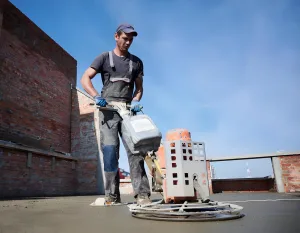
A power trowel leaves an uneven concrete surface when the slab condition and finishing sequence do not match the machine’s action. The trowel is only one part of the system; concrete bleed rate, aggregate exposure, evaporation, and operator timing decide whether the blades polish or tear the paste.
The most common cause is starting too early, when bleed water is still present. That traps water at the surface, weakens the paste layer, and creates smearing, mottling, or blade chatter. Starting too late creates the opposite problem: the slab begins to set, the blades dig in, and the surface can become ridged or burnished in bands.
Concrete mix behavior matters too. A low-slump or fast-setting mix gives a much shorter finishing window than a normal plastic mix. Hot weather, wind, low humidity, and high solar load reduce that window further by accelerating evaporation. In practice, that means a crew may need to shift from a heavy floating pass to lighter finishing passes earlier than expected.
Machine setup is the third cause. Blade pitch, rotor speed, and weight distribution all influence how aggressively the blade cuts the surface. A small pitch error can be enough to leave spiral marks or high-and-low bands, especially on a slab with inconsistent consolidation. For larger projects, a properly selected machine from the power trowel lineup is only effective if the operator matches the tool to the floor area and the concrete’s maturity.
| Common cause | What it looks like | Typical field clue | Likely correction |
|---|---|---|---|
| Too early finishing | Smearing, tearing, soft surface | Shiny water film remains | Wait for bleed water to dissipate |
| Too late finishing | Ridges, drag marks, chatter | Blades leave deep tracks | Begin finish earlier and reduce aggressiveness |
| Poor blade pitch | Wavy bands, spiral marks | Uneven cut across rotation path | Reset pitch in small increments |
| Wrong machine size | Inconsistent finish across slab | Overworked edges, missed center | Choose a better rotor diameter and weight class |
How to diagnose the trowel finishing fix step by step
The best trowel finishing fix is a diagnostic process, not guesswork. Start by checking the slab, then the machine, then the operator sequence. This avoids changing three variables at once and still not knowing which one caused the defect.
- Check whether bleed water is still visible across the slab surface.
- Inspect the concrete temperature, weather exposure, and set rate.
- Measure blade pitch and compare both rotors if the machine is dual-rotor.
- Verify that the machine is not crossing fresh lanes too soon.
- Look for edge damage, because edges often set differently from the middle.
A practical field test is to divide the slab into zones. If the center is smooth but the perimeter is wavy, the issue is often edge timing or access. If the machine leaves circular patterns everywhere, the cause is more likely pitch, pressure, or operator overlap. If only one side shows chatter, check rotor balance and blade wear.
Concrete flatness should also be measured rather than judged by appearance alone. ASTM E1155 defines floor-flatness and floor-levelness using statistical profile measurements, which is why a surface that “looks fine” may still fail a warehouse requirement. For projects with tighter tolerances, that measurement step prevents expensive disputes and avoids premature grinding.
| Diagnostic check | What to observe | Interpretation | Action |
|---|---|---|---|
| Bleed water | Visible film or dark sheen | Too early to finish | Delay power trowel passes |
| Blade wear | Rounded or chipped edge | Poor surface engagement | Replace blades |
| Pitch setting | Mismatch between rotors | Uneven cut depth | Recalibrate pitch uniformly |
| Travel path | Missed overlap or abrupt turns | Operator pattern issue | Use consistent overlap and speed |
Power trowel settings that reduce uneven surface defects
Correct settings reduce uneven concrete more reliably than extra passes. A power trowel should be set to match the slab stage: floating for correction, finishing for refinement. Too much aggression early will close the surface unevenly; too little aggression late will leave the slab textured and inconsistent.
Blade pitch is the most important variable because it controls the angle of attack. Lower pitch is safer for early passes, while higher pitch is used for final finishing. The adjustment should be incremental, especially on large slabs where the blade path magnifies small errors. Many operators make the mistake of adding pitch to “fix” a rough finish, but if the concrete is still soft, that often worsens the surface.
Rotor speed also matters. Higher speed can improve finish quality when the slab is ready, but excessive speed on a partially set floor can create burn marks and micro-rippling. Matching RPM to slab condition is better than running at maximum speed by default. On a broad industrial floor, consistent overlap and controlled turns matter more than raw rotor speed.
For crews handling multiple site conditions, a mixed fleet can help. A compact plate compactor may be used for adjacent base preparation, while the trowel handles the finish stage. That workflow matters because poor subgrade compaction can show up later as uneven settlement, which no finishing pass can truly fix.
Why concrete timing affects power trowel results
Concrete timing is the deciding factor behind most uneven finishing defects. The same machine can produce an excellent floor on one slab and a bad one on the next if the mix, weather, and waiting time are different.
Bleed water must exit before finishing begins. If the surface is closed too early, moisture gets trapped and the paste layer weakens. If the crew waits too long, the surface loses plasticity and the trowel starts dragging. This is why experienced finishers watch the slab, not the clock.
Evaporation control is especially important in hot or windy conditions. A concrete surface can dry faster than expected under strong air movement, which narrows the finishing window. In these situations, crews often use shade, wind breaks, or adjusted scheduling to keep the surface workable longer. That is a process fix, not a machine fix, but it directly affects whether a power trowel leaves an even surface.
The site environment also changes finish behavior. On a parking deck or outdoor pavement, sunlight and wind create different set zones across one pour. On a warehouse slab, the center can lag the perimeter because of airflow and slab thickness differences. Good crews plan finishing routes based on that variation instead of treating the slab as uniform.
How floor flatness standards explain what “uneven” really means
Uneven concrete is not just a visual complaint; it is a measurable performance issue. ASTM E1155 is the main reference for concrete floor flatness and levelness in many industrial applications, because it translates surface profile into FF and FL values rather than relying on visual judgment.
That standard matters because the same surface can feel acceptable during hand inspection but still cause forklift vibration, pallet rack instability, or water ponding. In warehouses and logistics centers, floor flatness influences both safety and operating cost. A floor that is slightly out of spec can force secondary grinding or patching, especially where high-bay storage or automated handling is involved.
When the job is more about durability than aesthetics, specs from related standards also matter. For example, ASTM C494/C494M covers chemical admixtures used to modify setting characteristics, which indirectly affects finishing time and trowel window. On a job where finish quality is critical, admixture selection should be reviewed before the pour, not after the defect appears.
| Standard | What it controls | Why it matters to finishing | Typical field use |
|---|---|---|---|
| ASTM E1155 | FF and FL measurement | Defines whether the floor is truly flat | Warehouses, industrial slabs |
| ASTM C494/C494M | Admixture performance | Changes set time and workability | High-performance concrete mixes |
| ACI guidance | Construction practice | Links mix, placement, and finishing | General slab finishing planning |
What crews can do on site to prevent uneven finishing
Uneven finishing is easier to prevent than to repair. A disciplined sequence before and during the pour lowers the risk of ridges, chatter, and surface waviness.
- Confirm the concrete mix, slump, and set behavior before placement.
- Assign one person to watch bleed water and another to monitor edge timing.
- Adjust power trowel pitch in small steps, not large jumps.
- Keep travel overlap consistent so rotor paths do not create banding.
- Finish edges separately when the slab perimeter sets faster than the center.
One of the most overlooked steps is edge management. The perimeter of a slab often sets differently because it is exposed to more air and loses moisture faster. If the crew waits for the center to be ready, the edges can become too hard to finish cleanly. In that case, the fix is to stage the work: edge first, field second, final pass last.

Another practical prevention tactic is equipment matching. A small slab does not need the same trowel footprint as a distribution center floor. When the machine is oversized, the operator may chase the slab instead of controlling it. That is where a smaller machine or a different finishing sequence can outperform a heavier unit.
When the problem is not the power trowel at all
Not every uneven concrete problem comes from the trowel. Sometimes the root cause is upstream in the slab system, and the trowel only reveals it.
Poor consolidation can create low spots and honeycombing near reinforcement or around embeds. Uneven base support can create thickness variation that becomes visible after curing. Inadequate joint planning can create stress concentrations that later show up as cracking or localized curling. None of those issues are solved by making more passes with the trowel.
That is why project teams often pair finishing equipment with preparation equipment. A compaction tool from the rammer category may be used on confined subbase areas, while a larger slab is finished with a power trowel. If the base is unstable, the finish will not stay even no matter how polished it looks on day one.
In repair scenarios, the right sequence may involve diamond grinding rather than trying to re-finish the slab. If the floor already hardened with waves or humps, surface correction is often more predictable with grinding than with rewetting and troweling, which can introduce more defects.
Choosing the right power trowel for a smoother floor
The right power trowel choice affects how easily a crew can achieve an even finish. Machine size, control layout, blade type, and power source all influence consistency.
Walk-behind units are often better for smaller slabs, tighter spaces, and edge work. Ride-on units are more efficient on larger floors where uniform coverage matters. If a project includes both open areas and narrow transitions, many crews use a combination of machines rather than forcing one tool to do everything.
Power source also matters in field logistics. Gasoline engines are common on mobile sites, while diesel options are often favored where fuel handling and runtime matter more. The best choice is the one that fits the site, the pour schedule, and the operator’s skill level.
For contractors who need a broader slab workflow, equipment often works best as a system: base compaction, slab placement, power trowel finishing, cutting, and surface correction. That is why a full construction equipment catalog is useful for planning, not just buying.
| Job type | Recommended trowel approach | Main risk | Control point |
|---|---|---|---|
| Small warehouse bay | Walk-behind finishing | Edge overwork | Use shorter passes |
| Large logistics floor | Ride-on finishing | Banding across lanes | Keep overlap uniform |
| Outdoor slab | Weather-sensitive timing | Rapid surface set | Monitor evaporation and shading |
| Repair area | Localized correction | Visible transition lines | Blend passes into surrounding slab |
Practical repair options for an already uneven concrete floor
Once a floor is uneven, the repair choice depends on severity and use case. Light waves may be corrected by grinding, while deeper ridges, curled joints, or widespread flatness problems may require overlay or partial replacement.
If the defect is cosmetic and shallow, a controlled grinding pass can remove high spots and improve wheel travel. If the defect affects drainage or rack placement, the team should measure the floor first and then decide whether to grind, patch, or overlay. Trying to “trowel it flat again” after set is usually ineffective and can weaken the surface bond.
The best repair decision is based on measured deviation, not emotion. For many commercial floors, the cost of repeated patching exceeds the cost of a planned correction strategy. That is why floor preparation, finishing, and post-cure inspection should be linked as one quality-control chain.
FAQ
Why does my power trowel leave swirl marks?
Swirl marks usually come from blade pitch, overlap inconsistency, or starting the finish before the concrete is ready. The most effective fix is to reduce aggressiveness, confirm blade condition, and make smoother overlapping passes.
Why is the concrete smooth in some places and rough in others?
Mixed texture usually means the slab set unevenly across zones. Edge areas, sunny areas, and thin areas often finish differently from the center. Route planning and timing corrections usually solve the problem better than extra passes.
Should I increase RPM to fix an uneven finish?
Not automatically. Higher RPM can help only if the slab is ready and the pitch is correct. If the concrete is still too soft or already too hard, more speed often makes the surface worse.
How do I know if the slab was finished too early?
If the surface smeared, tore, or trapped moisture, it was likely finished before bleed water had cleared. A sheen or visible water film is a strong warning sign.
What standard measures floor flatness on industrial slabs?
ASTM E1155 is the key reference for measuring floor-flatness and floor-levelness using FF and FL values.
Can a bad concrete mix cause uneven trowel marks?
Yes. Set time, workability, and admixture selection all affect the finishing window. Mix behavior can be as important as machine setup.
When should I grind instead of re-trowel?
Grind when the slab is already hardened and the problem is a high spot, wave, or local surface mismatch. Re-troweling after set rarely restores uniformity and may damage the slab surface.