
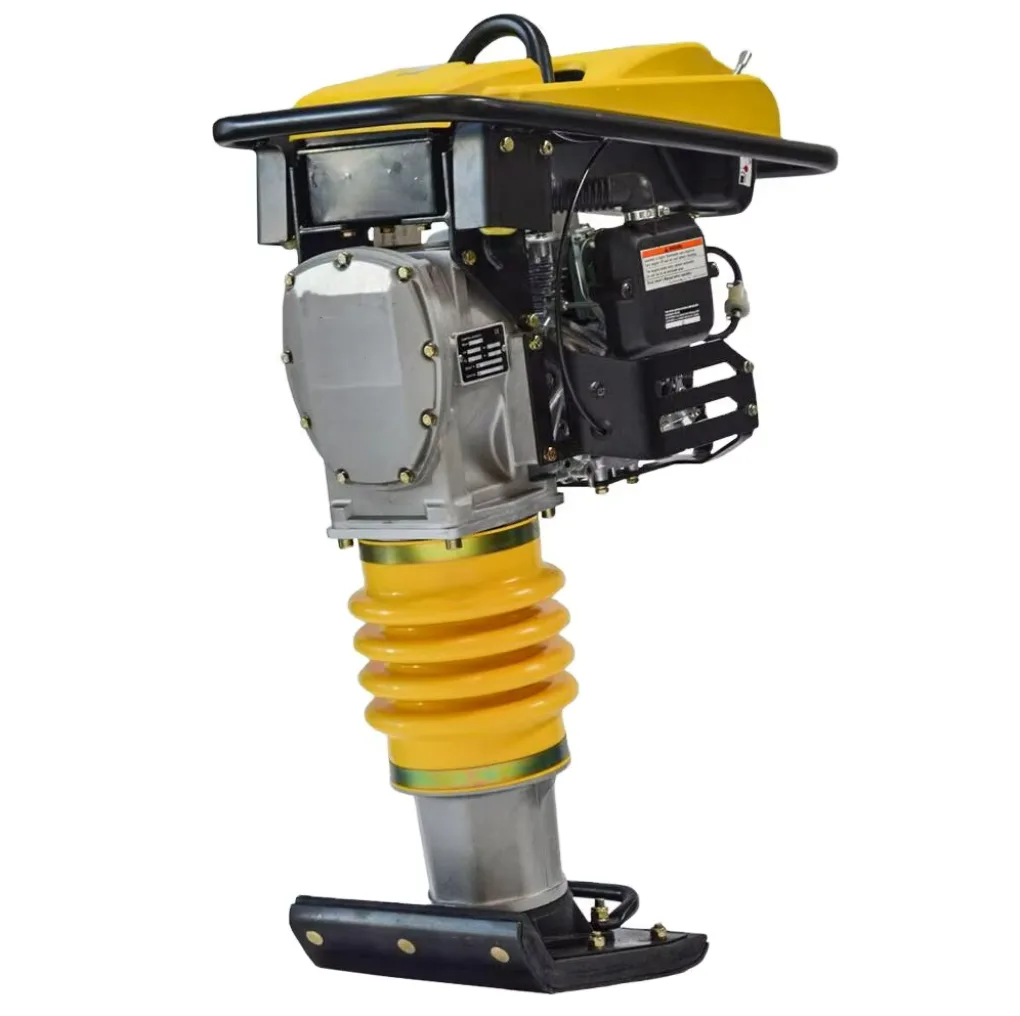
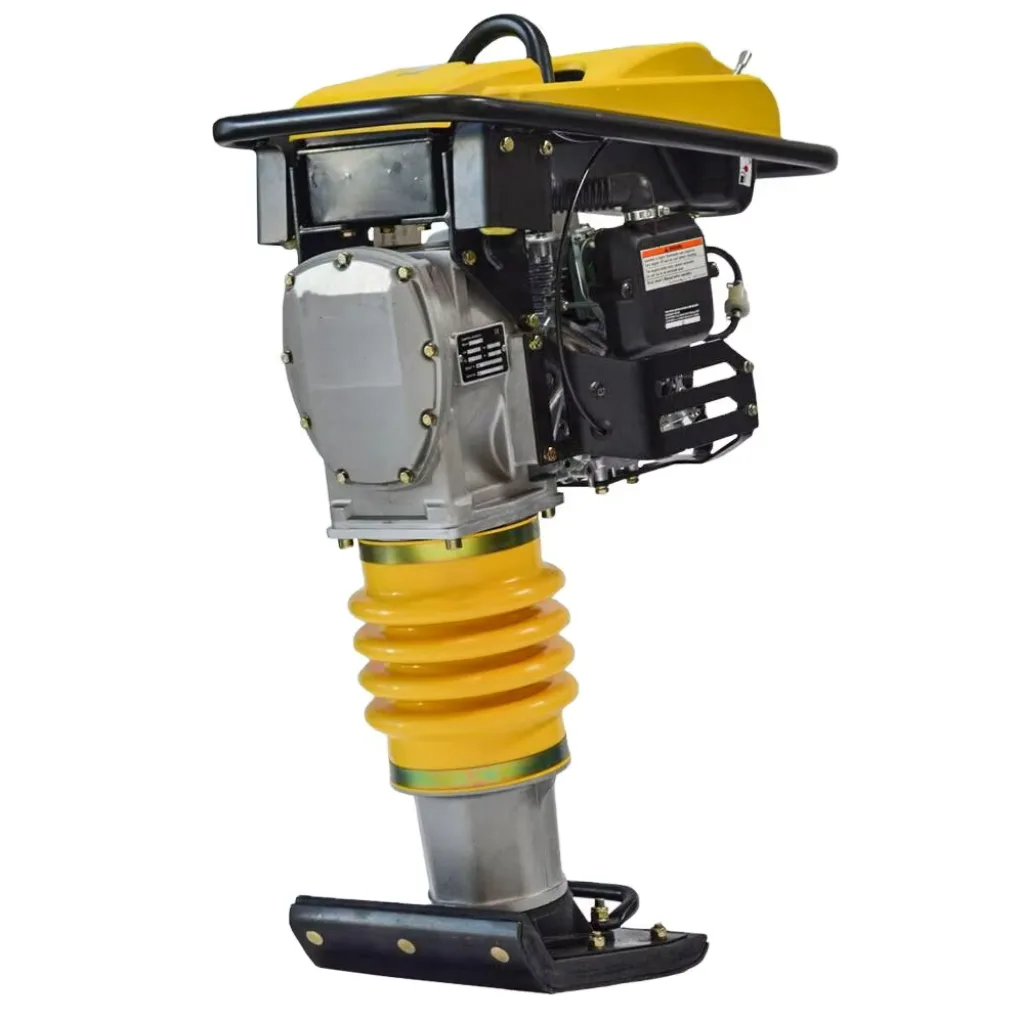
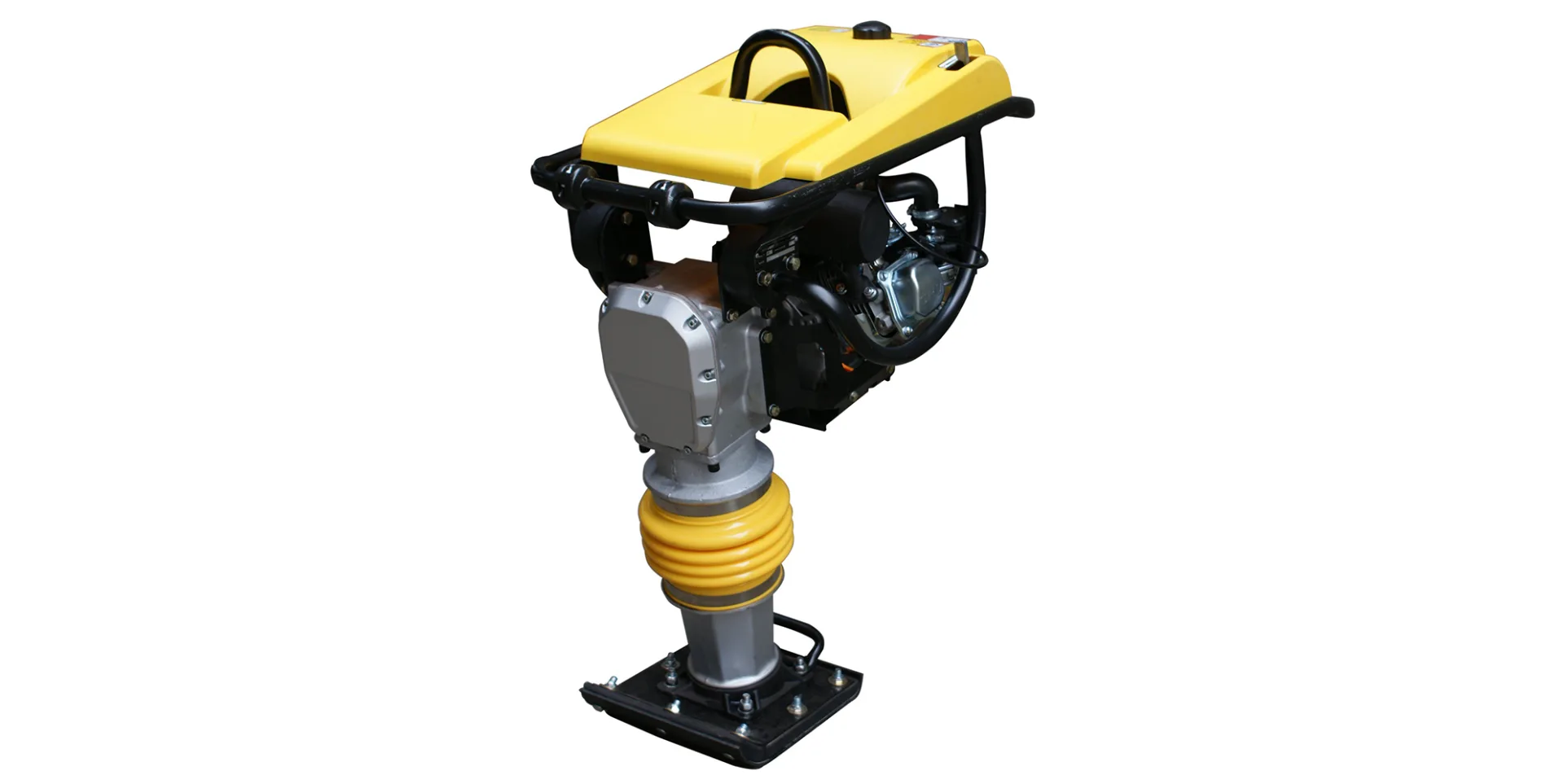
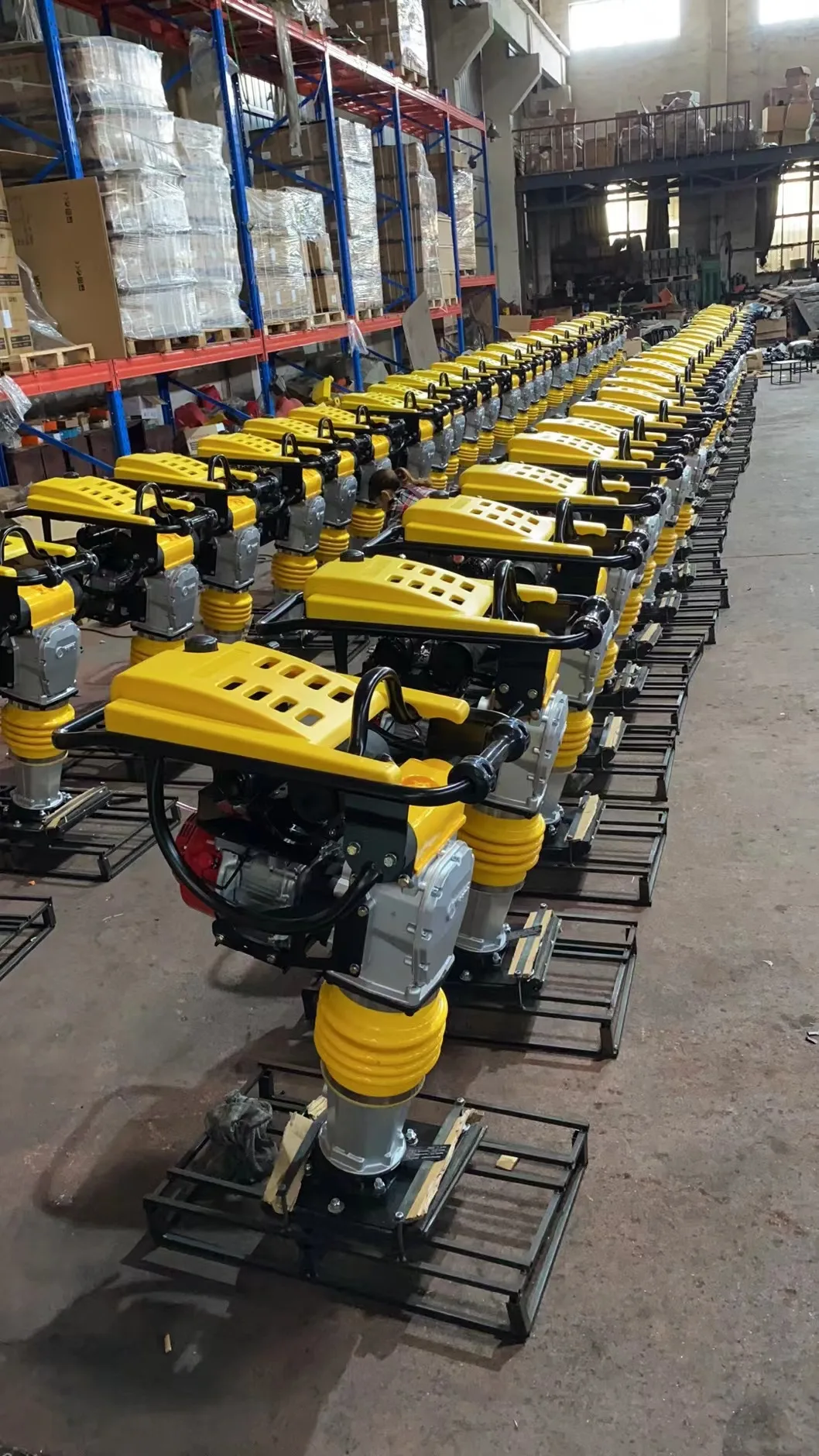
A tamping rammer is a handheld compaction machine that uses an internal combustion engine or electric motor to drive a crank-connecting rod mechanism, generating high-frequency reciprocating impact motion to deliver vertical impact force to the soil for deep-layer compaction–. Rammers cover three types of compaction action — impact, vibration, and kneading–. They are particularly effective for deep compaction of cohesive soils (clay, silty clay)– and remain the irreplaceable equipment for confined-space applications such as trench backfill, bridge abutment edges, and foundation corners–. Tamping rammers are classified by power source into internal combustion engine-driven (gasoline/diesel) and electric-driven types–.
Working Principle & Technical Parameters
A tamping rammer primarily consists of an engine (or electric motor), a crank-connecting rod mechanism, a spring system, a base plate, and a handle. During operation, engine power is transmitted via coupling to the gear shaft, driving the crankshaft to rotate, which in turn drives the push rod through the connecting rod in a reciprocating up-and-down motion–. The spring system absorbs and releases energy, causing the rammer to bounce rapidly, and the base plate delivers vertical impact force to the material being compacted at a specific impact frequency and jump height, achieving compaction–.
Tamping rammers cover three types of compaction action — impact, vibration, and kneading–. Impact provides the primary compaction energy; vibration helps rearrange soil particles; kneading further densifies soil particles. The synergy of these three actions makes tamping rammers excel in cohesive soils. The compaction depth of tamping rammers is approximately 0.6-0.8m, yielding a hard permeable surface crust.
Core performance parameters include:
Impact Force: The most important technical specification of tamping rammers, directly corresponding to the degree of soil compaction. Common models deliver 8-14kN impact force–. Impact pressure is a function of the base plate area, kinetic energy, and the deformation properties of the soil.
Jump Height: Typically 40-80mm–. Jump height affects the energy magnitude of each impact.
Impact Frequency: Typically 450-700 times per minute–. Higher impact frequency means greater compaction energy per unit time.
Advance Speed: Typically 9-13m/min–.
Plate Size: Typically 300×280mm to 330×285mm–.
Product Classification
By power source, tamping rammers are divided into internal combustion engine-driven (gasoline) and electric-driven types–.
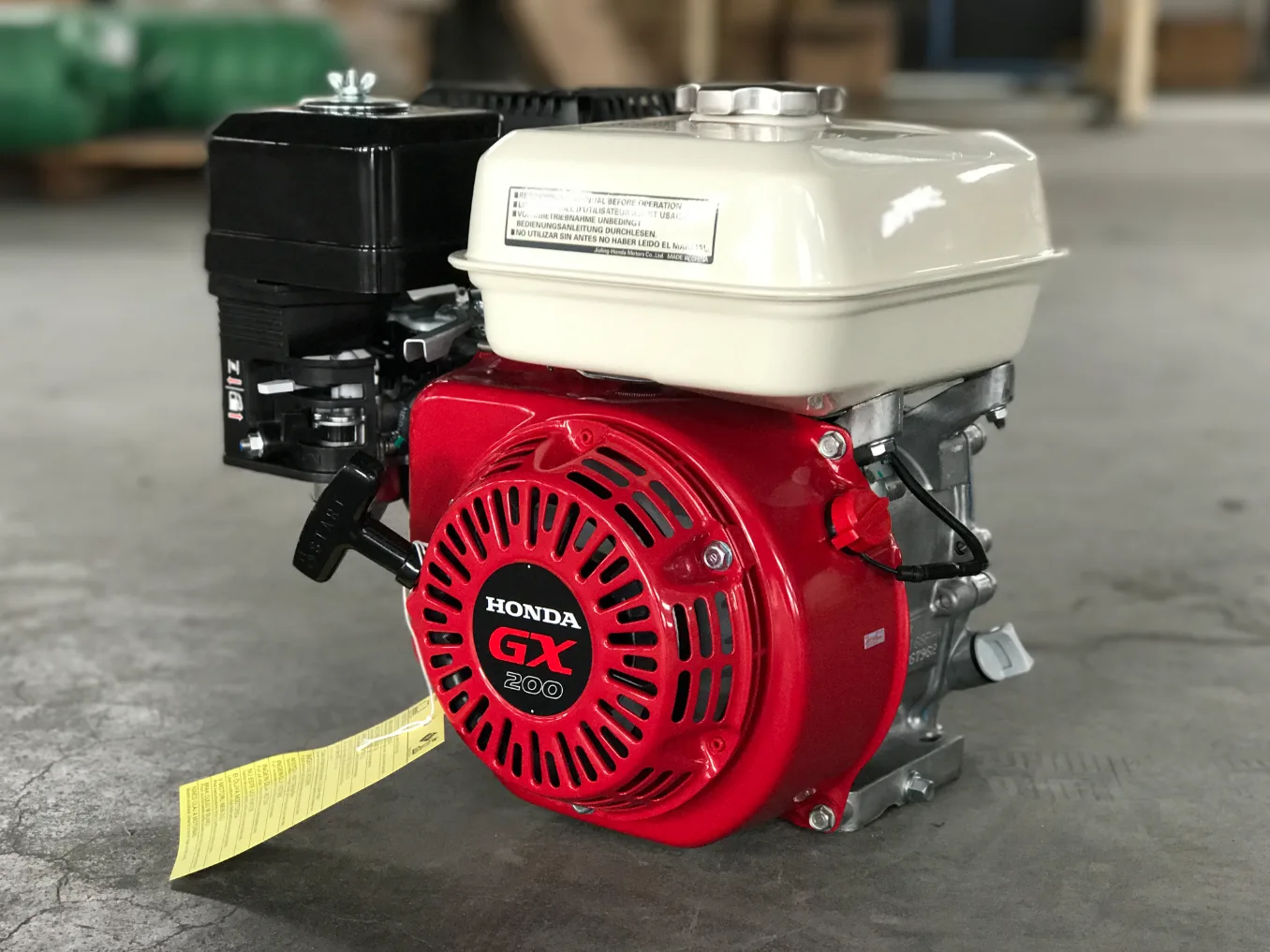
Gasoline Tamping Rammer: Powered by a gasoline engine, with common power ratings of 5.0-6.5HP (e.g., Robin EY20, Honda GX160 models)–. No fuel-oil mixing required, offering more efficient and economical operation–. Ideal for field environments without power supply and for mobile operations.
Diesel Tamping Rammer: Powered by a diesel engine, providing higher torque at low RPM with better fuel economy, suitable for extended continuous operation and high-intensity applications.
Electric Tamping Rammer: Powered by an electric motor, suitable for indoor or enclosed environments with strict emission and noise requirements.
Applications
Tamping rammers are specifically designed for tough compaction applications in confined areas, trench work, backfill, and asphalt repair–. Key application scenarios include–:
Trench backfill: Protecting pipes and underground cables from soil shifts
Backfill around foundations and forms: Compacting restricted areas such as building foundations, bridge abutment backs, and culvert sides
Backfill compaction after pipe and cable laying
Subgrade preparation for concrete slabs, curbs, and gutters
Asphalt repair work: Compacting asphalt surfaces in patched areas
Roadbed compaction: Suitable for roadbeds with low water content and confined sites–
Municipal side ditches, manhole perimeters, and pipe-side compaction
Tamping rammers are particularly suitable for construction in confined environments where large and medium-sized machinery cannot access — including buildings, grounds, roadbeds, bridge abutments, trenches, field sites, and narrow spaces–.
Product Features
Powerful Impact: High impact force and high impact frequency (450-700 times/min) deliver exceptional deep-layer compaction performance on cohesive soils (clay, silty clay)–. For clay, silty clay, and mixed-grain soils, tamping rammers provide deep compaction–.
Confined-Space Adaptability: Compact size, light weight, and narrow base plate allow flexible operation in restricted spaces such as trenches and foundation corners where large equipment cannot enter–.
Three Compaction Actions in Synergy: Impact, vibration, and kneading work together to ensure thorough soil particle densification–.
Multiple Power Options: Available in gasoline, diesel, and electric configurations to suit diverse working conditions and environmental requirements–.
Ergonomic Design: 4-point vibration isolation and shock-absorbing handle design significantly reduce operator fatigue and extend component service life–. Ratchet-type throttle control maintains constant engine speed throughout all stages of operation–.
Durable Construction: Reinforced steel structure with high-quality spring steel wire, heavy-duty design capable of withstanding extended high-intensity operation–.