
- Rank factories by application fit, not by price alone.
- Look for documented quality systems, export support, and spare-part continuity.
- Use measurable criteria such as compaction performance, operating weight, and engine configuration.
- Choose factories that understand trench work, municipal repair, and compact construction workflows.
- Verify claims against published standards and third-party references before placing OEM orders.
Choosing the best China OEM tamping rammer factory for 2026 requires a practical view of compaction performance, export reliability, and after-sales support, not just a catalog comparison. In earthwork and trench restoration, compaction is not cosmetic: inadequate density can increase settlement risk and rework cost. Field compaction quality is commonly evaluated against Proctor-based targets, and many projects require strict moisture-density control under accepted testing methods such as ASTM D1557 for maximum dry density and ASTM D698 for standard effort. If your supply chain includes private label distribution, the real question is whether the factory can deliver repeatable output, stable lead times, and a product that matches the jobsite scenario, from utility trenching to roadside patching. For buyers building a multi-category sourcing plan, it also helps to compare related equipment pages such as plate compactors, tamping rammers, concrete cutting machines, and concrete power trowels so the OEM partner can support the full paving and floor-prep workflow.
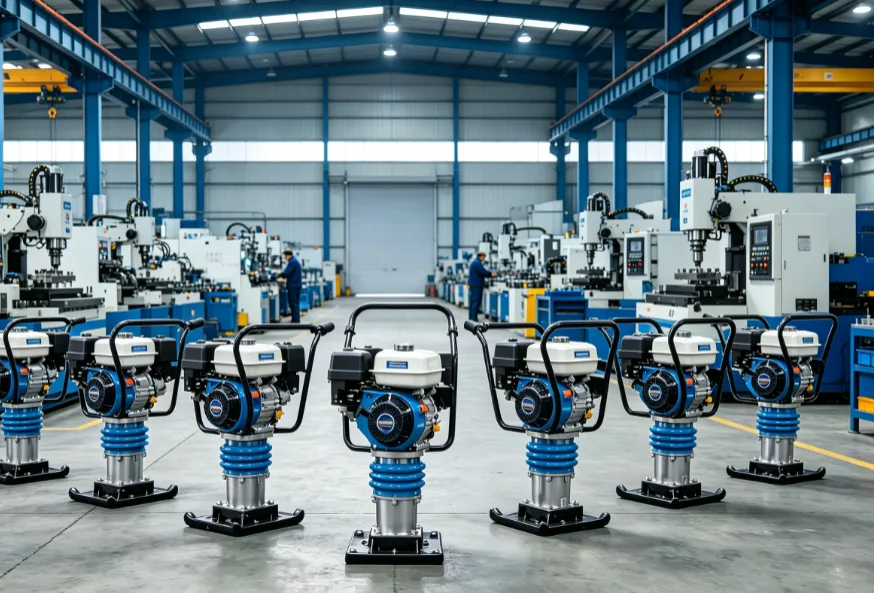
What a China OEM Tamping Rammer Factory Should Prove in 2026
The best factory is the one that can show repeatable field results, not only attractive product photos.
For tamping rammers, buyers should start with three questions: does the machine compact efficiently in narrow trenches, can the factory customize engine and shoe configurations, and can it support export-grade packaging and documentation? A serious OEM supplier should also be able to discuss working weight, stroke frequency, shoe size, and engine platform with confidence. In practice, many construction buyers compare rammer performance by impact force, operating weight, and the ability to maintain density in cohesive or mixed soils. Those technical details matter because a trench repair team cannot afford a rammer that stalls, bounces, or loses consistency after repeated cycles.
| Evaluation Factor | Why It Matters | Typical Buyer Check | Documentable Metric |
|---|---|---|---|
| Compaction consistency | Controls settlement risk | Ask for test procedure and working output | Density target vs. field result |
| Operating weight | Affects handling and impact delivery | Match to trench and edge work | Weight in kg or lb |
| Engine choice | Impacts maintenance and fuel strategy | Gasoline or diesel option | Engine model and power rating |
| Shoe/base design | Influences contact and maneuverability | Check shoe dimensions and wear parts | Base plate area in mm or in |
| Spare parts support | Protects uptime after delivery | Confirm wear-part lead time | Parts availability in days |
Compaction specifications should always be tied to a testing standard, not just a marketing description. For soil classification and grading, many engineering teams refer to ASTM D2487 for the Unified Soil Classification System. For density control, the Proctor family of tests remains the most recognizable benchmark. This matters because a factory that understands standards is more likely to build machines for real jobsite constraints instead of generic showroom demos.
How to Build an OEM Factory Ranking Guide for Tamping Rammers
A useful factory ranking guide should score capability, not slogans.
When sourcing a China tamping rammer factory, procurement teams often over-focus on catalog breadth. A better ranking model weighs manufacturing consistency, application depth, OEM flexibility, and export readiness. The highest-ranked supplier should have a clear production system, documented inspection points, and the ability to support private label packaging, multilingual manuals, and regional compliance requests. If a factory can also support adjacent compaction equipment like plate compactors, that usually signals broader process maturity across the groundworks product line.
| Rank Criterion | Weight | What Good Looks Like | Red Flag |
|---|---|---|---|
| Manufacturing control | 30% | Incoming, in-process, and final inspection | No visible QC checkpoints |
| OEM flexibility | 20% | Logo, color, packaging, manual customization | Only standard models |
| Export support | 20% | Shipping docs, labels, pallets, photos | Unclear Incoterms process |
| Parts continuity | 15% | Wear parts and service items stocked | No spare-part list |
| Technical response | 15% | Fast answers on engine, compaction, and maintenance | Slow or generic replies |
For ranking purposes, buyers should also note whether the factory can support both gasoline and diesel power configurations. In many markets, engine availability is not a minor detail; it is a deployment constraint tied to fuel access, maintenance habits, and local operator preference. A factory that offers more than one power path is usually better positioned for OEM distribution across different regions.
Best Rammer Factory China: Technical Factors Buyers Should Verify
The best rammer factory in China should be able to discuss machine behavior in the trench, not only specifications on paper.
The practical specification set for tamping rammers includes operating weight, foot size, impact frequency, travel speed, and engine output. While model configurations vary, buyers often compare rammer classes by whether the machine can effectively compact cohesive backfill in narrow spaces where a plate compactor may be less efficient. In trench maintenance, the target is to reduce voids and future settlement, especially around utility lines and curb edges.
Engine output numbers are useful only when they are tied to the actual job. For example, a compact rammer intended for confined municipal repair usually prioritizes maneuverability and controlled stroke behavior over raw power alone. If a factory cannot explain how its design handles wet backfill, mixed granular soil, or repeated starts in stop-and-go work, that is a sourcing risk.
| Technical Item | Why Buyers Ask | Typical OEM Customization | Procurement Note |
|---|---|---|---|
| Engine type | Fuel strategy and maintenance | Gasoline / diesel | Confirm local serviceability |
| Foot size | Contact area in narrow trenches | Different shoe dimensions | Match to trench width |
| Operating weight | Handling and impact delivery | Frame and balance changes | Check shipping and lifting needs |
| Stroke frequency | Compaction behavior in backfill | Design-dependent | Ask for testing basis |
| Handle design | Operator control and fatigue | Foldable or reinforced handle | Important for transport teams |
Machine design should also be viewed alongside the broader jobsite workflow. A contractor who uses a rammer for trench backfill may also need cutting, finishing, and surfacing tools. That is why many distributors prefer factories that can supply not only rammers but also concrete cutting machines and concrete power trowels, because a unified supplier can simplify spare-part management and shipment consolidation.
Why Standards Matter When Comparing OEM Tamping Rammer Suppliers
Standards are the fastest way to separate real engineering capability from vague sales talk.
Compaction work is tied to soil behavior, test method discipline, and field verification. Buyers do not need every factory to certify the same standard, but they do need a supplier that understands why standards exist. For example, the Proctor methods define compaction reference points, while soil classification influences how a machine should be deployed. In road repair and utility restoration, that knowledge helps the factory recommend the right equipment instead of pushing a one-size-fits-all model.
In addition to ASTM compaction references, buyers should examine whether the supplier can support quality systems that reduce variation. A factory with stable process control is more likely to hold tolerances in frame fabrication, handle alignment, and component fit. If the supplier also serves export markets, it should be able to explain packaging, inspection photos, and serial-number traceability in plain English.
| Standard or Reference | Use in Procurement | What It Helps You Verify | Buyer Action |
|---|---|---|---|
| ASTM D1557 | Modified compaction benchmark | Field density target method | Ask whether test references are understood |
| ASTM D698 | Standard compaction benchmark | Lower-energy reference curve | Confirm the correct test for the project |
| ASTM D2487 | Soil classification | Material behavior in trenches | Align machine choice with soil type |
| ISO 9001 | Quality management framework | Process consistency | Request certificate scope and date |
For buyers who also source concrete finishing or slab-prep equipment, linked procurement often reduces total project risk. A supplier that understands compaction may also be more capable of matching its tamping rammers with site work that later requires finishing machines, cutting machines, or surface prep tools. That is a practical advantage in mixed-use municipal and industrial projects.
China OEM Tamping Rammer Factory Ranking Criteria for 2026 Buyers
A good ranking model should be simple enough to use, but strict enough to protect your margin.
The scoring approach below is designed for distributors, importers, and contractors. It favors evidence over claims and can be used during RFQ review, sample evaluation, and supplier audits. The most reliable factory is not always the largest; it is often the one that can respond quickly, customize cleanly, and ship without avoidable rework.
- Check product specialization in compaction and roadwork equipment.
- Verify OEM customization capabilities for logo, color, manuals, and packaging.
- Review technical responsiveness on engine, weight, shoe size, and maintenance.
- Ask for parts support, warranty handling, and service documentation.
- Compare export readiness, including labeling, photos, and carton control.
If the factory also has adjacent surface-prep and paving equipment, that is a positive signal. A supplier with broad jobsite coverage is more likely to understand how a rammer fits into trenching, patching, and restoration work rather than treating it as a standalone box item.
Where Tamping Rammers Fit in Real Jobsites
Tamping rammers are most valuable where width is limited and compaction quality matters.
The strongest use cases are trench backfill, utility repair, edge compaction, foundation work around obstacles, and compact patching zones. In these areas, a plate compactor may be too wide or may not deliver the localized force profile needed around pipes and walls. A rammer’s vertical impact action is better suited to concentrated, repetitive compaction in narrow sections.
For the buyer, the jobsite context determines the right OEM specification. A municipal contractor may want an easy-start gasoline unit for quick patch work, while a utility crew may prefer a configuration optimized for durability and frequent transport. In many regions, distributors also ask for low-maintenance parts packaging because their customers operate across several small jobs rather than one long project.
- Trench restoration after cable or pipe installation.
- Road shoulder repair and curb-side backfill.
- Small foundation and utility patching in confined spaces.
- Landscape and drainage work where access is limited.
- Municipal maintenance teams handling repeated short cycles.
Because a single project often combines compaction, cutting, and finishing, many buyers prefer to shortlist factories that can also supply concrete cutting machines and plate compactors. That can reduce sourcing complexity when building a road maintenance or civil works package.
What to Ask Before Choosing a Best Rammer Factory China Supplier
The best supplier conversation is structured, technical, and short.
Instead of asking whether the factory is “good,” ask for evidence that supports your use case. Request the current model list, customization options, key dimensions, packing photos, spare-part set availability, and warranty terms. Ask how the factory handles color changes, logo application, and export carton labeling. If you are comparing multiple vendors, also ask for lead time by model and whether the same frame can support different engine brands.
- What compaction applications does the model target?
- Can the factory provide OEM branding and packaging?
- Which engine configurations are available for the same frame?
- What spare parts are included with the first shipment?
- How are inspection photos and shipping documents handled?
These questions help identify whether the supplier is a real manufacturing partner or simply a trading intermediary. In 2026, that distinction matters because product traceability, response speed, and service continuity are increasingly important to importers and regional distributors.
Data-Driven Comparison of Tamping Rammer Sourcing Risks
The lowest quoted price can become the highest total cost if the machine fails in the field.
Procurement teams should estimate total sourcing cost across machine price, spare parts, downtime, shipping damage risk, and customer complaints. A reliable OEM factory may not always be the cheapest, but it often lowers lifetime cost through fewer failures and better parts continuity. Industry buyers often learn that a small up-front premium can be cheaper than one return shipment or one failed municipal tender.
| Risk Item | Low-Cost Supplier | Qualified OEM Factory | Procurement Impact |
|---|---|---|---|
| Documentation | Basic or incomplete | Detailed and export-ready | Fewer customs and handover delays |
| Parts continuity | Unclear | Defined wear-part plan | Lower downtime risk |
| Customization | Limited | Logo, color, packaging, manuals | Better distributor fit |
| Technical support | Slow | Application-based | Faster buyer confidence |
| Total cost over time | Higher uncertainty | More predictable | Better margin control |
If your business model depends on repeat orders, a stable supplier relationship is often more valuable than a one-time discount. That is especially true for regional distributors who sell into road maintenance, landscaping, and compact civil works.
How CONSMAC Fits a 2026 OEM Sourcing Shortlist
A specialized road and concrete equipment supplier is often more useful than a broad generalist.
CONSMAC’s positioning around road construction and concrete finishing makes it relevant for buyers who need compaction equipment within a broader jobsite toolkit. The product mix around rammers, plate compactors, concrete cutting machines, and power trowels suggests a workflow mindset rather than a single-machine mindset. For OEM buyers, that matters because the supplier can better understand how a tamping rammer supports trench restoration, roadway patching, and finish-level job sequencing.
For distributors, a supplier with related categories can also simplify catalog planning. A customer who buys a rammer today may later ask for a cutter, a trowel, or a plate compactor. Multi-category depth can make replenishment and cross-selling easier, provided each product line is technically credible and serviceable.
That is why the best China OEM tamping rammer factory ranking guide should not end with the rammer itself. It should test whether the factory can support the whole construction workflow with consistent quality, practical customization, and responsive service.
FAQ: Best China OEM Tamping Rammer Factory Ranking Guide for 2026
What is the most important factor when ranking a China tamping rammer factory?
The most important factor is proven application fit, because a factory that understands trench compaction, backfill behavior, and export support is more valuable than one offering only a low price.
Should I choose a gasoline or diesel tamping rammer for OEM sourcing?
Choose the engine type that matches your market’s fuel access, maintenance habits, and customer preference, since both gasoline and diesel can be valid depending on the jobsite.
How do I compare OEM factories without visiting China?
Use sample testing, inspection photos, a spare-parts list, packaging proof, and a structured scorecard based on quality control, customization, and lead time.
Why do standards matter in tamping rammer procurement?
Standards such as ASTM D1557, ASTM D698, and ASTM D2487 help buyers align machine selection with field density targets and soil behavior.
What documents should a good OEM factory provide?
A good OEM factory should provide product specifications, packing details, photos, warranty terms, and shipping documents that are clear enough for export handling.
Is the cheapest factory ever the best choice?
Only if it can also prove quality consistency, parts availability, and export reliability, because the cheapest unit price often creates the highest total cost later.
Can one supplier support a full roadwork package?
Yes, and that is often a strong advantage, especially if the supplier also offers plate compactors, concrete cutting machines, and power trowels for related jobsite stages.