
- Site efficiency in compaction is mainly about matching equipment to access, lift thickness, and material moisture.
- A tamping rammer is strongest in cohesive soils, trench backfill, and narrow confined areas where plate compactors are less effective.
- Real productivity gains come from correct lift control, preventive maintenance, and choosing the right shoe size, impact rate, and engine setup.
- For roadwork and ground preparation workflows, a rammer should be selected as part of a system that may also include plate compactors, concrete cutting machines, and power trowels.
Tamping rammer selection has a direct impact on site efficiency, especially in trench backfill, roadside repairs, and small-footprint foundation work. Compaction quality is not a guess: ASTM D698 defines the Standard Proctor test using a 5.5 lb rammer dropped 12 inches, while ASTM D1557 uses a 10 lb rammer dropped 18 inches, showing how impact energy changes achieved density behavior. For crews trying to improve rammer productivity, the real objective is stable density, fewer passes, and less rework, not simply more vibration. In road and utility jobs, this matters because a compact machine that can fit the space often saves more time than a larger unit with higher nominal power. When projects also involve material handling or finishing, teams often pair compaction with mixing machines and floor grinding machines to keep the whole workflow moving.
Why a tamping rammer machine improves site efficiency in tight construction zones
A tamping rammer machine improves site efficiency by delivering concentrated impact energy where the material is hardest to access.
Unlike a larger compaction unit, a rammer is designed for confined trenches, utility corridors, and backfill zones near walls, curbs, or pipe runs. In these areas, access often matters more than raw machine size. The U.S. Occupational Safety and Health Administration notes that trenches 5 feet deep or more generally require protective systems unless excavation is made entirely in stable rock, which is one reason compact, controllable equipment is favored in utility work OSHA Trenching and Excavation. A machine that can work safely in narrow openings reduces hand tamping, reduces waiting time, and lowers the chance of uneven lift density.
For contractors, efficiency is usually measured in passes, rework, and crew coordination. A rammer that reaches the target density in fewer passes can shorten the cycle between filling, compacting, and next-layer placement. That is especially important on municipal maintenance jobs, service line installations, and small foundation pads where the crew may be shared across multiple tasks in one day.
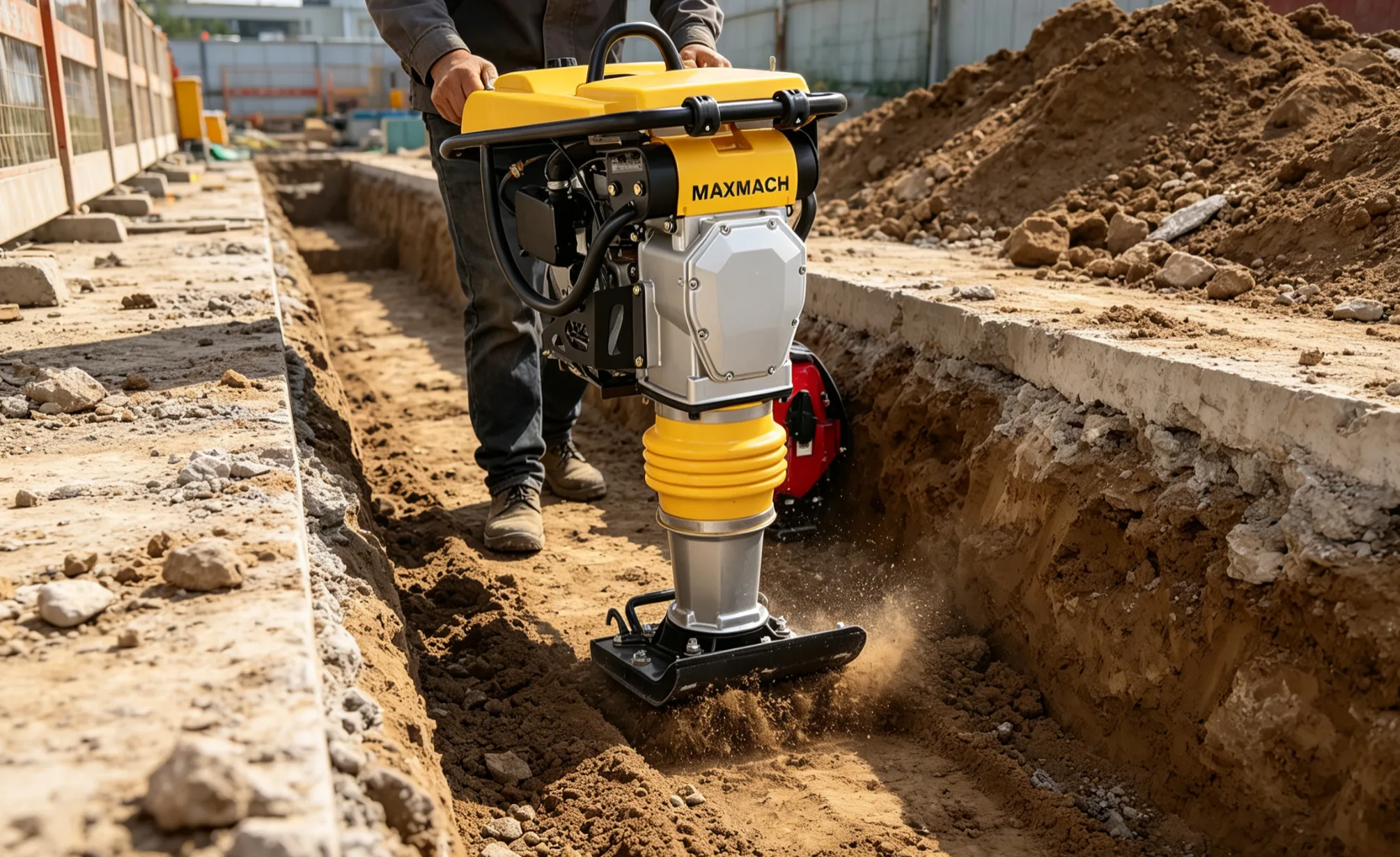
Best tamping rammer machine factors for rammer productivity
The best tamping rammer machine is the one that balances impact energy, mobility, and material compatibility.
Selection should begin with the soil. Granular fill, mixed fill, and cohesive soils respond differently to compaction energy. A rammer is typically preferred for cohesive or semi-cohesive materials because its vertical pounding action helps drive density downward through the lift. For clean granular materials in wider areas, a plate compactor may be faster. That is why many site managers treat the rammer as a precision tool rather than a universal compactor.
| Selection factor | Why it matters | Typical field target |
|---|---|---|
| Trench width | Determines maneuverability | Narrow access where plate size is limited |
| Lift thickness | Affects number of passes | Thin lifts compact more consistently |
| Soil type | Controls compaction response | Cohesive and mixed backfill |
| Engine type | Impacts fuel logistics | Gasoline or diesel depending on site policy |
| Machine weight | Influences transport and control | Light enough for one-crew movement |
Engine selection also affects productivity. CONSMAC’s product positioning around gasoline and diesel options reflects a real field need: sites often differ in fuel availability, emissions rules, and maintenance preferences. A gasoline unit is often easier to deploy for small crews and mobile repair teams, while a diesel setup can fit heavier-duty jobsite expectations where fuel logistics are already standardized.
For buyers comparing equipment across a full workflow, it helps to think in systems. In a road repair crew, the rammer addresses confined compaction, a concrete cutting machine handles section removal and edge control, and a road marking machine supports final surface traffic management. That workflow view is usually more useful than comparing machines in isolation.
Rammer productivity benchmarks supported by standards and field logic
Rammer productivity should be judged by density achievement, not by speed alone.
Compaction quality is tied to standardized test methods. ASTM D698 and ASTM D1557 are the most common references for soil compaction effort in construction practice, and they show that the same soil can behave differently under different impact energies. ASTM D698 uses a 5.5 lb rammer dropping 12 inches, while ASTM D1557 uses a 10 lb rammer dropping 18 inches. These standardized differences matter because they remind buyers that machine performance is not just about engine size; it is about how impact is delivered into the lift. You can review the standard references at ASTM D698 and ASTM D1557.
| Standard | Ram weight | Drop height | Use case |
|---|---|---|---|
| ASTM D698 | 5.5 lb | 12 in | Standard Proctor compaction |
| ASTM D1557 | 10 lb | 18 in | Modified Proctor compaction |
| ASTM C136 | Sieving method | Lab procedure | Aggregate gradation control |
For field teams, the practical benchmark is whether the machine can keep lift quality consistent without excess passes. In compact utility work, a well-chosen rammer often saves more labor by avoiding under-compaction than by simply compacting faster. Under-compacted backfill can lead to settlement, which then creates callback costs, patching work, and schedule friction. That is why site efficiency and rammer productivity should always be linked to long-term quality.
Dust and vibration management also influence productivity. OSHA’s hand and arm vibration guidance emphasizes exposure control, task rotation, and maintenance as part of reducing risk OSHA Hand-Arm Vibration. Machines that are easier to control and maintain usually keep operators fresher, which supports consistent output during a full shift.
How to choose a tamping rammer machine by construction scenario
The right tamping rammer machine depends on the job scenario more than the catalog description.
For utility trench backfill, prioritize narrow shoe geometry, balance, and operator control. For roadside repair, prioritize transportability and quick start reliability. For backfill near structures, prioritize precision and low bounce to avoid damaging adjacent surfaces. For municipal patching teams, a compact machine with simple service access can be more valuable than a heavier model with more complex adjustments.
- Measure the narrowest working width before buying.
- Match the machine to the dominant soil type, not the rare exception.
- Check fuel access, transport method, and daily maintenance time.
- Review service points, air filter access, and foot wear parts availability.
- Test whether the operator can control the machine for long cycles without fatigue.
Site managers often overlook the last point. A machine that is technically strong but difficult to handle will reduce actual productivity because the crew slows down to compensate. This is especially important for small contractors and export buyers serving mixed jobsite conditions, where one machine may move from trench work to repair patches in the same week.
Comparing tamping rammer, plate compactor, and finishing equipment
No single compaction tool is best for every construction surface.
A tamping rammer excels in vertical impact compaction. A plate compactor excels on wider, granular surfaces. A power trowel is not a compaction tool, but it becomes important after concrete placement because surface finishing quality affects downstream productivity. For contractors managing a full road and concrete workflow, the question is not which tool is best in general; it is which tool removes the most bottlenecks at each stage.
| Equipment | Best use | Typical strength | Main limitation |
|---|---|---|---|
| Tamping rammer | Trenches, edges, backfill | High impact in tight spaces | Slower on wide open areas |
| Plate compactor | Base layers, pavers, broad fills | Fast coverage | Less effective in narrow zones |
| Power trowel | Concrete finishing | Smoother surface finish | Not used for soil compaction |
That comparison matters because many productivity losses come from using the wrong tool first. A plate compactor forced into a narrow trench may leave edges under-compacted. A rammer used on a broad base may waste time. The efficient option is the one that matches geometry and material response.
In larger site systems, CONSMAC’s product mix across plate compactors, power trowels, and concrete mixers reflects this workflow logic: preparation, placement, compaction, finishing, and marking should be treated as a connected chain.
Maintenance habits that protect site efficiency and rammer productivity
Routine maintenance is one of the cheapest ways to protect tamping rammer productivity.
A rammer that starts reliably and keeps consistent impact behavior can outperform a neglected machine of the same specification. The main service points are air filtration, fuel quality, fastener tightening, boot condition, and bellows or vibration components where applicable. Manufacturers’ maintenance schedules vary, but the field logic is universal: clean air, clean fuel, correct lubrication, and tight hardware keep downtime low.
- Inspect the air filter before every shift in dusty zones.
- Check the shoe and wear parts for uneven damage.
- Verify fasteners and guards after transport.
- Use the recommended fuel grade and avoid contamination.
- Store the machine dry to reduce corrosion and starting issues.
Good maintenance also supports safety. A machine with predictable response reduces operator compensation movements and helps keep compaction lines straight in trench work. That reduces both fatigue and material disturbance.
Quantitative view of site efficiency: where the time is really saved
Site efficiency improves most when the rammer removes hidden delays, not just visible labor.
Those delays include hand tamping in corners, waiting for a larger machine to reposition, callbacks for soft spots, and cleanup caused by inconsistent lift control. On a small municipal repair job, preventing one rework visit can save more time than one extra hour of same-day compaction. In that sense, rammer productivity is measured across the full job cycle rather than one pass across the trench.
| Efficiency lever | Operational effect | Typical result |
|---|---|---|
| Right tool for narrow access | Less repositioning | Faster trench completion |
| Correct lift thickness | Fewer compaction passes | More consistent density |
| Preventive maintenance | Lower downtime | More usable machine hours |
| Operator training | Less rework | Better quality first time |
For buyers evaluating return on equipment, the strongest argument is often reduction in labor waste. Even when the machine is only one part of the project cost, it can influence downstream schedule, inspection success, and callback frequency. That is why the best tamping rammer machine is the one that fits the job, the crew, and the maintenance routine.
When a contractor should choose a tamping rammer over other compaction methods
A contractor should choose a tamping rammer when the job involves narrow access, cohesive fill, or high risk of edge settlement.
Typical examples include pipe trenches, utility line bedding, sidewalk edge repair, retaining wall backfill, and small foundation zones. If the space is wide and open, a plate compactor may be more efficient. If the job is concrete placement or surface finish, another machine in the workflow will be more relevant. The key is to avoid buying for one idealized case and instead buy for the most frequent actual condition.
That practical mindset is especially important for distributors and export buyers serving multiple regions. A machine that works well in urban trench repair may also need to handle rural maintenance, parking-lot patching, or mixed road shoulder work. Flexibility in fuel choice, service access, and transport weight can matter as much as compaction force.
FAQ about tamping rammer machine selection and site efficiency
What is the main advantage of a tamping rammer machine?
The main advantage is high compaction effectiveness in narrow or confined spaces where larger equipment cannot work efficiently.
Is a tamping rammer better than a plate compactor?
Neither is universally better; a rammer is better for trenches and cohesive backfill, while a plate compactor is usually better for wider granular areas.
How does a tamping rammer improve site efficiency?
It reduces repositioning, lowers hand tamping, improves lift consistency, and helps prevent settlement-related rework.
What standards are relevant to soil compaction?
ASTM D698 and ASTM D1557 are the most recognized soil compaction references, defining different rammer weights and drop heights.
What should I check before buying a rammer?
Check soil type, trench width, fuel type, machine weight, maintenance access, and operator comfort.
How often should a rammer be serviced?
Service intervals depend on the manufacturer, but air filter inspection, fastener checks, and wear-part inspection should be routine daily or pre-shift tasks.
Can a rammer be used on every backfill job?
No. It is best for confined or cohesive conditions; wider surfaces and granular materials may be better served by other compaction equipment.
For construction teams focused on roadwork, utility maintenance, and ground preparation, the best tamping rammer machine is the one that turns difficult access into predictable output. If the goal is higher construction site efficiency, the winning choice is rarely the biggest machine; it is the one that keeps the work moving with the fewest interruptions.