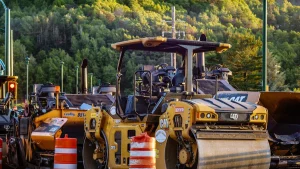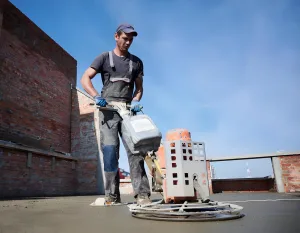

- Tamping rammers are optimized for cohesive and mixed soils in trenches, backfill, and tight access areas.
- Compaction efficiency depends on lift thickness, soil moisture, shoe energy, and pass count, not just machine power.
- Density verification should use recognized field methods such as ASTM D1556 or ASTM D6938.
- For roadwork and utility projects, the right rammer reduces settlement risk, callbacks, and patch repairs.
- Productivity improves most when operators keep the machine upright, work in thin lifts, and compact near edges first.
Tamping rammer performance matters because soil compaction is a structural step, not a cosmetic one. A well-compacted subgrade or trench backfill reduces future settlement, protects pipes and slabs, and improves load transfer under pavements. In field terms, that often means fewer passes to reach target density, which directly improves rammer productivity. For reference, many earthwork specifications target relative compaction values near 95% of maximum dry density, and field verification may use methods such as ISO 17892-10 for laboratory density-related geotechnical testing or ASTM field methods for in-place checks. If your project involves road edges, utility trenches, or small pads, a tamping rammer is usually more efficient than a plate compactor in confined zones, and it fits well with the broader equipment lineup such as rammers, plate compactors, and concrete cutting saws when the workflow includes patching and restoration.
Why tamping rammer machines improve compaction efficiency in confined spaces
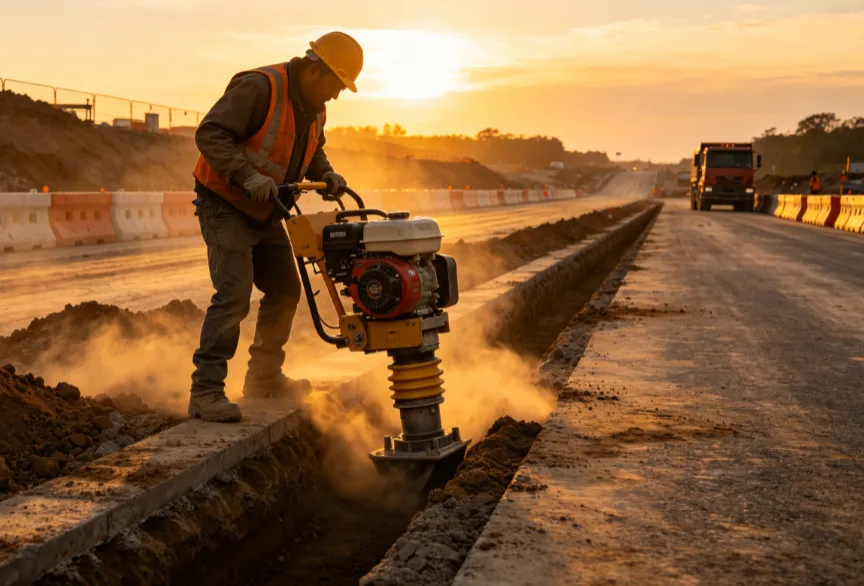
A tamping rammer improves confined-space compaction efficiency because it concentrates impact energy into a small foot and deeper vertical stroke. Unlike a plate compactor, which spreads force over a wider area, a rammer repeatedly drives soil particles downward, which is useful in narrow trenches and along foundations. The practical result is better edge compaction, fewer voids against trench walls, and more uniform density near buried utilities.
This matters most when access is limited. In utility backfill, operators often cannot run large rollers or wide plates close to the edge. A rammer can work inside a trench box, beside a curb line, or around pipe penetrations where settlement usually starts. For contractors, that means less hand-tamping, fewer correction passes, and less risk of differential settlement after reopening traffic or loading the surface.
| Compaction Tool | Best Use | Typical Working Width | Typical Soil Suitability | Main Efficiency Advantage |
|---|---|---|---|---|
| Tamping rammer | Trenches, backfill, edge zones | Approx. 280-340 mm shoe width | Cohesive and mixed soils | High impact energy in tight spaces |
| Plate compactor | Base layers, parking lots, wider pads | Approx. 300-500 mm plate width | Granular soils and sub-base | Higher area coverage per pass |
| Roller | Roadbeds, larger earthworks | Much wider than trench tools | Broad-area applications | Best for high-volume production |
In road and site work, efficiency is not only about machine speed. It is also about how much of the job reaches specification on the first attempt. A machine that compacts the trench toe, pipe sidewalls, and edge transitions more completely reduces the probability of soft spots later. That is why a tamping rammer often performs better than a plate compactor in narrow repair work, even if the plate has higher surface coverage on open areas.
Tamping rammer productivity factors that affect soil compaction efficiency
Rammer productivity is determined by energy transfer, operator technique, soil condition, and lift thickness. The machine itself is only one part of the equation. If the moisture content is too low, cohesive soil resists rearrangement. If it is too high, the material may pump or knead instead of densifying. In both cases, efficiency drops because the operator needs more passes to reach the target density.
Field practice usually favors thin lifts, especially in trenches. A common rule is to compact in layers rather than in one thick fill placement. In many utility and backfill scenarios, lift thickness around 100-200 mm is more manageable than thicker placements, though project specifications should always control the final requirement. Thinner lifts allow the rammer’s impact to reach the lower portion of the layer and reduce trapped air and bridging.
| Factor | Effect on Efficiency | Typical Field Guidance | Why It Matters |
|---|---|---|---|
| Lift thickness | Higher efficiency with thinner lifts | About 100-200 mm per lift | Improves energy penetration |
| Moisture content | Too dry or too wet lowers output | Close to optimum moisture content | Supports particle rearrangement |
| Pass count | More passes increase time and cost | Verify density after each lift | Prevents overcompaction or undercompaction |
| Shoe condition | Worn shoes reduce energy transfer | Inspect before each shift | Maintains consistent contact |
Engine output also matters, but not in isolation. A gasoline-powered model may be preferred for portable jobs where refueling is simple, while diesel options can suit harsher duty cycles or site preferences. The point is to select the power source that matches logistics and operating hours, not just peak horsepower. For companies that move between trench repair, foundation fill, and roadside maintenance, equipment flexibility is often more valuable than maximum rating on paper.
Modern site teams often pair a rammer with a concrete mixer for patch preparation, or with a ground grinding machine when the project includes slab restoration after settlement correction. That workflow reduces idle time and keeps one crew focused on the full repair sequence.
How to measure compaction efficiency with ASTM and field testing methods
Compaction efficiency should be measured against density, not guesswork. The most reliable approach is to compare field density with a lab-established maximum dry density, then calculate relative compaction. This is the basis for many project acceptance requirements in earthwork and trench backfill.
Two widely used field methods are ASTM D1556, the sand cone method, and ASTM D6938, the nuclear density gauge method. The sand cone method is often chosen when destructive testing is acceptable and precise volume measurement is needed, while the nuclear gauge offers faster repeat testing where licensing and safety controls are in place. Either way, the real objective is the same: confirm that the placed soil meets the required dry density and moisture range before the next lift goes in.
| Test Method | Reference | Typical Use | Key Advantage | Limitation |
|---|---|---|---|---|
| Sand cone | ASTM D1556 | Small to medium verification points | Direct in-place density measurement | Slower setup and excavation |
| Nuclear gauge | ASTM D6938 | Fast field density checks | Quick repeatability | Regulatory controls required |
| Relative compaction | Project specification | Acceptance criterion | Easy to compare to target | Depends on lab reference quality |
Many highway and utility specs also reference geotechnical lab procedures for soil classification and density-related properties. That is why lab and field data must stay connected. If the soil type changes from granular backfill to clayey trench fill, the compaction approach may need to change too. A rammer often performs especially well in cohesive soils because its impact-and-knead action helps rearrange particles more effectively than vibration alone.
If your project includes pavement restoration after utility work, the compaction step is only one part of the sequence. Crews often need cutting, removal, fill placement, compaction, and then surface reinstatement. That is where tools such as road marking machine and concrete vibrators can support a broader repair workflow on commercial sites and municipal jobs.
Rammer selection guide for better tamping rammer productivity
The right tamping rammer is the one that matches the site problem, not the one with the biggest headline number. Selection should start with soil type, trench width, required density, lift thickness, and runtime needs. For many contractors, a lighter machine is easier to move between jobs, but a heavier rammer may deliver stronger compaction in stiffer soils. The best choice balances maneuverability and impact performance.
Engine configuration is a practical selection point. Gasoline units are widely used for mobile crews because fueling is simple and startup is familiar. Diesel units may fit longer shifts or different regional fuel logistics. Noise, vibration, maintenance access, and parts availability should also be part of the decision. In real work, downtime is often more expensive than fuel consumption.
- Identify the soil type: cohesive, granular, or mixed fill.
- Measure the working width and check trench access.
- Confirm target density and testing method before work starts.
- Choose the rammer shoe size and impact characteristics for the lift thickness.
- Plan maintenance, refueling, and operator rotation to preserve productivity.
For equipment buyers comparing several compactors, a useful rule is this: if the site is open and the material is granular, a plate compactor may deliver better area coverage. If the site is narrow, irregular, or vertically constrained, a tamping rammer usually wins on effective compaction efficiency. That distinction is central to smarter procurement and better job planning.
Common mistakes that reduce soil compaction efficiency
Most compaction failures come from process mistakes rather than machine failure. The most common error is placing too much fill at once. When the lift is too thick, the rammer only densifies the top portion, leaving weak material below. Another frequent issue is working at the wrong moisture level, which causes either dry bridging or wet pumping.
Operators also lose efficiency when they rush edge work. The perimeter of a trench or slab often needs extra attention because it is harder to reach and more likely to settle later. Skipping that area can create differential settlement, cracking, or utility exposure after final grading. A few extra passes at the edge usually cost far less than return visits later.
- Do not compact overly thick lifts.
- Do not ignore moisture conditioning.
- Do not use worn shoes or damaged springs.
- Do not assume one pass equals target density.
- Do not skip verification testing on critical backfill.
Maintenance also affects productivity. A machine with poor throttle response, worn components, or inconsistent impact will need more passes and more operator effort. On small commercial crews, that reduction in output can slow the entire shift. Basic pre-use checks are inexpensive compared with the cost of rework.
Where tamping rammer machines deliver the highest return on site
Tamping rammers deliver the highest return in utility trenches, curb repairs, foundation backfill, and patch restoration after cutting. These are the jobs where access is restricted and settlement risk is high. In such cases, the machine helps the crew achieve acceptable density without bringing in larger, more expensive compaction equipment.
That efficiency is especially valuable for municipalities, road maintenance teams, and contractors handling repeated small repairs. A compact machine can move quickly from one location to another, start up fast, and support short-duration jobs with minimal setup. When combined with proper testing and layer control, the workflow reduces callbacks and keeps reopening dates on schedule.
In broader roadwork and site finishing operations, a rammer may sit alongside other equipment such as mortar mixers and tamping rammers for complete small-job coverage. That systems view is important because compaction is only one step in a connected process of preparation, placement, and surface restoration.
FAQ about tamping rammer compaction efficiency
What makes a tamping rammer more efficient than a plate compactor?
A tamping rammer is more efficient in narrow trenches and cohesive soils because it delivers concentrated vertical impact rather than wide-area vibration. That allows better edge compaction and deeper energy penetration in confined spaces.
How many passes does a tamping rammer usually need?
Pass count depends on soil type, moisture, and lift thickness, so there is no universal number. Many crews compact thin lifts and verify density after each layer instead of relying on a fixed pass count.
What soil types are best for a tamping rammer?
Tamping rammers are typically strong choices for cohesive and mixed soils, especially in trenches, backfill, and edge work where a plate compactor may not fit or may underperform.
How do contractors verify compaction quality?
Contractors commonly use field density tests such as ASTM D1556 sand cone testing or ASTM D6938 nuclear gauge testing, then compare results against the project’s required relative compaction.
What lift thickness is best for efficient rammer use?
Thin lifts are generally more efficient than thick lifts, and many field applications work around 100-200 mm per lift depending on the specification and soil conditions.
Why does moisture content affect rammer productivity?
Moisture changes how soil particles rearrange under impact. If the material is too dry or too wet, the rammer needs more passes to reach density, which lowers productivity.
How can a contractor reduce rework after trench backfill?
Use the correct lift thickness, condition the moisture, compact edges carefully, and verify density before placing the next layer. Those steps reduce settlement risk and help the work pass inspection the first time.