
- Use a tamping rammer for trenches, utility backfill, and edge work where maneuverability matters most.
- Use a plate compactor for broader base compaction, asphalt prep, and flat surfaces where coverage rate matters.
- Compaction quality depends on lift thickness, moisture content, and passes, not just machine weight.
- For roadwork and site prep, the wrong tool can increase rework, settlement risk, and crew time.
Tamping rammer vs compactor is not just a tool choice; it is a compaction strategy decision that affects density, settlement, and schedule. In practice, quality compaction is tied to accepted testing methods such as ASTM D698 for laboratory moisture-density relationships and ASTM D1557 for modified Proctor compaction, which help define the moisture window and target density for field work. For construction teams working on roads, parking areas, and utility trenches, choosing between rammer vs compactor often decides whether a surface is ready for paving or whether it will settle later. For product context, you can compare machine categories like plate compactors, tamping rammers, and broader site tools such as concrete cutting machines and concrete mixers.
Tamping Rammer vs Compactor Machine: What Each Tool Actually Does
The core difference is that a tamping rammer delivers vertical, impact-based force, while a plate compactor applies downward vibration across a wider base. That mechanical difference matters because granular and cohesive materials do not respond the same way. A rammer is designed to transmit concentrated energy into smaller zones, which is why it is favored in trench work and around obstacles. A plate compactor spreads vibration across a larger footprint, which makes it efficient for larger, flatter surfaces like road shoulders, pavers, and foundation pads.
In practical terms, a crew backfilling a utility trench may need repeated passes in a 300 to 400 mm wide working space, while a driveway base may be compacted efficiently with a machine that covers a much broader strip each pass. The equipment choice should therefore follow the site layout first, and only then the material type.
| Machine type | Best use case | Typical working width | Typical force pattern | Main advantage |
|---|---|---|---|---|
| Tamping rammer | Trenches, pipe backfill, corners | About 200 to 350 mm | High-impact vertical blows | Access and depth in confined spaces |
| Plate compactor | Base layers, driveways, parking areas | About 400 to 600 mm | Uniform vibration over plate area | Coverage rate and smooth finish |
| Reversible plate compactor | Medium to large jobs with directional control | About 500 to 700 mm | Bidirectional vibration | Higher productivity on open areas |
How Soil Type Changes the Rammer vs Compactor Decision
Soil behavior is often the real deciding factor, not machine preference. ASTM D2487 classifies soils under the Unified Soil Classification System, and that classification helps explain why some materials compact better with impact while others respond well to vibration. Cohesive soils with fines, such as silty clays, often benefit from the kneading and impact action of a rammer. Granular soils like sand and gravel usually respond better to plate vibration because particles can rearrange and lock into a denser structure more efficiently.
Laboratory compaction standards also matter. ASTM D698 defines the Standard Proctor method, while ASTM D1557 defines the Modified Proctor method, which uses higher compactive effort. The modified method applies about 56,000 ft-lbf/ft3 compared with about 12,400 ft-lbf/ft3 in the standard method. That difference illustrates why base courses for roads, industrial slabs, and heavy-duty surfaces often require a more aggressive field compaction approach than light landscaping work.
| Soil or fill type | Better machine | Why it works | Field risk if chosen wrong |
|---|---|---|---|
| Cohesive clayey backfill | Tamping rammer | Impact and kneading help reduce voids | Shallow densification and trapped air |
| Granular sand or gravel | Plate compactor | Vibration allows particle rearrangement | Uneven seating and slower production |
| Mixed fill with fines | Depends on moisture and layer depth | May require alternating machine types | Overworking or under-compaction |
The practical takeaway is simple: if the fill is cohesive and the space is narrow, start with a rammer. If the fill is granular and the area is open, start with a plate compactor.
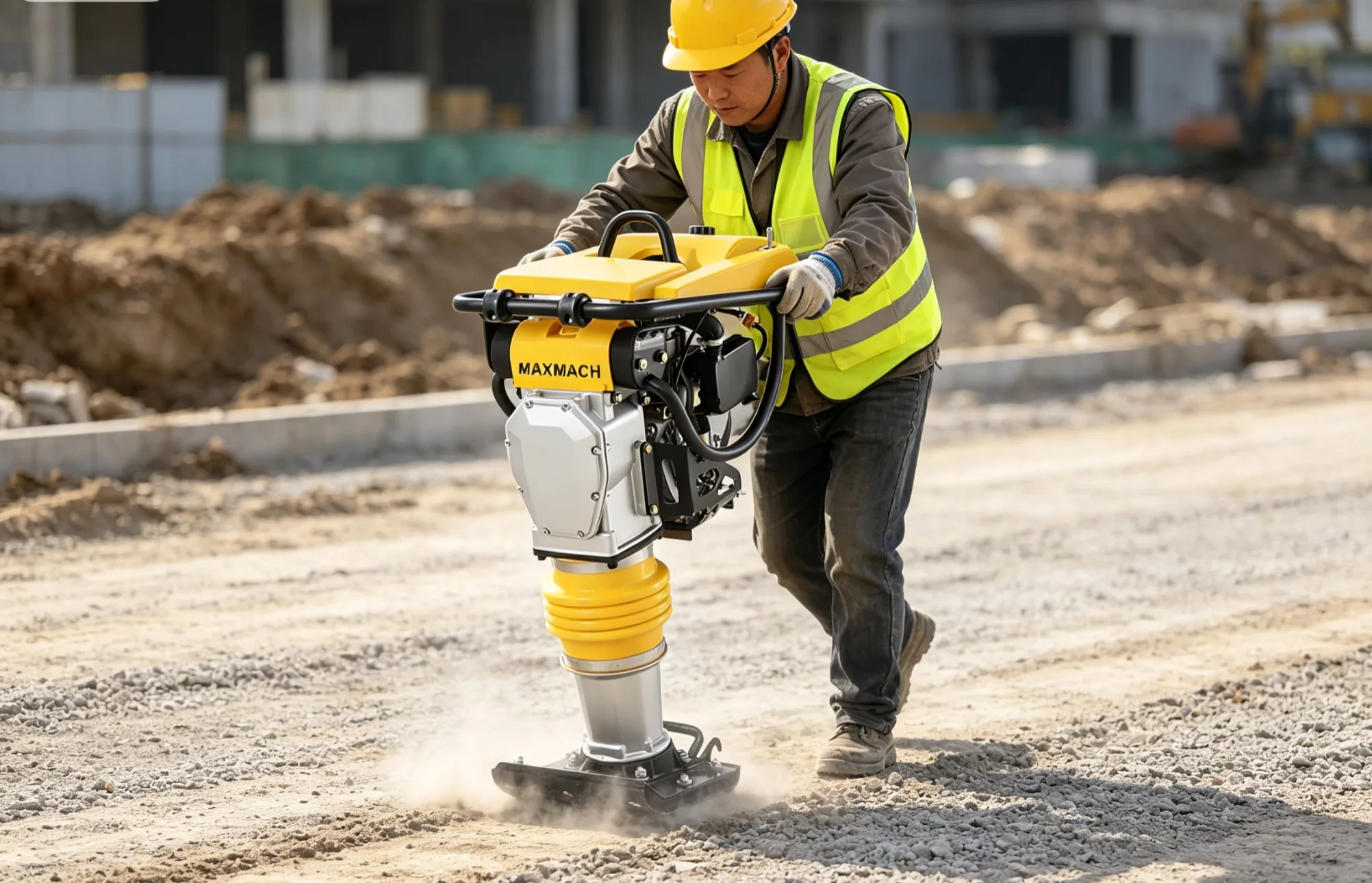
Rammer vs Compactor for Trenches, Bases, and Road Repairs
Jobsite geometry is the fastest way to decide between a tamping rammer vs compactor machine. In utility trenches, the trench width often limits the machine footprint more than the material itself. A rammer can work close to pipes, retaining walls, and foundations where a plate may not fit or may bridge over the compacted zone. That matters for municipal maintenance, drainage installation, and cable or pipe backfill.
For road base preparation, parking lots, and sidewalk subgrades, a plate compactor usually offers better productivity because the working surface is open and repeatable passes can be planned with less operator fatigue. On paving jobs, a plate compactor is also commonly used to seat interlocking pavers without damaging the surface the way more aggressive equipment might.
- Trench backfill: Choose a rammer when the working width is restricted and edge support is critical.
- Driveway base: Choose a plate compactor when the material is granular and the surface is broad.
- Patch repair: Choose according to access; the machine that fits the zone is usually the right one.
- Utility corners: Use a rammer where plates cannot reach uniformly.
For contractors building a larger workflow, compaction should be integrated with related tasks such as cutting, mixing, and finishing. That is why equipment families like floor grinders, power trowels, and road marking machines matter in the same project sequence, even if they are not compaction tools themselves.
Key Performance Factors: Weight, Frequency, Amplitude, and Lift Thickness
Compaction performance is driven by machine physics, not by marketing labels. The four variables that matter most are static weight, vibration frequency, amplitude, and lift thickness. A plate compactor with a larger plate area can cover more square meters per hour, but if the lift is too thick, the lower portion may remain loose. A rammer can push compactive energy deeper in a narrow zone, but it is less efficient for broad surface coverage.
Most site crews work best when lift thickness is controlled instead of forcing a single machine to solve every problem. Field practice often keeps lifts in the range of 100 to 200 mm for many granular base applications, while cohesive soils may require thinner lifts and more passes. The exact target should always follow the project specification and testing plan.
| Performance factor | Tamping rammer | Plate compactor | What it means on site |
|---|---|---|---|
| Coverage width | Narrow | Wide | Plate wins on open areas |
| Energy concentration | High | Moderate | Rammer wins in confined zones |
| Surface finish | Rougher | Cleaner and flatter | Plate better for paving prep |
| Operator fatigue | Higher in long runs | Lower over large flats | Plate usually improves productivity |
When comparing models, buyers should also check engine type, serviceability, and the availability of a vibration-damping handle. For mixed fleets, gasoline units are often favored on mobile crews because refueling is simple, while diesel may be preferred in certain higher-duty site conditions. The right decision is usually about uptime and logistics, not only raw power.
What Standards Say About Compaction Quality and Why That Matters
Verified compaction is measured, not guessed. ASTM D6938 is widely used for in-place density and moisture content by the nuclear gauge method, while ASTM D1556 covers the sand cone method for field density determination. These standards are important because the machine only creates the compaction action; the acceptance of the work depends on measured density relative to the specification.
In civil work, density targets are often written as a percentage of maximum dry density from Proctor testing. While the exact acceptance level depends on the project, common contract requirements reference a target based on laboratory results and field verification. This is why the best buying decision for buy rammer or compactor is not just about machine cost. It is about whether the tool helps the crew meet the specified density in fewer passes and with less rework.
For additional technical context on compaction-related field testing, see ASTM D6938, ASTM D1556, and ASTM D1557. For soil classification background, the US Federal Highway Administration provides practical geotechnical references at FHWA geotechnical guidance.
Buyer Checklist for Choosing a Tamping Rammer or Compactor Machine
The best purchase decision starts with site conditions, not catalog price. A compact machine may look inexpensive, but if it cannot reach the job zone or meet the required density, the project cost rises through extra labor and rework. Buyers should review access width, fill type, lift thickness, daily square footage, fuel availability, and maintenance access before choosing.
- Measure the narrowest access point on the jobsite.
- Identify whether the fill is cohesive, granular, or mixed.
- Check the required lift thickness and target density.
- Estimate daily production in square meters or linear meters.
- Match the machine to the most common job, not the rare exception.
- Verify parts availability, handle isolation, and service simplicity.
For buyers working across road maintenance, parking lot prep, and small concrete support jobs, it can also help to review connected equipment lines such as concrete cutters and road marking equipment so the full workflow stays coordinated.
Common Mistakes When Comparing Rammer vs Compactor
Most selection mistakes come from ignoring access and soil behavior. A frequent error is buying a plate compactor for trench work and then discovering it bridges across the backfill instead of consolidating it. Another mistake is choosing a rammer for a wide base and then losing production because the crew must cover too many square meters by hand. A third mistake is compaction without moisture control, which can make even the correct machine perform poorly.
- Do not assume heavier is always better.
- Do not use one machine for every layer and geometry.
- Do not skip density testing on critical work.
- Do not ignore the moisture window specified by the engineer.
On the operational side, a well-maintained machine often matters more than a larger engine. Worn shoes, loose bolts, damaged vibration mounts, and dirty air filters can reduce effective performance and increase downtime. In that sense, serviceability is part of the buying decision.
When a Contractor Should Own Both Machines
Many crews need both a rammer and a plate compactor because their projects vary by phase. A utility contractor may start with trench backfill using a rammer, then move to a plate on restored base layers. A pavement crew may use a plate for the main area and a smaller rammer for edges, corners, and utility boxes. Owning both tools reduces dependence on rental lead times and allows the foreman to assign the right machine instantly.
For distributors and project buyers, this combination also improves fleet flexibility. It means one jobsite can handle narrow and wide compaction without changing the work plan. That is especially useful for mobile maintenance teams, municipal repair crews, and contractors serving mixed road and concrete scopes.
| Business profile | Recommended equipment mix | Why | Typical job types |
|---|---|---|---|
| Utility contractor | Rammer plus light plate | Trench access and surface restoration | Pipes, cables, backfill |
| Parking lot contractor | Medium plate plus reversible plate | Fast coverage on flat areas | Base prep, pavers, apron work |
| Road maintenance crew | Rammer, plate, cutter, finishing tools | Multiple repair stages in one workflow | Patches, shoulders, local repairs |
Final Answer: Which One Should You Choose?
If the job is narrow, deep, or blocked by edges, choose a tamping rammer; if the job is open, broad, and surface-focused, choose a plate compactor. That is the simplest and most reliable rule for most buyers. For utility trenches, pipe backfill, and tight repair zones, the rammer is the safer and more effective compaction tool. For driveways, bases, sidewalks, and parking areas, the plate compactor usually delivers better productivity and a flatter finish.
If you are still deciding whether to buy rammer or compactor, start by mapping the most common jobsite dimensions and material types. Then compare the machine against the actual work zone, not the brochure. When in doubt, many contractors end up owning both because the combination covers the full range of road and concrete support work with fewer compromises.
FAQ
Is a tamping rammer better than a plate compactor?
A tamping rammer is better for narrow trenches, cohesive soils, and edge areas, while a plate compactor is better for wider, flatter surfaces and granular base layers.
Can a plate compactor replace a tamping rammer?
Not in most trench or confined-space applications, because a plate can bridge over narrow backfill and leave weak zones below the surface.
Can a tamping rammer be used for gravel?
Yes, but it is usually less efficient than a plate compactor on open gravel base because the rammer works in a smaller footprint.
Which machine is better for paving blocks?
A plate compactor is usually preferred because it provides even vibration across the paver surface without concentrating force into one point.
How do I know if my fill is compacted enough?
Field density testing is the reliable method. Common standards include ASTM D6938 for nuclear gauge testing and ASTM D1556 for the sand cone method.
What matters more: engine power or machine type?
Machine type matters first. A correctly matched machine with adequate maintenance and proper passes usually outperforms a mismatched machine with more power.
Should contractors own both a rammer and a plate compactor?
Yes, if they handle both trench work and open-area base compaction. Owning both tools reduces downtime and improves jobsite flexibility.