
The right compaction tool depends on access, soil behavior, and required coverage. This guide explains when each machine works best, how they differ in performance, and how contractors can choose the safer, more efficient option.
Tamping Rammer vs Plate Compactor: Core Difference
A tamping rammer delivers high-impact force in a small footprint, while a plate compactor spreads vibration across a wider base. That makes the first better for confined areas and the second better for open surfaces.
In practical terms, a rammer is often called a jumping jack, and a plate unit is often selected for subbase and surface preparation. CONSMAC positions these machines within a broader road and concrete equipment range that also includes mixers, cutters, grinders, and power trowels.
How Each Machine Works
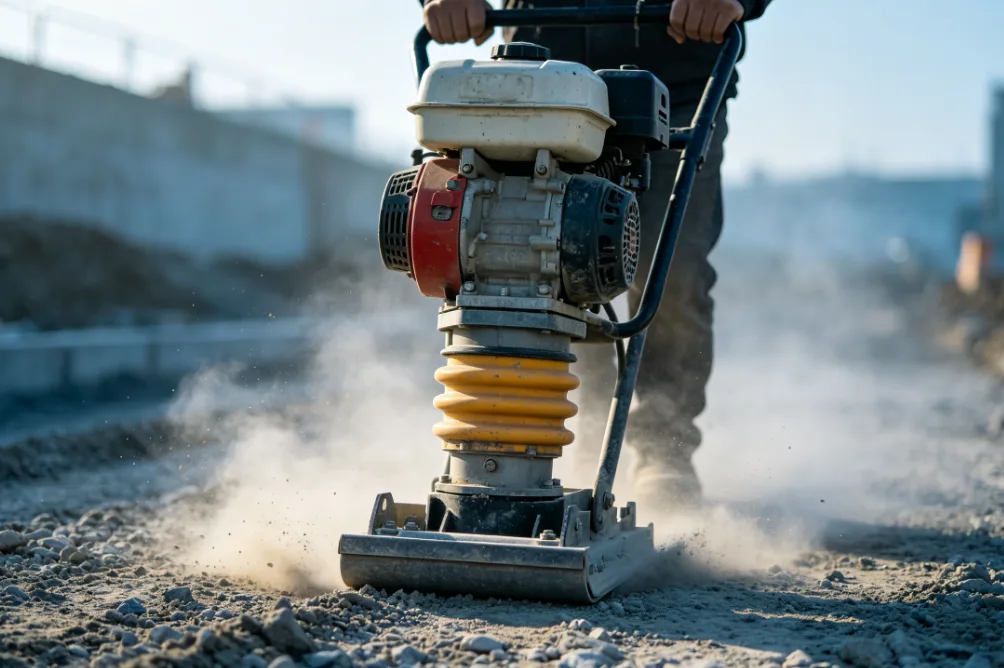
A tamping rammer compacts by repeated vertical impact. Its narrow shoe concentrates force, which helps densify soil in trenches, around utilities, and near edges where larger equipment cannot move freely.
A plate compactor uses a vibrating steel plate to transmit force into the material below. It is more efficient on granular soils, gravel, sand, and asphalt base layers because the vibration spreads over a larger area.
For general road and site work, the choice is usually based on geometry first and material second. The machine that reaches the area cleanly will usually produce the better result.
Comparison Table: Tamping Rammer vs Plate Compactor
| Factor | Tamping Rammer | Plate Compactor |
|---|---|---|
| Best use | Narrow trenches, backfill, edges | Open base layers, yards, pavements |
| Compaction action | Vertical impact | Surface vibration |
| Material fit | Cohesive soils and confined fills | Granular soils, gravel, asphalt |
| Mobility | High in tight spaces | High on open areas |
| Typical user | Utility crews, repair teams | Road crews, paving teams |
When to Use a Tamping Rammer
A tamping rammer is the better choice when the work area is narrow, deep, or irregular. It is especially useful for pipe trenches, foundation backfill, curb edges, and patch repairs where a plate cannot reach effectively.
According to the U.S. Occupational Safety and Health Administration, trench and excavation work requires careful attention to soil stability and worker protection, which makes compact, maneuverable equipment especially valuable in utility environments. See OSHA trenching and excavation guidance.
For crews that move between sites, gasoline and diesel versions can improve deployment flexibility. CONSMAC’s product structure reflects this need with gasoline and diesel tamping rammer options for mobile maintenance and heavier-duty compaction tasks.
When to Use a Plate Compactor
A plate compactor is the better choice for larger, flatter areas that need uniform coverage. It is commonly used for road base preparation, driveway work, parking lots, walkways, and asphalt patching.
The Federal Highway Administration notes that compaction quality strongly affects pavement performance and long-term durability. For road-related work, consistent density is a major quality control factor. See FHWA pavement resources.
For contractors, the main advantage is speed. A plate machine covers more area per pass, so it is usually more productive on open jobs where access is not restricted.
Key Specifications for Choosing the Right Compaction Tool
| Specification | Why It Matters | Selection Tip |
|---|---|---|
| Operating area | Determines machine access | Choose a rammer for confined spaces |
| Material type | Affects compaction response | Use vibration for granular materials |
| Base thickness | Influences density needs | Match equipment to lift depth |
| Fuel type | Impacts site flexibility | Select gasoline or diesel by jobsite conditions |
| Operator control | Supports productivity and safety | Prioritize easy handling on repetitive work |
Rammer vs Compactor: Material and Site Matching
Material behavior is the most important technical factor after access. Cohesive soils respond well to impact compaction, while free-draining granular materials usually respond better to vibration.
The U.S. Army Corps of Engineers explains that soil type, moisture, and lift thickness all affect compaction results. That is why jobsite testing and material awareness matter more than machine size alone. See U.S. Army Corps of Engineers for engineering references and field guidance.
In practice, contractors often keep both machines on hand. One handles trenches and edge work, while the other handles larger pads, bases, and surface layers.
Safety, Productivity, and Maintenance Considerations
Safety should influence the choice as much as performance. A smaller machine can reduce maneuvering risk in tight zones, while a wider unit can reduce the number of passes on open ground.
Modern compaction equipment also benefits from simpler maintenance routines. Fuel system checks, plate wear inspection, and vibration component monitoring help reduce downtime and extend service life.
CONSMAC’s broader road machinery lineup includes equipment such as road construction equipment, plate compactor solutions, and tamping rammer models, which supports contractors that want a standardized fleet for multiple job types.
Where These Machines Fit in a Full Jobsite Workflow
Compaction is only one step in a complete road or flooring workflow. A project may begin with concrete mixing, continue with base compaction, then move to cutting, finishing, and line marking.
That workflow is why many contractors prefer suppliers with a broader product range. A single source for mixers, compactors, cutters, and finishing tools can simplify procurement and reduce compatibility issues across crews.
For example, CONSMAC also supplies concrete mixers, floor grinding machines, concrete road cutters, and power trowels, which aligns with its focus on road and concrete construction applications.
Supplier Directory: Who Typically Sells These Machines
The best supplier is usually the one that matches your project scale, service expectations, and delivery timeline. For standardized procurement, one-stop road machinery suppliers can be practical because they support multiple equipment categories from a single source.
For buyers comparing options, well-known industry suppliers and manufacturers often include regional construction equipment dealers, global compaction brands, and specialized road machinery exporters. When evaluating them, check parts availability, warranty terms, and after-sales response time before price alone.
For buyers who need a compact product range for road and flooring work, the internal product pages at CONSMAC are relevant starting points for compaction and related site equipment.
Conclusion: Which One Should You Choose?
The best choice depends on access, material, and project scale. Use a tamping rammer for narrow, deep, or obstructed areas, and use a plate compactor for wider, flatter, and more uniform surfaces.
If your work includes both trench backfill and base preparation, the most efficient setup is often to keep both machines in the fleet. That approach reduces rework, improves density consistency, and supports faster job completion.
FAQ
1. Is a tamping rammer better than a plate compactor?
A tamping rammer is better only in confined or irregular spaces. It is not automatically superior. For open areas, a plate compactor usually performs faster and more evenly. The correct choice depends on soil type, access, and the shape of the work area.
2. Can a plate compactor replace a jumping jack?
Not always. A plate compactor can handle many base and surface tasks, but it cannot reach narrow trenches or tight edge zones as effectively. A jumping jack, or tamping rammer, is designed for those restricted areas and for impact-style compaction.
3. Which machine is better for backfill around pipes?
A tamping rammer is usually better for pipe backfill because it can work in narrow trenches and compact material close to utility lines. Operators still need to follow trench safety procedures and avoid damaging buried services during compaction.
4. What material is best for a plate compactor?
A plate compactor works best on granular materials such as sand, gravel, and crushed aggregate. It is also commonly used on asphalt. Cohesive clay-like soils are usually harder to compact evenly with vibration alone, so a rammer may be more effective there.
5. How do I choose between gasoline and diesel models?
Choose based on site conditions, runtime needs, and maintenance preference. Gasoline models are often used for lighter mobile work, while diesel models are often selected for longer or heavier-duty operation. The best option is the one that fits your crew’s daily workflow.