
- Tamping rammers are best for confined areas, trench work, and cohesive or mixed backfill.
- The working principle is repetitive impact compaction, not static pressing like a plate compactor.
- Good results depend on layer thickness, moisture control, operator technique, and routine maintenance.
- Understanding compaction basics helps beginners avoid overpassing, pumpy soil, and uneven density.
- For road and utility crews, the rammer is a precision tool for edges, corners, and narrow trenches.
Tamping rammer working principle matters because compaction quality directly affects settlement, pavement life, and rework risk, especially in trench and roadside repair jobs. In field practice, a well-run compaction process aims to keep soil density close to the project requirement, often verified against standards such as ASTM D698 and ASTM D1557, which define laboratory methods used to establish reference maximum dry density and optimum moisture content. For equipment buyers and beginner operators, the practical takeaway is clear: a tamping rammer is not just a small compactor, but a high-energy tool for narrow zones where uniform support is hard to achieve with a larger machine. When paired with site-appropriate compaction sequencing and the right tool selection from a rammers page, a plate compactor, or a cutting machine, it becomes part of a complete road and pavement workflow.
Tamping Rammer Working Principle: What Actually Happens Under the Hood
The tamping rammer working principle is a rapid vertical impact cycle that forces soil particles into tighter contact and removes air pockets. Unlike a plate compactor, which applies vibration across a broad base, a rammer concentrates energy into a smaller shoe area, making it better for trenches, around foundations, and along curbs. The machine’s motion is typically produced by a gasoline or diesel engine driving a clutch and crank mechanism, or by an internal reciprocating system that lifts and drops the shoe at high frequency.
That impact action is especially effective in cohesive or mixed soils because the repeated blows overcome internal friction and help the material rearrange into a denser structure. In simple terms, the tamping rammer working principle is closer to controlled pounding than to surface shaking. For a beginner, the important thing is that compaction quality comes from consistent, repeated strikes, not from forcing the machine too quickly through the trench.
| Compaction Tool | Main Action | Best Use Area | Typical Strength |
|---|---|---|---|
| Tamping rammer | Vertical impact | Trenches, edges, backfill | High point pressure |
| Plate compactor | Horizontal vibration | Open soil, pavement base | Broader coverage |
| Walk-behind roller | Static plus vibration | Larger surfaces | Higher productivity on open areas |
For road crews handling mixed tasks, compacting a trench with a rammer, then finishing nearby open sections with plate compactors, usually gives more consistent results than trying to use one tool everywhere. That workflow is common in utility reinstatement and small municipal repair projects.
How Rammer Works in the Compaction Cycle
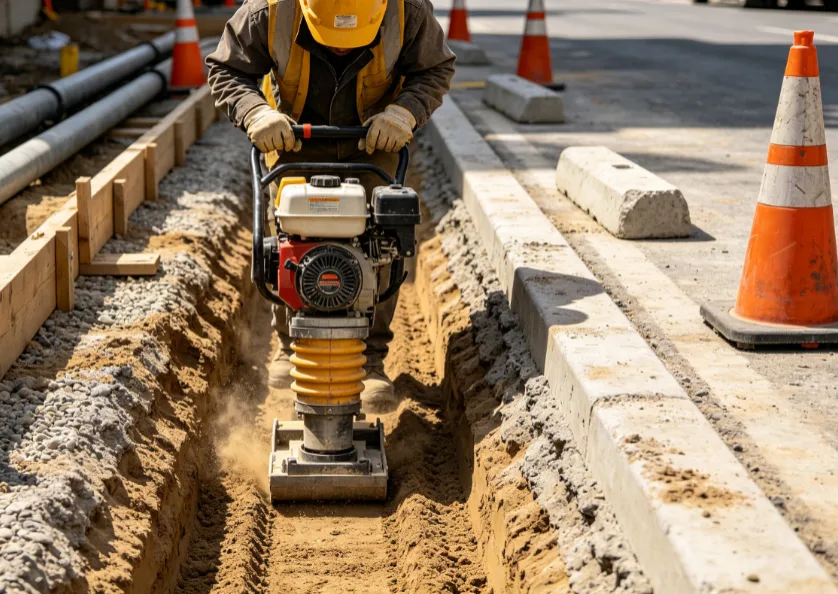
How rammer works is easiest to understand as a four-step cycle: lift, release, impact, rebound. The engine transfers motion to the internal drive system, the shoe rises, gravity and mechanical force bring it down, and the impact energy compresses the soil. The recoil or spring system then resets the shoe for the next strike. This sequence repeats many times per minute, building density through repeated micro-adjustments in particle arrangement.
Manufacturers commonly build these machines for jobsite mobility and easier handling, which matters for beginners moving from one repair point to another. In real work, that means less setup time, fewer transport issues, and better access in tight spaces. It also means the operator must respect the machine’s rhythm. Pushing too fast can leave soft bands in the lift, while staying too long in one spot can overwork the top layer and reduce surface stability.
Compaction performance is strongly influenced by soil moisture. The U.S. Federal Highway Administration notes that moisture content near optimum is critical for achieving target density, and laboratory reference testing is commonly based on ASTM D698 or ASTM D1557 methods. For practical site control, crews often compact in thinner lifts and confirm density with field testing rather than relying on visual appearance alone. You can review federal pavement and compaction guidance through FHWA geotechnical guidance and broader compaction references from NIST.
| Soil Condition | Rammer Response | Operator Note |
|---|---|---|
| Dry granular fill | Good densification | May need moisture conditioning |
| Moist cohesive soil | Strong impact response | Ideal for trench backfill |
| Over-wet soil | Pumping and rebound | Stop and correct moisture |
| Lift too thick | Lower density at depth | Compact in thinner layers |
Tamping Rammer Working Principle and Soil Types: What Beginners Should Know
Tamping rammer working principle is most effective when the soil structure can benefit from impact consolidation. Granular fills, sand, silt mixtures, and many trench backfill materials respond well when moisture is controlled and lift thickness is reasonable. By contrast, a very wet clay layer can deform without stabilizing, creating a pumping effect that reduces compaction quality.
Beginner operators often assume that more passes automatically mean better compaction, but that is not always true. Once the material reaches near-target density, extra passes add wear, increase fuel use, and may distort the upper layer. The better question is whether the lift is already within the required density range. On many utility jobs, the compactor is selected to meet the trench geometry first and the material second, which is why the narrow-footprint rammer remains a standard tool for edge work.
In roadway maintenance, the rammer is often used after pipe bedding, around manholes, at curb returns, and against foundations where the compaction zone is too narrow for a plate compactor. For broader surfaces such as sidewalk bases or parking lot subgrades, a larger machine from the plate compactor lineup may be more efficient. For crews that need a complete site workflow, the availability of concrete mixers and floor grinders supports upstream and downstream tasks beyond compaction alone.
Beginner Operator Guide: How to Use a Tamping Rammer Correctly
The most reliable tamping rammer working principle in the field depends as much on technique as on machine design. A beginner should think in terms of setup, compaction, and inspection rather than simply turning the machine on and moving around the trench.
- Inspect the shoe, bellows, fuel level, air filter, and fasteners before starting.
- Check soil moisture and break up large clods before compaction begins.
- Work in thin lifts and keep the rammer moving steadily across the area.
- Overlap adjacent passes slightly to avoid soft seams.
- Stop and recondition the material if pumping, bouncing, or cracking appears.
On small job sites, this sequence reduces the chance of uneven settlement later. It also lowers the likelihood of wasting time on redo work. In practical terms, a clean workflow matters more than aggressive machine handling. That is why many contractors prefer a light, maneuverable unit when working near walls, tree pits, utility boxes, and curb lines.
For buyers evaluating a full road and pavement equipment package, the site’s focus on road marking machines and concrete cutting machines matters because compaction is only one stage in the chain. A trench repair crew may compact with a rammer, saw-cut the pavement edge, and then restore the surface. The right machine mix shortens turnaround time and reduces operational friction.
Working Principle, Productivity, and Quality Control in the Field
The tamping rammer working principle improves productivity most when the crew uses it on the correct task instead of forcing it into the wrong one. Productivity depends on lift thickness, soil type, operator path, and the number of handoffs between machines. On narrow trenches, the rammer often outperforms larger equipment simply because it can access the full compaction zone without excavation changes.
Quality control in compaction is tied to density verification. ASTM D698 uses a 5.5 lb rammer dropping 12 in. in the standard Proctor test, while ASTM D1557 uses a 10 lb rammer dropping 18 in. in the modified Proctor test. These laboratory methods do not describe the site machine directly, but they set the density benchmark that field compaction is usually compared against. That is why compaction crews care about both equipment and testing.
| Reference Standard | Ram Impact Weight | Drop Height | Typical Use |
|---|---|---|---|
| ASTM D698 | 5.5 lb | 12 in | Standard Proctor |
| ASTM D1557 | 10 lb | 18 in | Modified Proctor |
| Field Density Check | Site dependent | Site dependent | Verify achieved density |
Those numbers help beginners understand why compaction cannot be judged by feel alone. The lab standard creates the target; the field rammer helps the crew get there. If the job requires high compaction energy, the modified Proctor reference is more demanding and usually tied to heavier-duty pavement and base applications.
Tamping Rammer Working Principle vs Plate Compactor: Choosing the Right Tool
The right tool choice depends on access, material, and project goal. A tamping rammer is superior in narrow, deep, or edge-constrained areas, while a plate compactor is usually better on wider open surfaces. This is not just a matter of convenience; it affects density uniformity and labor efficiency.
| Selection Factor | Tamping Rammer | Plate Compactor |
|---|---|---|
| Trench width | Excellent | Limited |
| Open base area | Moderate | Excellent |
| Corner access | Excellent | Moderate |
| Cohesive backfill | Strong | Moderate |
| Operator learning curve | Moderate | Low to moderate |
For beginners, the decision often comes down to geometry. If the compaction zone is narrow, vertical impact wins. If the zone is broad and flat, vibration coverage wins. On mixed jobs, using both tools is common, which is why a supplier with a road and pavement equipment range can be useful for contractors who want to match the machine to the task. A typical sequence might include a rammer for trench edges, a plate compactor for surrounding base layers, and a trowel machine for finishing concrete slabs.
Maintenance Tips That Protect the Tamping Rammer Working Principle
Maintenance preserves the tamping rammer working principle by keeping the impact system aligned, lubricated, and stable. A machine that starts easily but loses shoe travel or develops abnormal vibration often has a maintenance issue rather than an operator problem. Common causes include clogged air filters, worn bellows, loose fasteners, contaminated fuel, or damaged springs.
Routine checks should focus on air intake, fuel system cleanliness, wear parts, and base condition. On fuel-powered units, daily pre-start inspection is the cheapest way to prevent downtime. In contractor terms, a few minutes of care before work can save an entire afternoon of interruption. That matters on road repair sites where closure windows are short and rework is expensive.
- Clean the air filter at the interval recommended by the manufacturer.
- Inspect the shoe for wear, cracking, or uneven contact patterns.
- Check fasteners and guards for looseness before each shift.
- Use clean fuel and follow storage practices for seasonal shutdown.
- Stop operation if the machine begins to bounce abnormally or lose impact.
Many buyers also care about support. For export and contractor procurement, service access can be as important as purchase price. That is especially true for compact machines used by mobile maintenance teams. A supplier that positions itself around solution delivery rather than single-unit selling usually aligns better with jobsite realities, where uptime and parts availability determine total ownership value.
Real Jobsite Scenarios Where How Rammer Works Matters Most
How rammer works becomes most obvious in trench backfill, utility reinstatement, and curbside repair. In these settings, the compaction area is too narrow for broad equipment, but settlement risk is high if the fill is left loose. The rammer’s narrow shoe and vertical impact help close that gap.
Consider a telecom trench next to a sidewalk. The crew may place bedding material, install the conduit, and then backfill in layers. The tamping rammer is used near the pipe zone and against trench walls, while a plate compactor may finish the wider sidewalk section. That combined workflow reduces voids and helps support the finished pavement edge. The same logic applies to drainage work, streetlight bases, and edge repair near existing slabs.
Another common scene is a parking lot patch after saw cutting. The crew may first use a concrete cutting machine to define the repair edge, compact the base with a rammer in the narrow perimeter, then finish the slab with a concrete mixer supply and a trowel machine. That multi-tool sequence reflects real construction logic: compaction quality, edge integrity, and surface finish are connected, not separate.
Common Mistakes Beginners Make With a Tamping Rammer
Most beginner errors come from misunderstanding the tamping rammer working principle as brute force rather than controlled impact compaction. The machine is effective, but only when the material, lift, and pace are right.
- Using the rammer on overly wet soil and expecting density gains.
- Compacting in lifts that are too thick for the material.
- Moving too fast and leaving soft seams between passes.
- Ignoring shoe wear, loose bolts, or clogged filters.
- Choosing a rammer for broad open areas where a plate compactor is better.
These mistakes cause uneven settlement, wasted fuel, and extra labor. They also make operators think the tool is underperforming when the real issue is application mismatch. For a beginner, the fastest way to improve results is to match machine geometry to trench geometry, then respect moisture and lift control.
What Buyers Should Ask Before Choosing a Rammer
The best tamping rammer choice depends on the jobsite, not just the spec sheet. Buyers should evaluate access, soil type, expected daily workload, and service support before making a purchase. On mobile road maintenance and small contractor jobs, weight, balance, and ease of transport matter almost as much as compaction power.
| Buyer Question | Why It Matters | Practical Decision Rule |
|---|---|---|
| Is the work mostly trenches or open areas? | Tool geometry | Trenches favor rammers |
| What soil types are most common? | Compaction response | Choose impact for mixed backfill |
| How often will the machine move between sites? | Portability | Prefer lightweight handling |
| What support and parts access are available? | Downtime risk | Prioritize service continuity |
For procurement teams and distributors, these questions are especially important because the wrong machine can inflate labor cost and delay project delivery. That is why road and pavement contractors often build equipment packages around specific tasks instead of buying by size alone. The rammer is a targeted tool, and its value increases when it is used in the right niche.
FAQ
What is the main tamping rammer working principle?
The main tamping rammer working principle is repeated vertical impact that compresses soil in narrow zones and reduces air voids.
How rammer works in trench backfill?
How rammer works in trench backfill is by delivering fast downward blows that densify each lift layer before the next layer is placed.
Is a tamping rammer better than a plate compactor?
A tamping rammer is better for narrow trenches, edges, and cohesive backfill, while a plate compactor is better for wider open surfaces.
What soil is best for a tamping rammer?
Granular and mixed backfill, as well as moderately moist cohesive soil, usually respond well to a tamping rammer.
How thick should each lift be?
Lift thickness depends on the material and project specification, but thinner layers are usually safer for consistent density than thick fills.
Why does my rammer bounce or sink?
Bouncing or sinking often indicates over-wet material, poor lift control, or a maintenance issue such as worn components or unstable shoe contact.
What standards are used to judge compaction quality?
Compaction quality is commonly referenced against ASTM D698 and ASTM D1557 laboratory methods, then verified with field density testing.