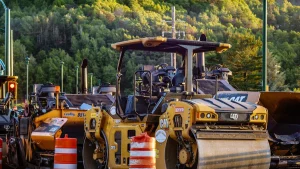
- Concrete mixers improve consistency, which is essential for compressive strength and surface finish.
- Modern projects use mixers across road maintenance, flooring, repair work, and parking lot construction.
- Equipment selection depends on batch size, mobility, power source, and the quality control target.
- Standards such as ASTM C31, ASTM C143, and ASTM C192 help define how fresh concrete is sampled, measured, and evaluated.
Concrete mixer use in construction projects worldwide is driven by one practical reality: fresh concrete must be uniform enough to place, finish, and cure predictably, and even small changes in mix consistency can affect slump, strength, and durability. Field practice is shaped by measurable targets, not guesswork, which is why contractors often track slump with ASTM C143/C143M, sample specimens under ASTM C31/C31M, and prepare mixtures under ASTM C192/C192M. In road and floor work, where surface flatness and early traffic opening matter, a mixer becomes part of the production system rather than a standalone machine.
Why concrete mixers matter in construction projects
Concrete mixers matter because they reduce variability before the concrete ever reaches the formwork or slab edge. A well-mixed batch lowers the risk of segregation, dry pockets, and inconsistent paste coating around aggregate.
That consistency is especially important in modern projects that use tighter tolerances, accelerated schedules, and smaller work crews. On a commercial slab, for example, the cost of one bad batch may include finishing delays, surface defects, and localized patching.
Contractors also use mixers to manage the logistics of remote or dispersed work. A small site repair crew, a municipal maintenance team, or a parking lot subcontractor often cannot rely on frequent ready-mix deliveries, so an on-site mixer helps align supply with actual placing capacity.
| Jobsite need | Why the mixer matters | Typical outcome |
|---|---|---|
| Slab placement | Stable batch consistency | Better finish and fewer rework spots |
| Road patching | Controlled placement timing | Less segregation at joints |
| Utility trench repair | Small-batch flexibility | Lower waste and easier staging |
| Parking lot work | Repeatable mix quality | More uniform surface performance |
Concrete mixer applications across modern construction workflows
Concrete mixer applications now cover far more than simple pouring tasks. They sit at the start of workflows that include compaction, cutting, finishing, and surface treatment.
In road maintenance, mixers support pothole repair, curb reconstruction, and small slab replacement. In flooring projects, they supply material for toppings, ramps, and localized repairs where batch size must match the crew’s placement speed.
In industrial and commercial builds, mixers help crews work around columns, edges, drains, and other interrupted geometry where ready-mix trucks are inefficient. The same logic applies to maintenance teams repairing sidewalks, warehouse aprons, or access ramps.
For contractors who move between jobsites, mobility matters as much as output. That is why compact equipment ecosystems are useful: a mixer can feed a repair process that later uses a plate compactor for base preparation, a rammer for trench zones, and a floor grinder for slab correction.
How mixer performance affects concrete quality
Mixer performance affects concrete quality because mixing energy, time, and sequence determine how evenly cement, water, admixtures, and aggregate are distributed. Poor mixing can create localized weak zones even if the design mix is correct on paper.
Fresh concrete quality is commonly evaluated by slump, temperature, unit weight, and air content, with sampling and test procedures defined by ASTM methods such as ASTM C143/C143M and ASTM C231/C231M. These checks help confirm whether the mixer and the batching process are producing material that can actually be placed as intended.
For many structural and slab applications, the issue is not only strength but also workability. If the mix is too stiff, crews spend more time placing and finishing; if it is too wet, segregation and bleed water can become finish defects.
| Quality factor | What it influences | Field check |
|---|---|---|
| Slump | Workability and placement speed | ASTM C143/C143M |
| Air content | Freeze-thaw durability and density | ASTM C231/C231M |
| Specimen sampling | Strength verification | ASTM C31/C31M |
| Mixing sequence | Uniformity and segregation risk | Batching records and jobsite checks |
Concrete mixer types and where each one fits
Concrete mixer selection should follow the job, not the other way around. Portable mixers are better for small repairs, while larger site mixers or batch systems suit higher-volume or repetitive work.
Drum mixers are often used because they are simple, durable, and easy to transport. Pan mixers are preferred in some controlled production settings because they can deliver strong blending action for stiffer mixes or specialty materials.
Forced-action mixers are more common when uniformity is critical, such as in precast, high-performance mixes, or fiber-reinforced applications. In contrast, tilt drum machines are popular for general contractor work because they are easy to operate and clean.
| Mixer type | Best use case | Typical advantage |
|---|---|---|
| Drum mixer | General site work, small pours | Simple handling and transport |
| Pan mixer | Controlled production, specialty mixes | Stronger blending action |
| Forced-action mixer | High-uniformity applications | Better mix homogeneity |
| Portable mixer | Repairs and small crews | Low setup burden |
The right choice also depends on power availability. On sites without reliable grid access, gasoline or diesel power is often preferred, especially for roadway maintenance and outdoor construction where mobility is the main constraint.
Concrete mixer selection criteria for contractors and distributors
Concrete mixer selection should start with output requirement, batch size, and transport method. A machine that is too small creates bottlenecks, while one that is too large can increase waste, idle time, and maintenance burden.
Contractors should compare drum capacity, cycle time, discharge control, mobility, and cleaning access. Distributors should also consider serviceability because easier maintenance improves field uptime and supports repeat demand.
- Match batch size to the crew’s placing rate.
- Choose a power source that fits site conditions.
- Check whether the machine is easy to clean after each shift.
- Evaluate mobility for lifting, loading, and roadside work.
- Review safety features such as emergency stop controls where applicable.
For international buyers, the best procurement decisions are usually made by linking machine capability to the actual work package. A road repair team may need a compact mixer, a cutter, and a compactor, while a flooring crew may need a mixer, trowel, and grinder combination.
That system-level view is consistent with the way many suppliers position their product lines, where a road marking machine or a concrete cutting machine is selected alongside the mixer to cover the full job sequence.
Standards, testing, and measurable quality control
Concrete mixer use becomes more reliable when it is tied to standard test methods and acceptance criteria. Standards do not replace field judgment, but they make quality discussions objective.
ASTM C143/C143M governs slump testing, ASTM C31/C31M governs making and curing field specimens, and ASTM C192/C192M covers laboratory mixing and testing of hydraulic cement concrete. Together, they help define whether the mixer, the mix design, and the placement process are aligned.

In Europe and many international projects, production and conformity are often aligned with ISO 22965-1, which addresses concrete specification, performance, production, and conformity. That matters in cross-border procurement because buyers need machine decisions that support documented quality control.
For equipment buyers, process control should be documented with numbers: batch size, mixing time, slump target, discharge window, and cleaning interval. These values vary by mix design and project specification, but the discipline of recording them is universal.
| Standard | What it covers | Why it matters |
|---|---|---|
| ASTM C31/C31M | Field specimens | Strength verification |
| ASTM C143/C143M | Slump | Workability control |
| ASTM C192/C192M | Mixing/testing in the lab | Mix consistency checks |
| ISO 22965-1 | Concrete production and conformity | International quality alignment |
Why concrete mixers support productivity on road and floor projects
Concrete mixers support productivity because they reduce waiting time between material preparation and placement. In work zones where labor is already split across cutting, forming, and finishing, a dependable mixer keeps the crew moving.
On road projects, the mixer helps ensure that patch material is ready when the cut, clean, and base preparation steps are complete. On flooring jobs, it prevents the finishing team from standing idle while material is sourced or remixed.
According to the National Institute of Standards and Technology, measurement and process consistency are central to manufacturing quality, and the same logic applies to construction workflows that depend on repeatable outputs. The practical lesson is simple: controlled inputs produce more predictable results.
In field terms, even a small reduction in remixing or cleanup time can matter because labor, machine rental, and traffic-control windows are often the real cost drivers. That is why reliable mixers are valued not only for output but for schedule protection.
Common mistakes when using a concrete mixer
Most mixer problems come from process errors rather than the machine itself. The most expensive mistakes are usually preventable with basic discipline.
- Overloading the drum, which reduces mix uniformity.
- Adding water by eye instead of following the target water-cement ratio.
- Allowing hardened buildup to accumulate inside the mixer.
- Using the wrong mixer type for stiff or specialty mixes.
- Ignoring discharge timing and letting the mix sit too long before placement.
These mistakes show up quickly in the field as segregation, inconsistent slump, poor finishability, or early surface defects. Once defects appear, the cost is not only repair material but also labor lost to rework and schedule disruption.
For buyers, this is why machine usability matters. A mixer that is easier to clean, easier to load, and easier to transport can reduce the chance of operator shortcuts.
What buyers should ask before purchasing a concrete mixer
Buyers should evaluate a concrete mixer as part of the full job workflow, not as a single piece of hardware. The key question is whether the mixer supports the project from batch preparation through final placement.
- What is the average batch volume per pour?
- How often will the machine move between sites?
- Is gasoline, diesel, or electric power more practical?
- What level of finish quality and consistency is required?
- How much time can be spent on cleaning and maintenance each day?
These questions are especially important for distributors and contractors serving roadwork, municipal maintenance, and commercial flooring. In those markets, uptime, service support, and spare-parts access are often as important as drum size.
For companies building a broader jobsite fleet, it can also make sense to pair the mixer with adjacent equipment from the same application chain, such as plate compactors for subbase work and floor grinders for slab finishing and renovation.
FAQ
Why are concrete mixers used instead of mixing by hand?
Concrete mixers produce more uniform material in less time, which reduces segregation risk and improves placement consistency compared with hand mixing.
What standards are most relevant to fresh concrete quality?
Common references include ASTM C31/C31M for field specimens, ASTM C143/C143M for slump, ASTM C231/C231M for air content, and ASTM C192/C192M for laboratory mixing and testing.
When is a portable concrete mixer the best choice?
A portable mixer is best for repair work, small pours, mobile crews, and sites where ready-mix access is limited or intermittent.
How does mixer choice affect surface finish?
Mixer choice affects workability and consistency, which in turn influence how easily the concrete can be placed, screeded, and troweled without defects.
Can one mixer work for road repair and floor work?
Yes, but only if the batch size, mix type, and site mobility match both applications; many contractors still prefer separate setup logic for repair and finishing tasks.
What should buyers inspect before purchase?
Check capacity, power source, mobility, discharge control, cleaning access, and service support before choosing a mixer for field use.
Why do international buyers care about standards?
Because standards make procurement, testing, and project acceptance more predictable across different markets and contract specifications.