- Uneven finish is often a process problem, not just a machine problem.
- Blade pitch, slab timing, and moisture condition are the three fastest checks.
- Flatness should be built into screeding and floating, not rescued at the final pass.
- Repairing a bad surface after curing is slower and more expensive than preventing it.
Why power trowel leaves uneven surface and fix methods is a practical question for contractors because a poor finish can trigger rework, delay handover, and damage client trust. In floor construction, even small variation matters: the American Concrete Institute notes that floor tolerances are typically measured by straightedge and F-number methods, while surface finish quality is affected by placement, finishing, and curing sequence. For project teams comparing power trowel equipment, concrete vibrator tools, and compaction equipment, the lesson is the same: a smooth slab starts before the trowel ever touches the concrete.
Why a Power Trowel Leaves an Uneven Surface
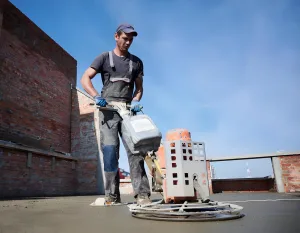
A power trowel leaves an uneven surface when the slab condition, machine setup, and operator timing do not match the finishing window.
The most common cause is starting too early, while bleed water is still on the surface. If finishing begins before the water film dissipates, the blades can trap moisture, smear paste, and create a weak, blotchy skin that later shrinks differently from the surrounding surface. Starting too late causes the opposite problem: the slab stiffens, the blades cut harder, and the machine can leave ridges or chatter marks.
Blade angle is the second major cause. A small pitch change can dramatically alter how much paste the blades move. Too much pitch during the first passes can dig into the slab and leave gouges. Too little pitch can polish only the highs and leave visible waves between passes. That is why the operator should think in stages: float first, finish later, and increase blade angle gradually.
Slab support matters as well. If the base is soft, unevenly compacted, or not properly struck off, the trowel will follow the slab’s geometry instead of correcting it. This is where upstream equipment matters. Good compaction from plate compactors on open areas or rammers in narrow trench zones reduces settlement risk that can later appear as floor waviness. A trowel is a finishing tool, not a structural leveling tool.
| Common Cause | Typical Surface Defect | Fast Field Check | Practical Fix |
|---|---|---|---|
| Finishing too early | Smearing, tearing, weak crust | Bleed water still visible | Wait until the sheen disappears |
| Incorrect blade pitch | Ridges, gouges, burn marks | Compare pitch setting on both rotors | Reset pitch in small increments |
| Uneven screed level | Wavy finish, repeated highs and lows | Straightedge check after strikeoff | Correct at screed stage |
| Soft or uneven base | Localized settlement, edge dips | Probe subbase and compaction uniformity | Recompact and regrade before placing |
How Timing Affects Trowel Finishing Fix Results
Timing is the single most important variable in trowel finishing fix work because concrete surface behavior changes quickly during hydration.
Finishing is easiest during the narrow interval between initial set and final set, when the surface supports the machine but still allows the paste to close properly. The problem is that this window is not identical for every mix, temperature, or wind condition. Hot weather shortens the workable finish time; cooler conditions extend it. Admixtures, slab thickness, and evaporation rate all shift the window.
Industry guidance from the National Ready Mixed Concrete Association emphasizes that finishing should not begin while bleed water is present. The Portland Cement Association similarly warns that premature finishing can trap water and weaken the surface. Those points are not theoretical. A slab that is closed too early can look smooth on day one and later dust, craze, or scale under traffic.
A practical rule is to test the surface by foot pressure and sheen, not by the clock alone. If the shoe still makes a deep imprint or water glistens under light, the slab is not ready. If the slab is hard enough to support the machine but still plastic enough to close under the blades, the operator can begin the first pass.
| Condition | What the Surface Looks Like | Recommended Action | Risk if Ignored |
|---|---|---|---|
| Bleed water present | Glossy, wet film | Delay finishing | Dusting and delamination |
| Early set | Dull sheen, soft resistance | Begin floating pass | Rough texture and tearing |
| Late set | Hardening, drag marks appear | Use lower speed, careful pitch | Ridges and chatter |
For teams that want a complete equipment flow, the supporting sequence often starts with mix transport, placement, vibration, and then finishing. That is why a jobsite may pair a concrete mixer with a vibrator and a power trowel rather than relying on one machine to compensate for all upstream weaknesses.
Blade Pitch, Rotor Speed, and Why They Change Surface Flatness
Blade pitch and rotor speed determine whether the trowel levels paste or carves the slab.
Most walk-behind and ride-on power trowels use variable blade pitch so the operator can move from floating to finishing. In the float stage, blades stay flatter to distribute weight and knock down minor highs. In the finish stage, the pitch increases to close the surface and improve gloss. If the operator increases pitch too aggressively, the machine can leave helical marks, especially at overlaps or at the slab perimeter where resistance changes.
Rotor speed also matters. Higher speed can improve productivity, but only if the slab has enough stiffness to resist distortion. On weaker slabs, speed can amplify vibration, encourage chatter, and expose flatness errors that a slower pass might have concealed. Equipment selection should therefore match the job type. Large open floors often benefit from ride-on units, while edge-heavy or smaller projects may be easier with walk-behind machines.
The ISO 679 mortar test standard and ASTM C109/C109M are not finishing standards, but they show how the industry treats test conditions seriously. In floor work, the same discipline applies: repeatable conditions give repeatable results. If the slab varies from one bay to the next, the final finish will vary too.
| Setting | Typical Effect | When to Use | When to Avoid |
|---|---|---|---|
| Low blade pitch | Less cutting, more floating | Early passes, soft surface | Final closure on stiff slabs |
| Medium blade pitch | Balanced leveling and closure | Intermediate passes | Very wet slabs |
| High blade pitch | Dense, glossy finish | Final passes on firm slab | Premature finishing |
| Higher rotor speed | Faster output, more sensitivity | Experienced crews, stable slab | Weak or variable concrete |
How to Fix an Uneven Surface Before It Becomes a Claim
The best trowel finishing fix is to correct the problem while the concrete is still workable.
First, stop chasing the defect with repeated passes. If the slab is still too wet, extra passes usually worsen the surface. If it is already too stiff, more pressure can create local burn marks and visible swirl lines. Second, assess whether the issue is isolated or systemic. A single edge dip may be a boundary problem, while repeated waves across the slab usually indicate screed or placement inconsistency.
Third, rework the process in order. Check strikeoff level, verify that vibration was adequate, and make sure the base was compacted uniformly. Then reset the machine and use overlapping passes with consistent travel speed. The operator should not swing the trowel in wide, uneven arcs, because uneven overlap creates distinct bands that show up under side lighting.
For larger projects, flatness should be verified with a straightedge, and the team should log any rework before final cure. The ACI 117 standard is widely used in the United States for tolerances and construction control. Its value in practice is simple: if the floor is checked early, the contractor can fix it early.
- Confirm whether bleed water has fully disappeared.
- Measure blade pitch on both rotors before continuing.
- Inspect screed lines for highs, lows, and lap marks.
- Check whether the subbase or forms have settled.
- Make the next pass with steady overlap and speed.
When the Problem Is Not the Trowel: Concrete, Base, and Environment
Many “trowel” defects actually begin in the mix design, base preparation, or weather.

If the concrete has too much water, finishing becomes slippery and unstable. If it is too dry, the surface closes harshly and tears. A mix with poor aggregate grading can also expose paste-rich or stone-rich zones, which respond differently under the blades. Temperature and wind speed change evaporation, and fast evaporation can produce plastic shrinkage issues that are mistaken for poor troweling.
Subbase quality is equally important. A properly compacted base reduces settlement and helps the slab support the finishing machine evenly. This is why contractors often treat compaction and finishing as one workflow. A compacted trench with a plate compactor or tamping rammer upstream makes the final floor more predictable downstream.
Environmental control is not optional on demanding jobs. Windbreaks, shade, curing compound timing, and pour scheduling all affect whether the slab stays inside the finish window. In hot or windy conditions, teams may need smaller placement areas so the crew can finish each panel before the surface drops out of the workable range.
| Factor | Impact on Finish | Field Control | Best Practice |
|---|---|---|---|
| High water content | Soft, smeared finish | Mix control | Keep water within design limits |
| Wind and heat | Shorter finish window | Weather monitoring | Reduce pour size and pace work |
| Poor compaction | Settlement and waviness | Subbase testing | Compact in lifts |
| Uneven aggregate grading | Patchy texture | Mix review | Use consistent batching |
Choosing the Right Power Trowel for the Jobsite
The right machine reduces the chance of an uneven surface more effectively than operator skill alone.
Walk-behind trowels are often better for smaller slabs, corridors, and edge work, while ride-on trowels improve productivity on open floors. The choice should match the layout, access width, and daily output target. A machine with poor balance or unsuitable blade diameter for the slab size can make control harder, especially near walls and around columns.
For buyers comparing options, it helps to think in application groups rather than product names. Open industrial floors, warehouse slabs, and parking decks need different handling than repair bays, curb-side pours, or small commercial pads. If the job often combines placing, compaction, cutting, and finishing, a contractor may need a broader equipment mix rather than a single high-spec trowel.
For example, many site teams that manage mixed projects also review concrete cutting machine options for repair joints and slab opening work, because a good finishing system often sits within a larger floor-construction workflow.
| Job Type | Best Trowel Type | Main Challenge | Selection Priority |
|---|---|---|---|
| Warehouse floor | Ride-on | Large area consistency | Coverage and speed |
| Small commercial slab | Walk-behind | Edge control | Manoeuvrability |
| Repair patch | Compact walk-behind | Limited access | Precision |
| Mixed site work | Flexible lineup | Multiple surfaces | Versatility |
Preventive Checklist for Trowel Finishing Fix Work
A short checklist before finishing prevents most uneven surface complaints.
- Confirm mix design, slump range, and placement plan before the pour.
- Verify base compaction and screed elevation before strikeoff.
- Wait until bleed water is gone and the slab supports the machine.
- Set both rotors to the same blade pitch before each pass.
- Use steady overlap, consistent speed, and a defined finishing sequence.
- Inspect edge zones separately, since they harden and react differently.
- Log weather, timing, and machine settings for future jobs.
These steps are valuable because floor finishing is cumulative. A small mistake at placement becomes a visible defect after curing. The good news is that most defects are preventable when the site team treats the trowel as part of a controlled process rather than the last rescue step.
FAQ About Why Power Trowel Leaves Uneven Surface and Fix Methods
Why does a power trowel leave swirl marks?
Swirl marks usually appear when blade pitch, travel speed, or overlap is inconsistent. If the operator circles too tightly or changes speed abruptly, the blades leave visible bands in the paste.
Can you fix an uneven trowel finish after it cures?
Yes, but the fix is usually grinding, resurfacing, or overlay work rather than more trowel passes. Once the slab cures, the machine can no longer reset the surface.
What is the most common mistake during power troweling?
Starting too early is one of the most common mistakes. Finishing before bleed water disappears can trap moisture and create a weak surface layer.
How do you know when the slab is ready for troweling?
The slab is ready when it supports the machine, no bleed water remains, and the surface has enough resistance to close without tearing.
Does a vibrator help reduce uneven trowel finish?
Yes, proper vibration helps consolidate the mix and reduce voids, which makes finishing more uniform. Poor consolidation often shows up later as surface inconsistency.
Is a ride-on trowel better than a walk-behind for flatness?
Not automatically. A ride-on trowel can improve productivity on large floors, but flatness still depends on base preparation, screeding, timing, and operator control.
What should I check first when the floor looks wavy?
Check the finish timing, blade pitch, and screed level first. Those three factors explain most visible waviness before the machine itself becomes the issue.
In practical terms, why power trowel leaves uneven surface and fix methods comes down to control. Control the base, control the mix, control the timing, and control the blade settings. If those four variables stay consistent, the trowel becomes a reliable finishing tool instead of a source of rework. For contractors, distributors, and rental fleets, that is the difference between a floor that needs rescue and a floor that passes inspection the first time.