
- Most tamping rammer overheating cases start with restricted cooling airflow or poor maintenance, not a catastrophic engine defect.
- Repair should follow a sequence: airflow, lubrication, fuel quality, load, then mechanical wear.
- Preventive checks are faster and cheaper than a piston, crankshaft, or bearing repair after heat damage.
- Correct compaction technique matters because excessive idle, buried rammer shoes, and overworked engines raise temperature quickly.
Why a tamping rammer engine overheats is often easier to answer with standards and field data than with guesswork: engine tests commonly reference ISO 3046-1 for reciprocating internal combustion engine performance, while small-engine maintenance guidelines from NIOSH emphasize ventilation, housekeeping, and safe servicing around hot components. For compacting crews, that matters because a rammer operating with restricted airflow, dirty combustion passages, or low-quality fuel can move from normal heat to damaging temperatures in one shift. If you are comparing site equipment for trench backfill or road repair, it also helps to understand how related machines such as rammer compactors, plate compactors, and concrete cutters fit different jobsite loads and operating patterns.
Why a tamping rammer engine overheats: the real mechanism
The engine overheats because heat generation exceeds the machine’s ability to reject heat through airflow, lubrication, and combustion control.
A tamping rammer is a high-vibration compaction machine, so engine heat is not only from combustion. It also comes from friction, repeated shock loads, and continuous high-RPM operation under dust and debris exposure. When the air intake is restricted or the cooling fins are packed with soil, the engine cannot shed heat efficiently. When the oil film thins, friction rises. When fuel is too lean, combustion temperature increases. When the rammer is forced into dense material longer than intended, the engine works near maximum load and temperature climbs even if no single part is broken.
| Overheating cause | What it does | Typical field sign | Repair priority |
|---|---|---|---|
| Clogged air filter | Reduces cooling and changes fuel burn | Loss of power, hot engine, dark dust around intake | High |
| Low engine oil | Raises friction and bearing temperature | Oil warning, metallic smell, louder running noise | Critical |
| Blocked cooling shroud or fan | Prevents heat removal | Outer cover hot to touch, uneven temperature rise | Critical |
| Stale or wrong fuel | Creates poor combustion and carbon deposits | Hard starting, surging, plug fouling | Medium |
| Overload or improper operation | Raises cylinder pressure and heat | Machine bogs down, operator keeps reopening throttle | High |
In many construction fleets, the difference between a normal service issue and heat damage is time. The OSHA machine guarding guidance is a useful reminder that rotating and hot parts must be kept clear and maintained, because hot surfaces and moving components create both performance and safety risk. For tamping rammer engine overheating, the first 10 minutes after shutdown often reveal more than an hour of speculation.
Rammer engine overheating symptoms that tell you where to look
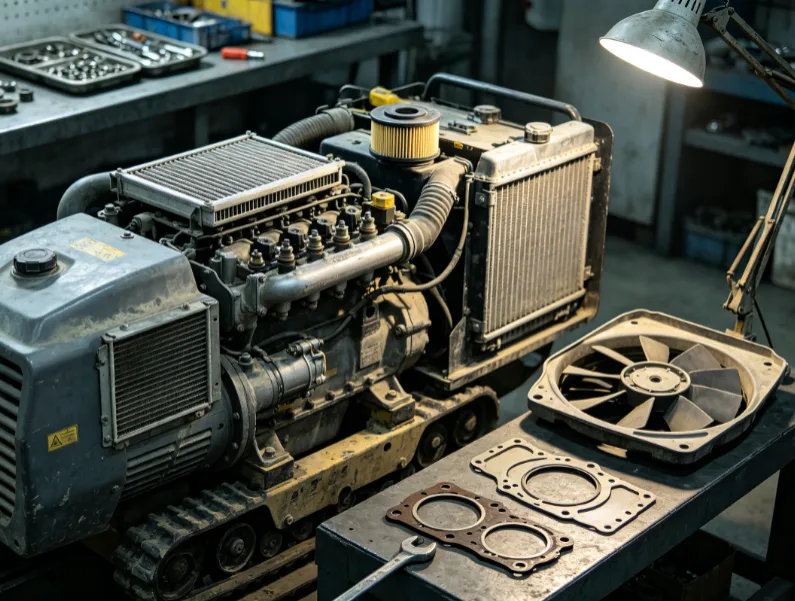
Each overheating symptom points to a different layer of the fault, so diagnosis should start with the pattern, not the part number.
If the engine gets hot quickly after a cold start, look first at airflow, fuel mixture, and choke position. If it overheats after 15 to 30 minutes of work, think about oil level, cooling blockage, or excessive load. If the exhaust smells unusually sharp or the engine runs with surging speed, the carburetion or fuel system may be too lean. If the machine loses power before it gets hot, compression loss, carbon buildup, or exhaust restriction may be the deeper issue.
| Symptom | Likely cause | What to inspect first | Repair difficulty |
|---|---|---|---|
| Hot within 5 to 10 minutes | Airflow restriction or lean mixture | Filter, shroud, fan, choke | Low to medium |
| Hot after a full work cycle | Load, oil, carbon deposits | Oil level, working soil, exhaust port | Medium |
| Power drops before heat peaks | Fuel starvation or compression loss | Fuel line, plug, carburetor, ring wear | Medium to high |
| Strong burning smell | Overheated oil or bearing wear | Crankcase, seals, bearings | High |
In the field, crews often misread a hot muffler as a normal issue and miss the real warning signs. The engine should be treated as a system: intake, combustion, cooling, and load transfer all affect whether the tamping rammer stays within a safe thermal range. If a machine that normally performs well suddenly needs full choke, stalls under compression, or emits smoke after a short run, the problem is usually developing rather than sudden.
Practical repair solutions for a tamping rammer engine that overheats
The best repair solution is to isolate the cause in a fixed order, because random part replacement wastes time and does not solve heat damage.
- Shut the machine down and let it cool fully before touching the engine or muffler.
- Inspect the air filter, intake path, and cooling fan or shroud for dust, mud, and blockages.
- Check oil level and oil condition; replace oil if it smells burnt or looks diluted.
- Verify fuel freshness, fuel line condition, and carburetor cleanliness.
- Examine the spark plug, exhaust port, and muffler for carbon buildup.
- Test for compression loss, worn rings, or bearing noise if the problem persists.
Cleaning is often the highest-value repair. A rammer used in trench backfill, cohesive soil, or dusty base material can pack fines into the cooling fins faster than operators expect. Once that dirt layer forms, the engine’s thermal margin shrinks. A simple brush-out, compressed-air cleaning, and cover removal can restore normal operation if done before the engine suffers repeated heat soak.
If cleaning does not help, move to fuel and ignition. Stale gasoline, water contamination, or a partially blocked carburetor jet can create a lean condition that pushes combustion temperature up. Spark plug inspection is useful because a white, blistered insulator can indicate overheating or a lean burn, while heavy soot suggests incomplete combustion. For diesel-powered units, injector or fuel quality problems can show up as smoke, rough running, and higher thermal stress.
| Repair action | Estimated time | Tools needed | Expected result |
|---|---|---|---|
| Air filter and shroud cleaning | 10 to 20 minutes | Brush, air gun, screwdriver | Restores airflow |
| Oil service | 15 to 25 minutes | Drain pan, oil, wrench | Reduces friction heat |
| Spark plug replacement | 10 to 15 minutes | Plug wrench, gap tool | Improves combustion consistency |
| Carburetor cleaning | 30 to 60 minutes | Cleaner, small hand tools | Fixes lean or unstable fuel delivery |
| Compression or bearing repair | 2 to 4 hours | Engine tools, replacement parts | Addresses internal damage |
For crews managing multiple machines, it is useful to compare repair economics against replacement. A short service interval can save a rammer from seizure, especially on projects where downtime affects backfill, trenching, or patch-repair sequencing. If a machine is repeatedly overheating after normal maintenance, then engine rebuild, isolation of the crankcase, or replacement of the power unit becomes more rational than repeated field fixes.
When overheating is caused by operating conditions, not failure
Many tamping rammer engine overheating cases are created by jobsite conditions that push the machine beyond its intended duty cycle.
Operators sometimes hold the throttle open for longer than needed, work in material that is too dry or too stiff, or force the shoe through a compacted layer without lifting and feeding the rammer properly. In trench work, this is common when crews try to finish a lift too quickly. The engine then spends more time at full load, the fuel burn rises, and the cooling system must work harder while surrounded by dust and heat reflected from the excavation.
The operating environment matters as much as the engine itself. High ambient temperature, poor ventilation, and fine airborne dust all reduce heat rejection. The NIST thermal control guidance is not specific to tamping rammers, but its basic principle applies: when heat cannot be transferred away efficiently, the system temperature rises quickly. That is why a machine that runs normally in open air may overheat faster in a narrow trench or inside a partially enclosed maintenance area.
- Do not run the machine at full throttle while idling in place for long periods.
- Keep intake and cooling passages clear of wet soil and fines.
- Use the correct rammer for the material density and lift thickness.
- Stop periodically during very hot weather so the engine can shed heat.
How to prevent rammer engine overheating before it starts
Preventive maintenance prevents most overheating failures at a lower cost than reactive repair.
A practical site checklist should begin with the basics: clean air filter, correct oil level, fresh fuel, intact cooling cover, and no visible fuel leaks. Then inspect the spark plug color, check for loose fasteners, and confirm the rammer shoe and bellows are not binding. A unit that vibrates excessively can loosen covers and accelerate wear, which in turn increases heat. This is especially important for mobile contractors who move equipment between road repair, utilities, and patch-compaction jobs.
| Preventive check | Frequency | Why it matters | Failure avoided |
|---|---|---|---|
| Air filter inspection | Daily in dusty work | Maintains airflow | Lean burn and power loss |
| Oil level verification | Before each shift | Protects bearings and piston | Friction overheating |
| Cooling shroud cleaning | Weekly or after heavy dust exposure | Restores heat rejection | Heat soak |
| Spark plug check | Every service interval | Shows combustion condition | Hard starts and hot running |
| Fuel freshness review | Each refuel cycle | Prevents varnish and deposits | Lean or unstable running |
For buyers choosing equipment, the best prevention is also selecting the right machine family. A plate compactor is generally better for larger, flatter areas, while a rammer handles cohesive soil and narrow trench lifts more effectively. That choice reduces unnecessary engine stress because the machine matches the compaction task instead of fighting it. Where crews also need surface cutting or repair sequencing, pairing the compactor with a concrete cutter can improve workflow and reduce total site handling.
What the engine temperature data and standards mean for repair decisions
Temperature control is not only about keeping the engine “cool”; it is about keeping thermal load inside a safe operating window.
Internal combustion engines are typically validated under standardized test methods, and the broader engine-performance framework in ISO 3046-1 helps explain why repeatable operating conditions matter. In the field, that means overheating should be interpreted against load, ambient air, fuel condition, and maintenance state rather than against a single magic temperature number. For hand-held and portable site machinery, the practical repair threshold is simple: if a machine repeatedly overheats after airflow, fuel, and oil checks, internal wear is likely.
The most expensive mistake is continuing to run the rammer while it is already hot. Heat accelerates oil oxidation, breaks down seals, and can score cylinders or bearings. Once that happens, the repair shifts from routine maintenance to engine teardown. In procurement terms, the cheapest machine is not the one with the lowest purchase price; it is the one with the lowest thermal-failure rate over the service life of the project.
Decision guide: repair, rebuild, or replace the rammer engine
The correct decision depends on how often the overheating returns and how deep the damage has gone.
- Repair when the machine only overheats under dust, neglect, or light misuse and returns to normal after cleaning and service.
- Rebuild when compression, bearings, or the piston assembly show heat-related wear but the frame and compaction unit remain sound.
- Replace when the engine has repeated seizure, severe scoring, or recurring overheating after multiple proper repairs.
For small contractors, this choice is often about uptime. A machine that fails repeatedly on a trench or road patch job can delay the whole crew, which is why many teams keep a backup unit on hand. That is also why product families such as rammer compactors and plate compactors are often purchased together: the right tool for the right compaction geometry reduces strain, service interruptions, and heat-related wear.
Common mistakes that make a tamping rammer engine overheat faster
Most repeat overheating problems are created by a few preventable habits.
- Running with a dirty air filter for too long.
- Ignoring low oil because the engine still starts and runs.
- Using old fuel that has sat in the tank between jobs.
- Working the machine continuously in a trench without cooling breaks.
- Blocking the fan cover with tape, debris, or improvised guards.
- Replacing parts before inspecting the cooling path.
These mistakes matter because they compound. A dirty filter raises engine temperature, the operator compensates with more throttle, and the hotter engine then consumes more fuel and becomes even more stressed. Once the cycle starts, the rammer may still finish the shift, but internal wear is already progressing.
FAQ about tamping rammer engine overheating
Why does my tamping rammer engine overheat after a few minutes?
It usually overheats that quickly because the cooling airflow is blocked, the air filter is clogged, or the fuel mixture is too lean. Check the intake, shroud, and choke position first.
Can low oil make a rammer engine overheat?
Yes. Low oil reduces lubrication, increases friction, and raises bearing and piston temperatures, which can quickly turn into engine damage.
Should I keep using the rammer if it gets hot but still runs?
No. Continued operation can turn a maintenance issue into cylinder scoring, seized bearings, or a full engine rebuild.
What is the most common repair for rammer overheating?
Cleaning the air filter, cooling cover, and fan passages is the most common first repair because airflow restriction is a frequent cause.
Does fuel quality really affect engine temperature?
Yes. Old or contaminated fuel can cause lean running, rough combustion, carbon buildup, and higher operating temperature.
When should I replace the engine instead of repairing it?
Replace it when overheating returns after proper maintenance or when internal damage such as severe scoring, compression loss, or bearing failure is confirmed.
How often should a tamping rammer be serviced to prevent overheating?
Daily checks are best for air filter, oil, and visible debris in dusty work, with deeper service at regular intervals based on operating hours and site conditions.